Commercial
Cold Call Practice: Scripts and Objection Drills

Cold call practice is rehearsal you can hear, not a script you highlight. The useful sequence is script familiarity, then objection drills, then full simulated calls, then live dials with review. Skip a stage and you will “know the talk track” and still fold on the first gatekeeper.
Updated September 2026. The live objection rooms match the drills below: send me an email, already have a supplier, not interested, and competitor is cheaper.
This is for SDRs, managers, and enablement leads who want to practise cold calling before a real prospect pays for your nerves.

Cold call practice in four stages
Stage 1 — Script familiarity. Say the first twenty seconds out loud until you can do it while mildly bored. If you can only do it with the doc in front of you, you do not have a script. You have a reading.
Stage 2 — Objection drills. One objection, thirty seconds, reset. Five of those beat one “full roleplay” in which your buddy is kind. The five exchanges below are the drill book.
Stage 3 — Full simulated calls. Opening plus two objections plus a next step. Time-box to the length of a real connect. Change the buyer’s mood on the second attempt.
Stage 4 — Live calls with review. Same scorecard as the sim. If you only review live calls, you are using customers as the practice room. If you only review sims, you will not know whether it transferred.
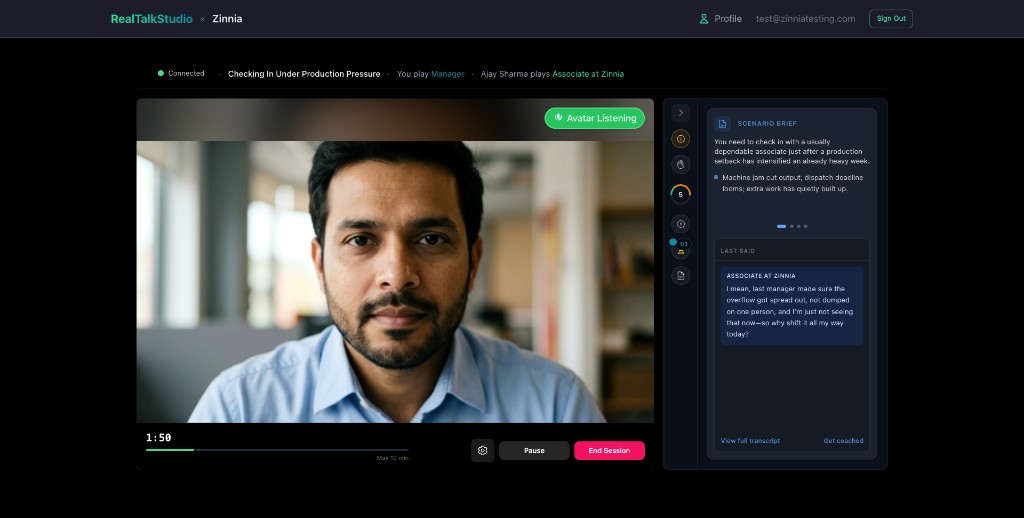
AI cold call tools are stage 2 and 3. They are not a substitute for stage 4. They are a way to stop stage 4 being your first rep.
1. Gatekeeper
Gatekeeper: “What’s this regarding? If you don’t have a meeting I can’t put you through.”
Clumsy: “It’s kind of a partnership thing — I just need two minutes with the VP. I’m not selling.”
Gatekeeper: “Everyone says that. Send an email to the info box.”
You: “Sure, what’s the best email?” (You have just been filed.)
Skilled: “Fair. I am selling a conversation, not a box. I want twelve minutes with [Name] about [one outcome you can name]. If that’s the wrong person, tell me who owns [problem]. I will not pretend I’m not selling, and I will not ask you to break a rule.”
Gatekeeper: “They don’t take cold calls.”
You: “Then I will not ask you to put me through. Who should I send a three-line note to, and what subject line will actually get opened on that desk?”
Drill: thirty seconds. If you lie about “not selling,” restart.
Practise a gatekeeper-style hold
2. “Send me an email”
Prospect: “Sounds interesting. Send me an email and I’ll take a look.”
Clumsy: “Absolutely — I’ll send a full deck and some case studies. What’s the best address?”
Prospect: “The one on the website is fine.” (It is not fine.)
Skilled: “I can. If I send it, it will be three lines and one question — not a deck. Before I do that: is email how you actually decide this, or is it how this call ends? If it’s the second, tell me no. If it’s the first, give me the address you read, and a day I can call you about that one question.”
Prospect: “Just send it.”
You: “I will send it in the next ten minutes. I will call you Thursday at 9.40. If Thursday is bad, give me a better ten-minute slot now.”
Drill: do not leave without a time or a clean no.
3. “We already have a supplier”
Prospect: “We’re all set. We’ve used [Incumbent] for years.”
Clumsy: “A lot of our customers [used Incumbent / were unhappy]. What if I could show you a 20% save?”
Prospect: “We’re not unhappy.” (Click.)
Skilled: “Then I am not asking you to rip them out on a cold call. I am asking whether [one job] is still painful even with them in the building. If it isn’t, I should hang up. If it is, give me one example and I will tell you in one sentence whether we are relevant.”
Prospect: “It’s fine. Really.”
You: “Good. I’ll leave it. If [job] blows up this quarter, my name is on the note I’ll send — three lines, no deck. Thanks for the direct answer.”
Drill: earn the right to a future note. Do not attack the incumbent.
Practise “we already have a supplier”
4. Instant hang-up recovery
Prospect: “Not interested.” Click.
There is no skilled reply on that call. The drill is the next forty seconds of your nervous system.
Clumsy (to yourself): replay the rejection, rewrite your personality, skip the next dial, go to Slack.
Skilled (to yourself, out loud if you have to): “That was a four-second no. It was not a review of my life. Next number. Same first twenty seconds.”
Then, on the next connect, do not mention the hang-up. Do not get “warmer” to compensate. Run the same open.
Drill: hang up on each other in practice. The person who just got cut must dial (or start the next sim) inside twenty seconds. This is cold calling practice as sport, not as therapy.
5. “We’re not interested” / “How much is it?”
Two cousins. One is a close. One is a trap to make you pitch price before a problem exists.
Prospect: “Not interested. How much is it, anyway?”
Clumsy: “It depends, but typically we’re about [number] a year — though we can be flexible.”
Prospect: “Yeah, that’s not in the budget.” Click.
Skilled: “You’re asking price before we’ve agreed there is a job. I can give you a band if you want a band: [range] for [what that buys]. I will not haggle with a stranger on a first call. If the job isn’t [problem], the price is irrelevant and I should let you go.”
Prospect: “Just tell me the number.”
You: “Band is [range]. The next useful step is twelve minutes on whether [problem] is real. Thursday 9.40 or I send nothing.”
Five verbatim exchanges is enough to train the mouth. The rest is volume.
Practice cold calling: what to measure after twenty attempts
Do not invent a conversion rate for a blog. Measure whether the next step survived.
After twenty short drills (not twenty cinematic hours):
- Can they get past a gatekeeper without lying about who they are?
- Do they still have a next step after “send me an email”?
- Do they recover from a four-second hang-up without rewriting the open in a panic?
- Does a manager hear the same scorecard they will use on a live call?
If the answer to those is no, they are not ready for a live book. More slides will not fix it. More cold call practice — short, ugly, frequent — might. If the answer is yes, stop practising in a vacuum and sample the live hour.
Mistakes that look like practice
Highlighting the talk track in silence. You are studying literature.
Roleplay with a friendly AE. You are practising being liked.
A two-hour “full call” once a quarter. You are practising theatre. Short, ugly, frequent.
Changing the open after every no. You will never know whether the open works. Change the open when a manager has heard twenty attempts, not when your feelings are hurt.
Reviewing only wins. The useful tape is the four-second no and the “send me an email” you folded on.
If you run a team, put the five drills on a wall. Ten minutes at the start of the huddle. One objection per day. That is more cold calling practice than most academies deliver in a month of slideware.
A note on AI cold call tools
The category is noisy. Some products are speech coaches (Yoodli). Some are buyer bots with a real-call loop (Hyperbound). Some are avatar courses (Second Nature). We sit with mixed workplace conversations, including commercial holds like competitor is cheaper.
None of them remove stage 4. If your enablement story ends at “the bot said they were ready,” you have rebuilt e-learning with a microphone.
Enablement leads sometimes ask for a “certification.” A certificate that the person watched the talk track is the old world. A certificate that they booked a next step against an unhelpful buyer, twice, on the same card you use live — that is closer to ready. Still sample the live hour. Customers should not be the first people to hear the fold.
Practise a commercial hold Practise send-me-an-email Practise an incumbent objection
How teams verify call-readiness
“Ready for the phones” is not “finished the academy.” In contact-centre work we have been in the room for, readiness meant a lead had heard the person recover from the hard variant — not that they had watched the talk track. The same logic applies to SDR floors.
A simple bar, if you have no platform yet:
- Two recorded sims against an unhelpful buyer (gatekeeper + “send me an email”).
- The same scorecard you will use on live calls.
- A manager listen on the first live session, not week four.
- A rule: no live book until the sim next-step rate is real — not a number I will invent for your motion.
If you want the wider library, use workplace roleplay scenarios (sales is one category of eight). If you are comparing tools, start with Hyperbound for sales-call loops and Yoodli for delivery. For mixed workplace conversations, see sales enablement.
FAQ
Frequently asked questions
01How do I practise cold calling?
Say the open out loud, drill one objection at a time, then run a full simulated call before you dial. Review live calls on the same card as the sim.
02What is the best way to practice cold calling without burning leads?
Simulation or a colleague briefed to be unhelpful. Do not use real prospects as your first objection drill.
03Does AI cold call practice work?
It works for reps and composure. It does not close deals by itself. Use it as stages 2–3, then listen to live calls.
04How is cold call roleplay different from a script review?
A script review checks memory. Roleplay checks whether the next step survives contact with a human who wants you off the phone.
05How many practice calls before going live?
Enough that a manager has heard you recover from a gatekeeper and a polite brush-off. I will not invent a magic number for your market.
Practise the live version on the Real Talk Studio platform— scored attempts against characters that push back, not a script on a slide.