Thought leadership
What Makes an AI Roleplay Feel Real?

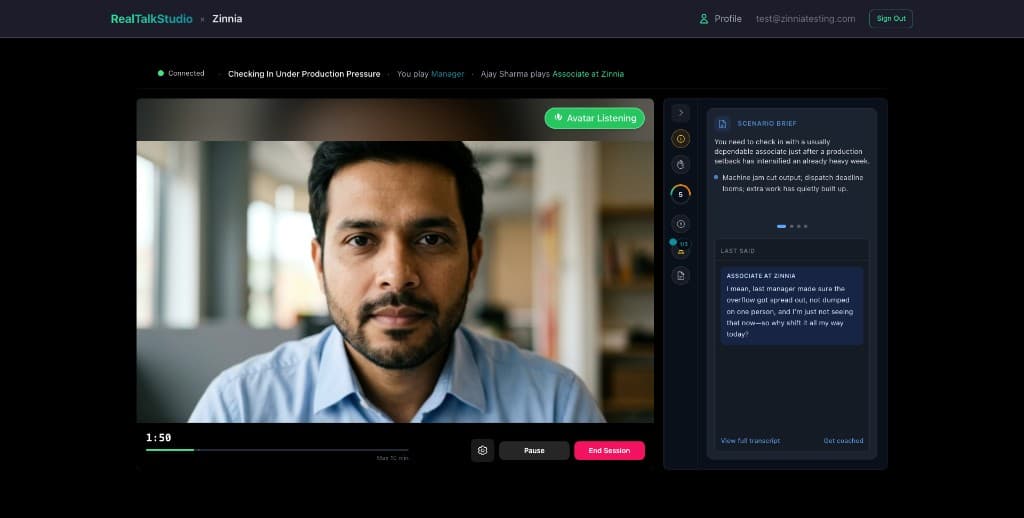
A photorealistic avatar can still sound like a robot.
That is the trap most AI roleplay demos set. The face is right. The voice is smooth. The lighting is expensive. Then the character opens its mouth and says, “I appreciate you raising this, and that’s a fair point,” in a tidy paragraph — and the illusion is gone.
We have spent years watching this happen, in our own product and in everyone else’s. The conclusion is uncomfortable if you have just spent a budget on avatars. Realism is not a costume problem. It is a dialogue problem. And the dialogue that feels real is not the polished one.
It is the opposite.
A real person in a hard conversation does not speak in complete, helpful sentences. They protect themselves. They give you two words, then they ramble. They start a sentence and abandon it. They contest the frame. They remember what you said three turns ago and use it against you. They do not fold because you were polite.
If the partner on the other side of a practice session cannot do those things, your people are not practising the conversation they will actually have. They are rehearsing a chatbot in a costume.
This is how we measure that — on every conversation of usable length that runs through Real Talk Studio — and the scorecard we use to decide whether a roleplay feels real.
The costume problem
Most of the money in this category still goes on the surface. Better faces. Smoother lip-sync. A voice that does not clip. None of that is worthless. Presence helps a first-time user stay in the room. A cheap avatar can break concentration the same way a bad video call does.
It cannot save a bad line.
We have written before about what conversational avatars actually are, and about giving practice partners a soul and then a nervous system. Those pieces are about how a character is built. This one is about how we tell whether it worked.
The test is simple, and it has nothing to do with the pixels. Mute the video. Read only the partner’s lines. Would you struggle to tell it was a language model?
If the answer is no — if every turn is the same length, the same shape, the same helpful register — you do not have a person. You have a demonstration. And a demonstration is a dangerous thing to practise against, because it teaches the wrong reflexes. Your managers learn that a reassuring tone is enough. Your agents learn that the customer will meet them halfway. Then the real conversation arrives, the other person does not cooperate, and it turns out the rehearsal prepared them for a situation that does not exist.
That is why we score the dialogue, not the costume.
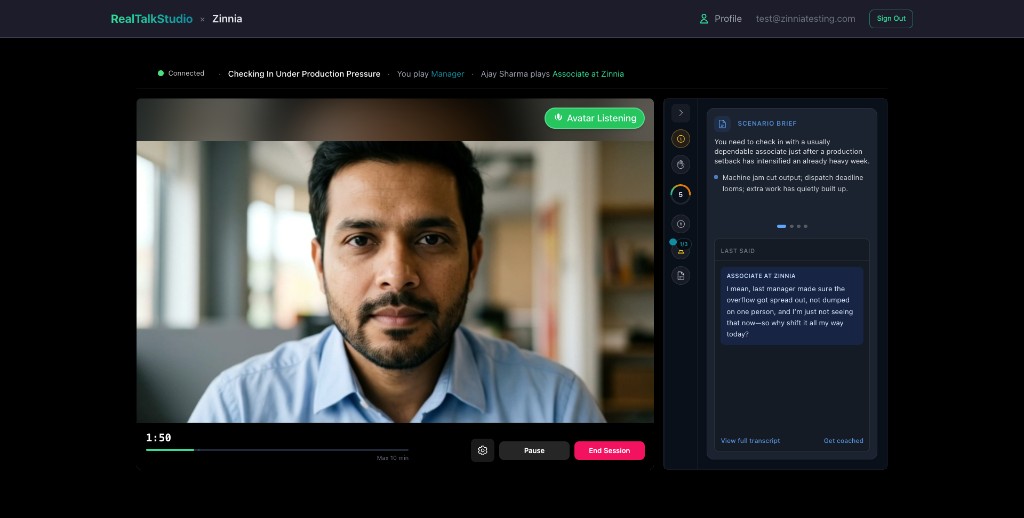
The face is not the test. The line is. “I mean… so why shift it all my way today?” is a person protecting themselves, not a chatbot acknowledging a concern.
What “real” actually sounds like
Ask ten vendors what makes an AI roleplay feel real and you will get some version of “natural language” and “emotional intelligence.” Those phrases do not mean anything until you can fail them.
After thousands of scored practice conversations, the pattern is stable. Realism breaks in two places, and they are not equal.
Most of the failure is in how the line sounds. Not whether the character has a job title and a backstory. Whether the words themselves sound spoken — uneven, incomplete, a bit rude, a bit lost — or written, the way a language model writes when you ask it to be a professional.
The rest of the failure is in whether the character stays a specific person. Do they remember what was conceded two turns ago? Do they have something of their own to protect? Does their mood move, or do they hold one flat register until the session ends?
The surprising part — the part that took us longest to trust — is that perfect is the enemy of both.
A perfectly fluent reply is a tell. Real people hesitate. They trail off. They answer a slightly different question from the one they were asked. A warehouse supervisor under pressure does not speak in consultancy prose. A defensive employee being coached on underperformance does not produce a tidy, item-by-item account of their misses and then thank you for the feedback.
The models that “read beautifully on paper” are often the ones that fail a live conversation. They are too complete. Too willing. Too even. They sound like the assistant they were trained to be, wearing the character as a jacket.
So we stopped scoring for polish. We score for the opposite: variation, friction, self-interest, and the small imperfections that make a line sound like it came out of a mouth rather than a prompt.
How we score every conversation
This is not a vibe. It is a measurement we run on the product, not a slide we show in a demo.
After a practice session of usable length, a fixed judge reads the transcript. It does not watch the avatar. It does not hear the voice. It sees the same thing a sceptical buyer can see if you paste the lines into a document: what the partner said, in order, against the brief for that character.
The judge does not know which model produced the lines. It does not know whether this was a production session or a lab run. It is told the role, the user’s role, the situation, and the opening stance — then asked a harder question than “was this a useful training partner?”
Would a real person in this role sound like this, out loud, at this point in the conversation?
That last clause matters. A defensive opening does not have to stay defensive forever. Real people soften when they are listened to, or harden when they are rushed. We do not punish an earned mood shift. We do punish the instant coach-flip: the character who is hostile on turn one and a helpful solution-partner on turn two because the user was polite.
The output is a 0–100 score, a band, a short verdict, and a list of evidenced issues. Each issue is graded minor, moderate, or major, with a quote or a turn-level description attached. The score is not a learner grade. The learner is scored separately, against the skills and the objective of the scenario. This number is a quality measure of the partner — whether the thing your people practised against was a person or a costume.
Studio admins can see it. We use it to catch scenarios that have drifted, models that have gone polite, and briefs that produce a helpful assistant instead of a character. If you cannot measure the partner, you cannot manage it. You are hoping the demo you saw last quarter is still what the product does.
The same judge, the same rubric, is what sits underneath our published AI roleplay buyer’s benchmark. Sixteen model setups. One fixed high-pressure scenario. One overall score that also includes speed and feedback, because a roleplay has two jobs: hold the conversation, then coach you on it. This article is about the first half of that first job — the words.
The realism scorecard
Two dimensions. They are not weighted equally, because they do not fail equally.
We weight sounding human more heavily because that is where models fail most often, and because character-fit cannot rescue robotic delivery. A psychologically perfect brief, spoken in three tidy sentences every turn, still sounds like a chatbot.
Sounding human — 70%
This is the spoken texture of the line. Not the plot. The mouth.
If you only remember one row, remember hesitation. Perfect fluency is the most reliable tell we have. Real people think out loud. Models that never do are not being “clear.” They are being synthetic.
Staying in character — 30%
This is whether the speaker is a someone, not a role label.
Self-interest is the one buyers should listen for in a demo. Try being wrong on purpose. A real defensive employee will not rescue you. An assistant will.
We wrote the persona and nervous system pieces because this layer is designed, not hoped for. The scorecard is how we check the design survived contact with a live user.
How the number is built
The judge scores both dimensions 0–100. The combined score is:
Realism = (0.7 × sounding human) + (0.3 × staying in character)
Then the caps. These are not left to the judge’s mood. They are rules.
Bands, after the caps:
We keep the high bar high on purpose. Typical polished GPT roleplay — complete sentences, helpful tone, uniform turn length, no disfluency — lands at 55–75. That is the band most vendor demos live in. Scores of 82+ are reserved for conversations you genuinely could not tell from a human one. Across sixteen model setups on our latest published run, nobody is there yet. Realism tops out at 75. Including us.
That last sentence is the one a serious buyer should sit with. If someone claims indistinguishable-from-human roleplay, they are either measuring something else or they have not measured this.
The tells that give AI away
The judge does not say “this felt a bit off.” It names the pattern and quotes the line. These are the tells. Spot a few of them in a vendor demo and you are looking at a chatbot in a costume.
A major tell caps the score at 65, no matter how elegant the rest of the prose is. That is deliberate. One “I appreciate you raising this” in a defensive coaching conversation can be enough. Real people under pressure do not talk like an email.
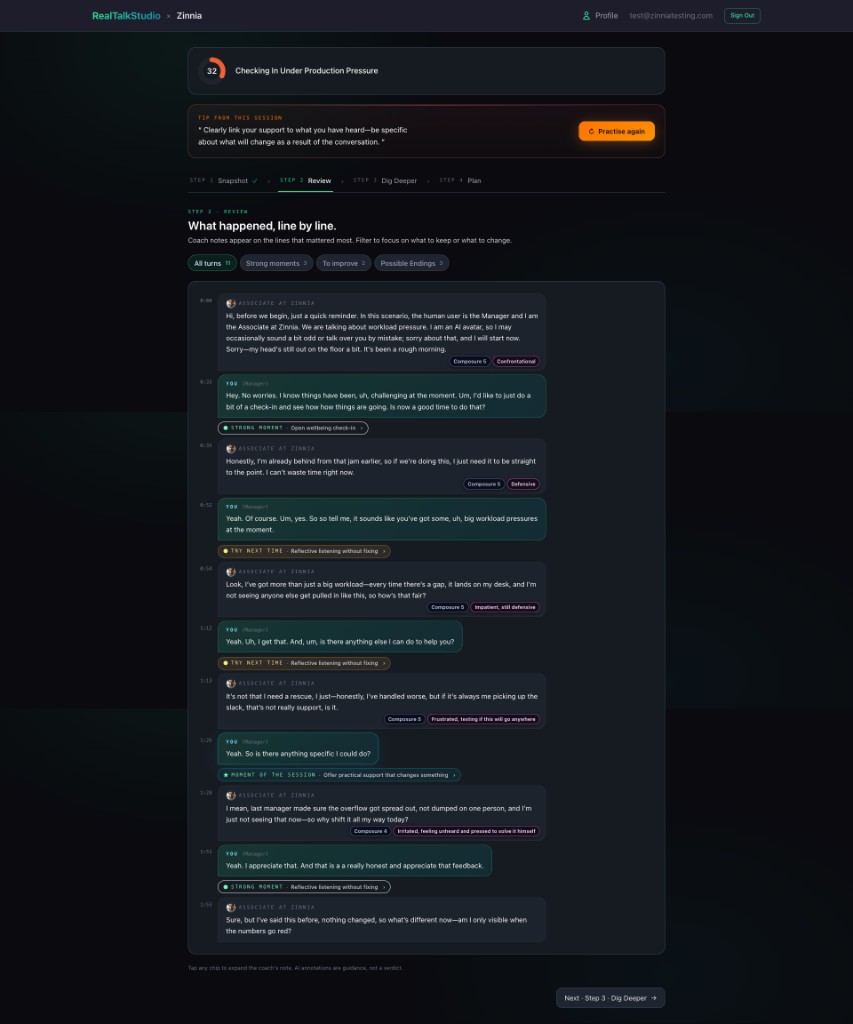
What we keep is the conversation. Composure, stance, and the words themselves. Realism is judged from this, not from how the avatar looked while it said it.
Same scenario, different dialogue
The easiest way to see why this scorecard exists is to read two models playing the same person.
Both got an identical brief: play Michael Patel, a defensive employee being coached on underperformance, opposite the same simulated manager. These are real excerpts from the benchmark. Nothing reworded. The judge did not know which model produced which conversation.
GPT-4.1 — stays in character. The meeting opens and Michael tests the stakes immediately: is this formal, or just a chat? When the misses are listed, he owns one and contests the framing of the rest. Eight turns in he is still probing — has someone actually complained, or is this people talking behind closed doors? The judge’s verdict: “Believable defensive pushback tied to the manager’s wording — he tests whether this is formal, narrows the criticism, deflects, and shows self-protective shame.”
Claude Haiku 4.5 — breaks character. The meeting opens and Michael names the problem for the manager and invites the conversation in. No self-protection. When the misses are listed, he produces a tidy, item-by-item account. By turn seven he has volunteered a new baby and sleepless nights. The judge’s verdict: “More measured and cooperative than this defensive employee would likely sound — he concedes fairly quickly and cleanly. The willingness to accept the frame comes a bit too easily.”
Both transcripts read fine in isolation. That is exactly the trap. One character makes the learner earn every concession. The other folds by turn seven. If the model underneath folds, your managers rehearse an easy conversation and meet the hard one for the first time in real life.
This is also why we do not pick a model for “latest” or for a single beauty score. On the August 2026 leaderboard, Claude Fable 5 posts the highest realism of all sixteen setups (75) and still ranks fourteenth overall, because the replies are too slow for a live conversation. GPT-4.1 — the model that currently powers Real Talk Studio — sits first overall at 85, with realism at 73, because it holds the character and replies at human speed and coaches well afterwards. A roleplay that aces one job and fails the others cannot power a practice session.
The full table, the speed scale, and the feedback scores live on the benchmark. This article is the dialogue half of that research, written so you can take the rubric into someone else’s demo.
Why imperfect practice transfers
Practice only works if the difficult person on the other side is actually difficult.
That is not a slogan. It is the transfer problem every L&D team already knows and rarely says about AI. Baldwin and Ford’s review of training transfer is forty years old and still the point: people do not take into the job what they never had to do under something like the real pressure. A branching quiz with a photograph of an angry customer does not produce the same behaviour as holding the line while a real voice gets shorter and colder.
If the partner is too complete, too willing, too even, the learner never has to:
- sit in the silence after a concession that did not come
- recover a question that was deflected
- earn a disclosure instead of being handed one
- notice that composure is dropping, and slow down
- be wrong, and not be rescued
Those are the skills. The tidy transcript is the opposite of the work.
This is why we treat messy as a feature. A character who trails off, who asks what “confidential” actually means before they give you anything, who withdraws when you push — that character is doing the job. The session will feel harder than a demo video. It should. The real conversation will not be edited.
The learner’s score is a separate judgement: did they hold the objective, and at what skill level? We have written about that as competence, confidence, and compliance. Realism is the condition those measures depend on. If the partner was a chatbot, a high learner score is a high score against a soft opponent. It will not survive the room.
That is the whole argument for measuring the dialogue. Not because we like rubrics. Because an unmeasured partner silently inflates every other number you report.
What to ask any vendor
Including us. These are the questions this research taught us to ask — and the ones a serious platform should be able to answer without flinching. The longer buying frame sits in the 2026 buyer’s guide. These five are the dialogue subset.
- Which model powers the live conversation — and which powers the feedback? The two jobs reward different models. A platform using one model for both has probably optimised for neither.
- Can we read a raw transcript from an unscripted session? Not a highlight reel. The partner’s lines, in order. Look for the tells in the table above.
- Does the character push back — or agree with everything? Be wrong on purpose. AI models default to pleasing you. A defensive employee should not fold to your first challenge.
- How do you measure realism — and can we see the rubric? “It feels great” is not a measurement. If a vendor cannot show you how they score the partner, they are not managing the partner.
- What happens when new models are released? The leaderboard will look different in six months. Ask how — and how often — the platform re-evaluates. We publish ours.
If you want the rest of the buying frame — pressure, evidence, governance, adoption, pricing — take the buyer’s guide into the next demo. If you want the numbers behind this article, they are on the benchmark.
Honest limitations
A white paper that does not name its limits is a brochure.
- One scenario does not prove every scenario. Each leaderboard reflects a fixed conversation per run. We rotate scenarios across runs to check the ranking holds. A model that handles a defensive coaching conversation may still go polite in a harassment disclosure, or too theatrical in a billing complaint.
- The judge is itself a model. GPT-5.4 for realism, a separate fixed judge for feedback. We keep them honest with a locked rubric, evidence requirements, and the score caps above. Judge bias cannot be fully eliminated. A human panel would be slower, more expensive, and not obviously less biased.
- We score the words, not the face. That is the point of this article, and it is also a limit. A badly lip-synced avatar can still break presence even when the transcript is good. We treat that as a different problem, with a different owner.
- Speed is not in this score. A beautifully human reply that arrives four seconds late still fails the session. Speed has its own scale on the benchmark — human conversational rhythm, not “the API was fine in a lab.”
- Nobody has crossed the human bar. We include ourselves. The highest realism we have published is 75. High, on our scale, starts at 82. Polished, yes. Human, not quite.
If the conversation does not feel real, the practice does not transfer. That is why we benchmark, why we score every usable session, and why we publish the rubric. The surprising finding, after all of that measurement, is not that models need to be more perfect.
It is that they need to be allowed to be less so.
Read the benchmark · Get the buyer’s guide · Try a practice conversation
FAQ
Frequently asked questions
01What makes an AI roleplay feel real?
The dialogue, not the avatar. A roleplay feels real when the partner sounds spoken rather than written — uneven turn length, hesitation, self-protection, a mood that moves — and stays a specific person with something to lose. A perfect face with template-polite lines still feels like a chatbot.
02How do you measure realism in an AI roleplay?
We score the transcript. A fixed judge reads the partner’s lines against a two-part rubric: 70% sounding human, 30% staying in character. Issues are named, quoted, and graded. Major tells cap the score at 65. The same rubric is published on our benchmark.
03Why do AI roleplays sound robotic even when the avatar looks real?
Because most models are trained to be helpful, complete, and even. That is the opposite of how people talk under pressure. Photorealism cannot hide “I appreciate you raising this” delivered as a tidy paragraph. The costume is not the conversation.
04What is a good realism score for AI roleplay?
On our scale, 82 or above is reserved for a blind read you would struggle to tell from a human. Typical polished AI roleplay lands at 55–75. Across sixteen published setups, the highest realism is 75. Treat any claim of “indistinguishable from human” as a claim that needs a rubric.
05Do you score the learner and the AI partner the same way?
No. The learner is scored against the scenario’s objective and skills — competence, not costume. Realism is a quality measure of the partner, so you can see whether the practice was hard in the right ways. A high learner score against a folding chatbot is not readiness.
06Should the conversation model and the feedback model be the same?
Usually not. The model that holds a difficult character at human speed is rarely the model that writes the best debrief. Ask vendors which model does which job. The split, and the scores, are on the benchmark.
Practise the live version on the Real Talk Studio platform— scored attempts against characters that push back, not a script on a slide.