Thought leadership
Scenario-Based Training Examples and Templates

Scenario-based training examples work when the learner has to decide or speak in a specific situation — not click through a story about someone else. The templates below are the four types, with a real workplace example of each, plus a seven-step build you can run this week.
If you came here for examples and templates you can actually run, start with the workplace roleplay library and come back for the method.
Updated September 2026.
What is scenario-based training?
Scenario-based training (sometimes called scenario-based learning) is a design in which the learner faces a realistic situation, makes choices or speaks, and sees consequences. The situation is the lesson. The debrief is the teaching. A slide that describes a scenario is not scenario-based training. It is a case study you did not discuss.
If you came here for examples you can run, start with the 50 workplace roleplay scenarios and come back for the method.
Four types — with a real example of each
1. Branching scenario
The learner clicks through a story. Each choice opens a different path. Good for “what do I do next?” when the skill is a decision, not a live conversation.
Example: A contact-centre branching module on a missed payment. Choice A: stay in collections. Choice B: pause and ask about rent and food. The path shows the complaint or the forbearance. Useful. Limited: nobody’s voice shakes.
2. Simulation (operational)
The learner operates a model of the work — a till, a cockpit, a claims screen, a 3D shop. Game mechanics sometimes sit on top (Attensi lives here). Good when the environment is the skill.
Example: A store manager restocks under a delivery cut. The sim scores what they pulled from the floor, not what they said in a 1-1 afterwards.
3. Roleplay
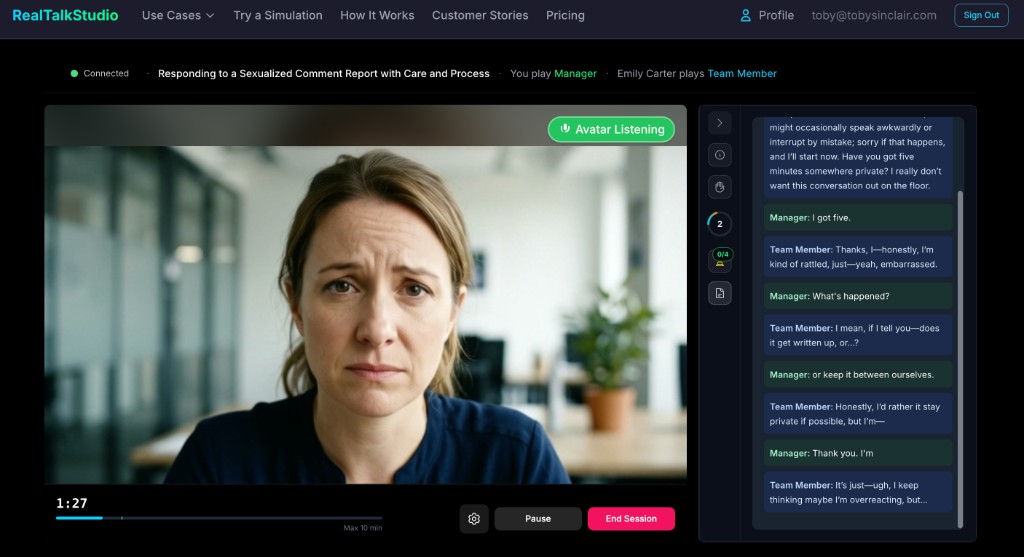
The learner speaks as themselves (or as the role) to another person — colleague, actor, or AI. This is the type most “difficult conversation” programmes mean and then under-run. See coaching, feedback, leadership, customer service.
Example: A manager tells someone they are not being promoted. The other side says, “So what was the year for?” The lesson is the next sentence.
4. Case study
A written or filmed situation discussed in a group. Excellent for shared language. Weak for transfer if it never becomes a spoken rep.
Example: The team reads a pack about a failed change programme and argues about the sponsor. Nobody has to walk into a room and say the unpopular thing.
Most programmes need more than one type. A case study on Monday and a roleplay on Thursday is a design. A case study instead of a roleplay is a dodge.
Why it beats passive training — without invented statistics
Three claims I will stand behind, because they are old and checkable:
Transfer is the problem, not memory of the slide. Baldwin and Ford (1988) framed transfer as a function of training design, trainee characteristics, and the work environment. If the practice does not look like the task, and the workplace does not require the new behaviour, the course becomes trivia. Scenario design is how you make the practice look like the task.
People forget what they only watched. Ebbinghaus’s forgetting curve is the standard citation for why a January e-learning module is a thin defence in June. The exact percentages in vendor brochures wander. The direction does not: unused, unrehearsed material decays. We have used this point in the Worker Protection Act writing because tribunals care about staleness — see Allay (UK) Ltd v Gehlen [2021].
Most organisations stop measuring before behaviour. The Kirkpatrick model has four levels (reaction, learning, behaviour, results). Brandon Hall Group’s learning-measurement work has repeatedly found that few organisations track impact well; we cited the “fewer than one in six” figure in the three measures piece. Scenario-based training does not magically give you Level 3. It makes Level 3 observable if you record what people did in the scenario.
I will not invent a “scenario-based training increases retention by X%” number. If a vendor gives you one, ask for the study, the n, and whether the control was “nothing” or a serious alternative.
Comparison: four ways L&D actually buys this
None of these rows is a moral victory. E-learning is the right tool for “what is the policy.” It is the wrong tool for “can you take the disclosure.” Workshop roleplay is the right tool for a twelve-person intact team with a grown-up facilitator. It is the wrong tool for 400 managers and a harassment scenario.
Build your own — seven steps
- Name the real moment. Last quarter’s incident, not a stock “difficult customer.” If you cannot point at a call or a meeting, you do not have a scenario yet.
- Write the tension in one sentence. “They will agree and change nothing.” If the tension is “be professional,” stop.
- Write the first three turns. Opening, their pushback, your hold. If you cannot, you will get a monologue.
- Choose the type. Decision → branch. Environment → ops sim. Spoken hold → roleplay. Shared sense-making → case.
- Decide the evidence. What would convince a sceptic they can do it? A quiz score will not. A transcript might. See training audit.
- Brief the other side. Hidden instruction, not “be a bit difficult.”
- Run, collapse, replay. One scenario, twice in a week, different mood. Then — and only then — write the next.
If you want the conversations already named, use the hub. If you want them spoken, use /practice or a workshop that follows the same briefs.
How to write one scenario-based training piece this week
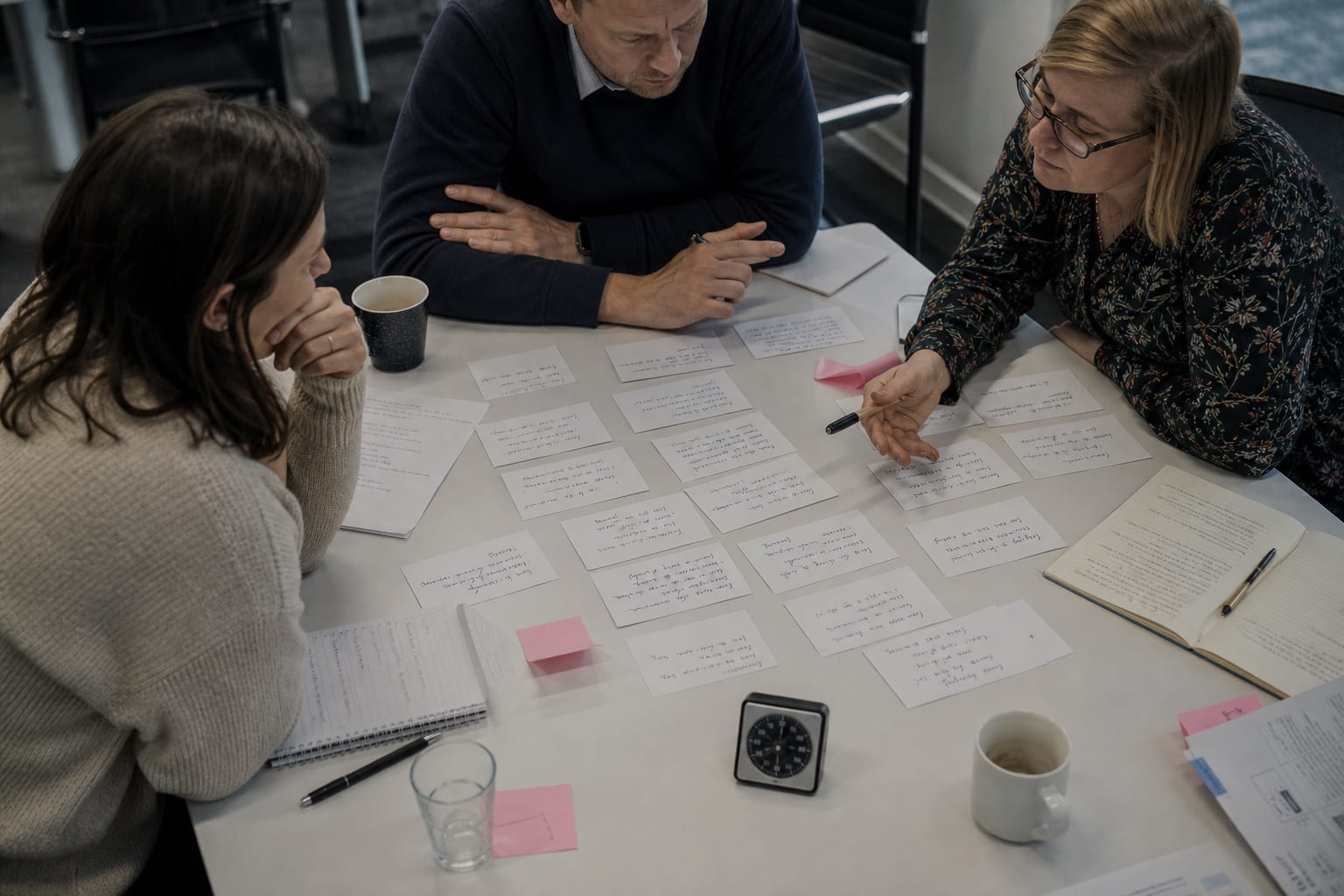
You do not need a catalogue. You need one real moment and three turns.
Monday. Ask three line managers: “Which conversation last month went badly, and what did the other person say on the second line?” Write the one that made someone go quiet.
Tuesday. Draft the clumsy version from memory. Then the hold you wish they had used. If you cannot write the third turn, you do not understand the tension yet.
Wednesday. Brief one person to play the other side with a hidden instruction (agree and stall / make it personal / go silent). Three minutes. Stop at the collapse.
Thursday. Same scenario, different mood. Keep the transcript or the notes.
Friday. File the date, the names, and whether the original point survived. That is already more of a training audit than most programmes keep.
That is scenario based training as a week of work, not a methodology slide.
Common failure modes
The happy path. Every branch leads to a gold star. Learners learn that the organisation is fictional.
The cartoon villain. The customer is a monster; the employee is a saint. Real calls are mixed. Cartoon villains teach contempt.
The framework recital. People perform SBI and never meet the third turn. I wrote about that in feedback frameworks.
The dignity problem. You ask a colleague to play the bereaved caller or the disclosure. They will either hold back or take it home. Use a simulation.
The wrong owner. L&D builds the scenario. The line manager never sees the attempt. The workplace demand stays theoretical. Transfer needs a boss who will ask “show me the tape,” not only “did you finish the module.”
Too many scenarios. A catalogue of fifty titles assigned as pre-work is a reading list. Three, run twice, with a different mood the second time, is a curriculum. Use the hub as a menu, not as a homework dump.
No workplace demand. You built a beautiful scenario and nobody is expected to be good. Practice tools in a low-standard culture die. Nobody Practises.
Measuring the wrong thing. Completions, thumbs-up, time-in-module. If you needed behaviour, you did not measure it.
Where this sits in a curriculum
A year of L&D is not “we are a scenario-based organisation” or “we are an e-learning organisation.” It is a mix with honest jobs:
- Policy facts — what counts as harassment, how to report, what the travel rule is. E-learning or a live briefing. Quiz if you must.
- Shared language — a case discussion so a leadership cohort means the same thing by “hold the line.”
- Decisions — branching when the skill is which path, not which sentence.
- Spoken holds — roleplay or AI simulation for the moments that fail in the mouth.
- Evidence — a sample of Level 3, filed. See training audit.
The scripts live in coaching, feedback, leadership, customer service, and cold call. If you only assign the titles as pre-work, you have built a reading list.
What “good” looks like in a review, not a brochure
A sceptical Head of L&D should be able to answer, for one scenario:
- Which real incident or QA fail is this from?
- What is the tension in one sentence?
- What does the other side do on turn three?
- What evidence do we keep?
- What happens to someone who cannot do it yet — and is that kinder than putting them on the live queue?
If you cannot answer those, you do not have scenario-based training. You have a theme.
Scenario-based learning is not a content format. It is a bet that people get better at the thing they have had to do, under something like the real pressure, more than once.
Try a scenario as a spoken simulation
FAQ
Frequently asked questions
01What is the difference between scenario-based training and scenario-based learning?
In practice, none. “Learning” is the academic label; “training” is the L&D label. Both fail if the scenario is only described.
02What are good scenario-based training examples?
A third-call billing complaint, a post-redundancy team meeting, a promotion no, a disclosure. See the workplace library for fifty.
03Is roleplay the same as scenario-based training?
Roleplay is one type. Branching, operational simulation, and case discussion are the others. Most “soft skills” problems need roleplay, not another branch.
04Does scenario-based training work?
It works when the scenario matches the task and the workplace requires the behaviour. It does not work as a more expensive quiz. Demand transfer evidence, not a retention percentage on a slide.
Practise the live version on the Real Talk Studio platform— scored attempts against characters that push back, not a script on a slide.