Manager
Feedback Role Play Scenarios (Scripts)

Feedback role play scenarios are only useful if they include the bit after the model. Here are eight conversations, ordered by difficulty, each with the clumsy version, what went wrong, and a skilled rewrite. They are written so you can read them aloud and feel the room change.
I use one framework in this article, once. After that, you will see it working or failing in the lines — not as a poster on the wall.

Feedback role play scenarios, in order of difficulty
Eight conversations. Same shape each time: the clumsy version, what broke, then a skilled rewrite. Where we have a live practice, I have linked it.
A framework you can remember under stress
SBI — Situation, Behaviour, Impact — is enough. Situation is when and where. Behaviour is what a camera would have seen. Impact is what it did to the work, the customer, or the other person.
That is the whole model. The rest of this page is what happens when the other person does not sit still for it.
If you want a longer argument about why frameworks make managers worse when they replace practice, I have written that separately in Feedback Frameworks Made Your Managers Worse. This page is the drill book.
1. Praise that lands flat
You want to reinforce a good piece of work. You say “great job” in the corridor. They smile and keep walking. Nothing is more likely to happen again, because nothing was specific enough to repeat.
Clumsy
Manager: “Great job on that thing yesterday. You’re a star.”
Employee: “Thanks.”
Manager: “No, really. Love your energy.”
What went wrong
- “That thing yesterday” is not a situation.
- “You’re a star” is a verdict on the person, not a behaviour.
- “Energy” is un-copyable. They cannot do “energy” next Tuesday.
Skilled
Manager: “In yesterday’s client call — the one with the finance lead — you stopped the room and restated their constraint in one sentence before you pitched. They leaned in. That is why we got the follow-up. I want that move in the Thursday call as well.”
Employee: “I wasn’t sure it landed.”
Manager: “It landed. That is the behaviour I am asking you to keep.”
Practise praise that specifies the move
2. A minor correction, said early
A slide title was wrong in a pack that went to a client. Small. Easy to leave. Easy to let become a habit.
Clumsy
Manager: “Tiny thing — don’t worry about it — the title on slide four was a bit off. All good though!”
Employee: “Oh God, was it bad?”
Manager: “No, no, I shouldn’t have said anything.”
What went wrong
- You undercut the message twice before it arrived.
- They now have anxiety and no instruction.
- “Don’t worry” teaches them that your feedback is optional.
Skilled
Manager: “Slide four in yesterday’s client pack had last quarter’s title. The numbers were right. I want you to run the title check before it leaves, same as the numbers. Can you own that on the next pack?”
Employee: “Yes. Sorry.”
Manager: “I do not need sorry. I need the check. Send me the next pack with that done.”
3. Repeated behaviour you have already named
You mentioned lateness to stand-up twice. It is still happening. The third conversation is not a first conversation with more adjectives.
Clumsy
Manager: “So… the start times. I feel like we’ve talked about this? I just need everyone to try a bit harder to be there.”
Employee: “Traffic has been a nightmare. I’ll do my best.”
Manager: “That’s all I ask.”
What went wrong
- “I feel like we’ve talked about this” is you asking them to confirm your memory.
- “Try a bit harder” has no measure.
- “That’s all I ask” closes a loop that had not opened.
Skilled
Manager: “This is the third time I am raising late arrival to stand-up. On Monday and Wednesday you were twelve minutes late. The impact is that we recap for you and the board decisions slip. I need you in the room at 9.15 for the next four weeks. If something structural is in the way — school run, train — say it now so we can adjust. If not, I will treat the next miss as a performance point, not a weather report.”
4. Feedback to a defensive person
You name one behaviour. They put your whole relationship on trial.
Clumsy
Manager: “I wanted to talk about how you spoke to Dev in the huddle.”
Employee: “So I’m the problem? After I carried last sprint? This is so one-sided.”
Manager: “You’re not the problem. Everyone values you. Maybe I got this wrong.”
What went wrong
- You abandoned SBI at the first spike.
- You let “am I the problem?” become the agenda.
- You apologised for the observation, so the observation died.
Skilled
Manager: “In this morning’s huddle you cut Dev off twice and said the estimate was ‘amateur.’ Dev went quiet and we left without a number. I want you to repair that with Dev today, and I want estimates challenged on the work, not on the person.”
Employee: “So I’m the problem? I carried last sprint.”
Manager: “Last sprint is not what we are talking about. I can talk about your load in Friday’s 1-1. Right now I am staying with how you spoke to Dev. Will you have that conversation today, or do you want me in the room?”
Practise with a defensive pushback
5. Feedback to a friend
You hired together. You still go for a pint. Their reviews have got sloppy. You keep waiting for a “natural” moment. There isn’t one.
Clumsy
Manager: “Mate, this is weird because it’s us — the last two reviews were a bit messy? I don’t want to be That Boss.”
Friend: “Are you serious right now? I covered you last month.”
Manager: “You did. Forget it. I’ll sort the reviews.”
What went wrong
- You asked for permission to be their manager.
- They used the friendship as a shield, and you agreed.
- You took the work back, which trains the sloppiness.
Skilled
Manager: “I am putting the friendship on the side of the table for ten minutes, because I am still your manager. The last two reviews went out with missing test notes. That is now a quality issue, not a vibe. I need the next one complete, and I will not rewrite it for you.”
Friend: “This is a bit corporate.”
Manager: “It is work. After we agree the standard, we can still get a pint. I will not trade the standard for the pint.”
Practise feedback to someone you like
6. Feedback across a power gap — to your boss
They talk over people in the steering group. You are the one who has to go back to the team and explain why nobody could finish a sentence.
Clumsy
You: “This is probably out of line, but I wondered if the steering group feels a bit… fast? People have mentioned it. Not me, necessarily.”
Boss: “If people have things to say they should say them. I don’t have time for process theatre.”
You: “Yeah, fair. I’ll tell them to speak up more.”
What went wrong
- You hid behind “people.”
- You offered a diagnosis they can dismiss as softness.
- You left with an action that puts the burden on the quieter people.
Skilled
You: “In yesterday’s steering group you spoke across Priya and then closed the item. She had the dependency that later blew up in Slack. I need a rule: if I raise a hand, you give me thirty seconds before we close. That is not process theatre. It is how we stop discovering the risk at 6pm.”
Boss: “Then raise the hand faster.”
You: “I will. I still need you to take the hand. Will you?”
Practise holding a line with a colleague
7. Feedback after a customer or colleague complaint
A complaint has come in. Some of it is fair. Some of it is heat. You have to give feedback without becoming the complainant’s lawyer or the employee’s defence counsel.
Clumsy
Manager: “So, legal-ish thing — someone has raised a concern. I’m sure it’s a misunderstanding. Just… be careful?”
Employee: “Who? What did I do? This is a stitch-up.”
Manager: “I shouldn’t have said anything. HR might follow up. Try not to worry.”
What went wrong
- You leaked a process you cannot finish.
- “Be careful” is not behaviour.
- You created a hunt for the complainant.
Skilled
Manager: “A client has complained about the tone of Friday’s call. I have listened to the recording. At 04:12 you said ‘if you had read the email this would be obvious.’ That is the line I want us to talk about — not who complained, and not your whole year.”
Employee: “They were impossible.”
Manager: “They were difficult. The line still sits with you. I want you to practise the next call where the customer has not read the email, and I want that sentence gone. We will listen to one together next week.”
Practise the customer-side of this complaint
8. Feedback that might trigger a grievance
The behaviour is real. The relationship is already thin. They have mentioned “speaking to HR” before. You still have to give the feedback. You also have to stop freelancing process.
Clumsy
Manager: “I need to say this even though I know you’ll probably escalate it. Your attitude in meetings is a problem. I’m documenting everything, just so you know.”
Employee: “So this is a formal warning.”
Manager: “I didn’t say that. Don’t twist my words. Maybe we should get HR in. Or not. I don’t know.”
What went wrong
- You threatened documentation as a weapon.
- You were unclear whether this was informal or formal.
- You invited a process fight instead of naming one behaviour.
Skilled
Manager: “I am giving you informal feedback, today, about one behaviour. In Tuesday’s planning meeting you said the estimate was ‘a joke’ and then left the call. The impact was that we had no number and two people asked me afterwards whether it was safe to speak. I will write a short note of this conversation and share it with you so we agree what was said. If you want HR in the next one, say so and I will arrange it. I will not argue about your right to raise a grievance. I will still name the behaviour.”
Employee: “I’m taking this to HR.”
Manager: “That is your right. I will send you the note by 4pm. The next planning meeting is Thursday. I expect you there, and I expect estimates challenged on the work, not on the people.”
This is the one to practise with a simulation, not with a willing colleague. The temperature is the training.
Practise a higher-stakes version
Why your prepared words disappear — and why rehearsal beats reading
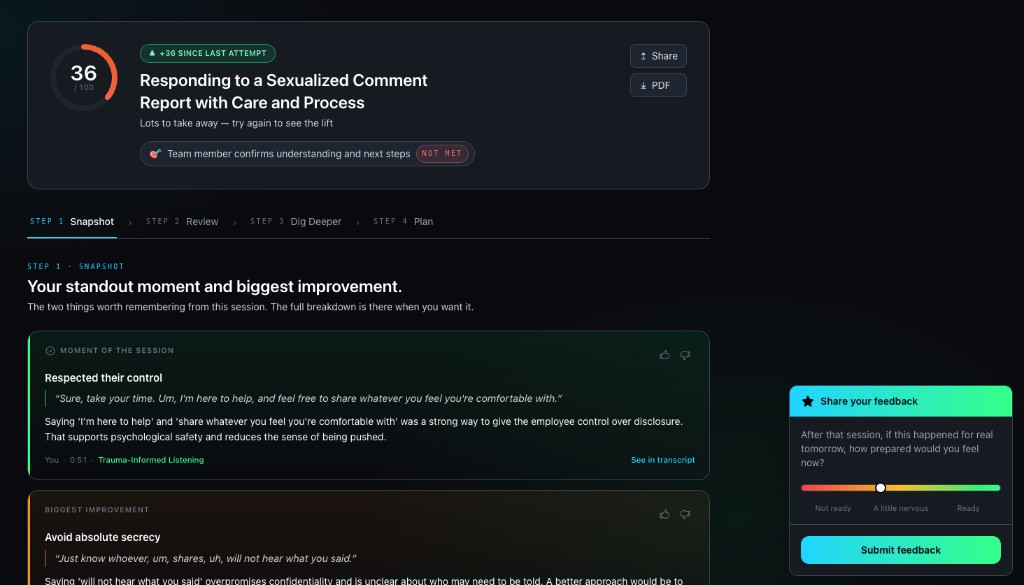
What a scored attempt looks like after the conversation — not a smile sheet.
Hard feedback is not mainly an information problem. It is a body problem.
Your heart rate goes up. Your mouth goes dry. The other person’s face does something you did not budget for. The SBI sentence you wrote in Notes last night is still in Notes. In the room you reach for the nearest social repair: a joke, a compliment, a retreat.
That is not a character flaw. It is what stress does to working memory. The people who look “naturally good” at feedback have usually had more live reps than you — or they have a higher tolerance for other people’s discomfort, which is not the same as skill.
Reading this page will not change that. Saying the lines out loud, against a person who pushes back, will. In our simulations the collapse almost always arrives on the second or third turn, not the first. That is why these feedback role play scenarios are written as exchanges, not as opening monologues.
If you are building a wider set, start from the 50 workplace roleplay scenarios. For coaching that has to last beyond one piece of feedback, use the coaching scenarios for managers. For the legal end of the spectrum, use the training audit piece — completion is not evidence you can give feedback under pressure.
FAQ
Frequently asked questions
01What are feedback role play scenarios?
They are practice conversations for giving praise, correction, or hard feedback, written with both a clumsy version and a skilled version so a manager can hear the difference, not just read a tip.
02How do I give negative feedback without it becoming an argument?
Name situation, behaviour, and impact. Then stay with that one point when they widen the frame. The argument starts when you follow them into history, motive, or your right to speak.
03How many feedback scenarios should I run in a training session?
Three, with real pushback, beats eight performed by helpful peers. Use the later scenarios on this page only if people have already practised the early ones out loud.
04Should I use SBI for every feedback conversation?
Use it to start. Do not hide in it. Once the other person responds, the skill is holding the point, not reciting the acronym.
05Can I practise feedback role play scenarios on my own?
Yes — if something talks back. Rehearsing in your head trains fluency, not composure. A live simulation, or a colleague briefed to be unhelpful, is the actual drill.
Practise the live version on the Real Talk Studio platform— scored attempts against characters that push back, not a script on a slide.