Manager
50 Workplace Roleplay Scenarios & Ideas

50 workplace roleplay scenarios
Eight categories. Three you will actually run.
Workplace roleplay scenarios are useful when they name the tension in a paragraph and then send you somewhere you can actually speak. This is the library: fifty roleplay ideas for work, in eight categories. Each setup is short on purpose. The scripts live in the longer pieces.
Updated September 2026.
Start with a guide, then a live attempt
Customer service scenarios
Angry, billing, vulnerable, cancellation, and call-centre phone drills — with a free script pack.
Coaching scenario examples
Manager 1-1s, including new-manager conversations, with clumsy vs skilled scripts.
Feedback role play
Praise, correction, and the ones that might become a grievance.
Leadership training scenarios
The meeting after a restructure, an unpopular decision, conflict the room can see.
Cold call practice
Gatekeeper, send-me-an-email, incumbent, hang-up recovery, price.
Practise a scored conversation
Live rooms for feedback, PIP, promotion-no, angry customers, and competitor-is-cheaper.
Workplace roleplay scenarios — the library
Fifty setups. The tension is on this page. The spoken scripts live in the longer pieces, listed under each category. Use this as a menu, not as homework.
Roleplay ideas by who has to speak
New managers:
start with coaching 1–3 and feedback 8–10.
Leads of leads:
start with leadership 15–18.
Contact-centre coaches:
start with customer service 22–28, then the full CS list.
Enablement:
start with sales 29–34 and cold call practice.
HR / compliance:
start with 40–45, then Worker Protection Act reasonable steps.
How to choose a scenario
Pick the conversation someone in your organisation has to have in the next four weeks. Not the one that photographs well in a catalogue.
If you are training managers, start in coaching or feedback. If you are training leads of leads, start in leadership. If you are a contact-centre lead, start in customer service. If you are enablement, start in sales. If you are HR or compliance, start in compliance — and read training audit before you call completion “done.”
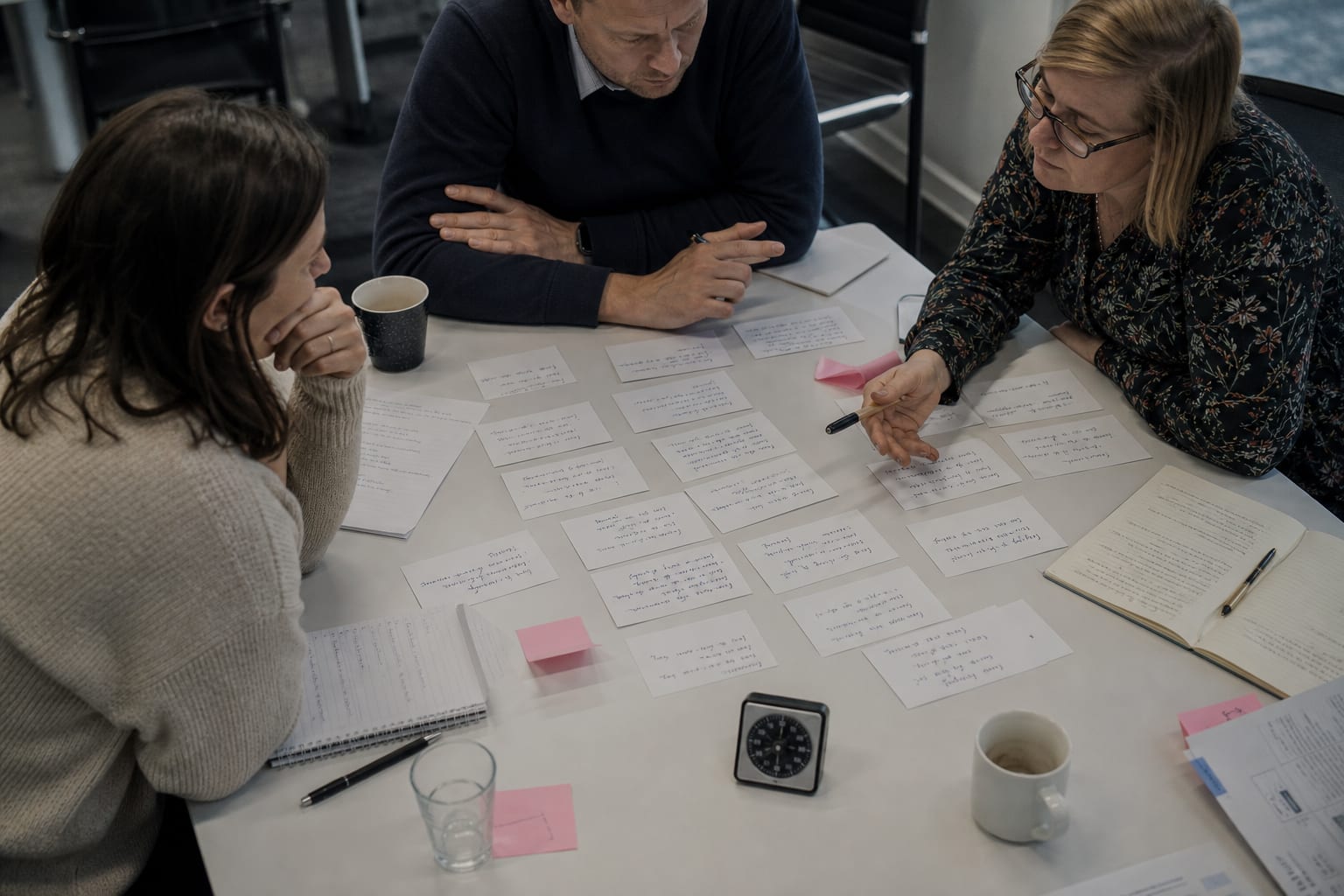
How to run a roleplay that is not cringeworthy
The number-one objection to role play training is that it is embarrassing. The embarrassment is usually the design, not the method.
- 01
Brief the other side in writing.
“Be a bit difficult” produces comedy. “Agree to everything and change nothing” produces a real coaching failure.
- 02
Three minutes, then stop.
The learning is in the first collapse. Long improvisation is theatre.
- 03
Do not use humans for the worst content.
Harassment disclosure, bereavement, a PIP that might become a grievance — practise those in simulation. I have written about why in compliant and compassionate.
- 04
Grade the point, not the performance.
Did the original message survive? That is the score.
Solo vs pair vs AI simulation
Solo, out loud
- Use it when
- You need to hear your opening
- It fails when
- Nothing talks back
Pair, live
- Use it when
- The content is safe and you have a good brief
- It fails when
- The colleague is kind, or the content is traumatic
Workshop group
- Use it when
- You want shared language
- It fails when
- People perform for the room
AI simulation
- Use it when
- You need reps, pushback, and a transcript
- It fails when
- You treat it as a module to finish
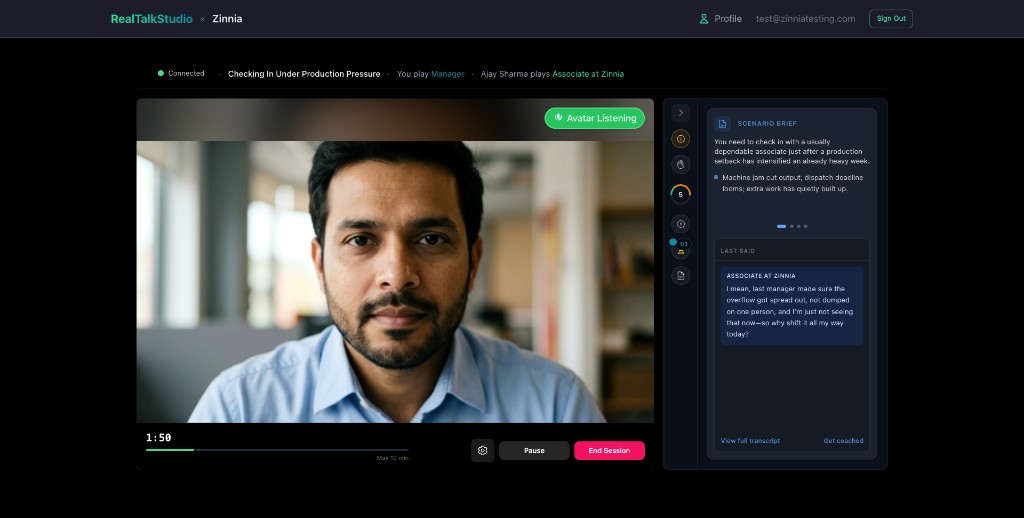
We built Real Talk Studio for the last row. The public drills are on /practice. The rest of this page is the map.
Where the full scripts live
Coaching scenarios for managers
Feedback role play scenarios
Leadership training scenarios
Customer service role play
Cold call practice
Method and evidence: scenario-based training · training audit · Worker Protection Act reasonable steps
If you are buying a platform: start with Second Nature vs Hyperbound vs Yoodli vs RTS, then Yoodli, Hyperbound, Attensi, or Virti.
01. Underperformance left too late.
Turnaround has slipped for a quarter. Two colleagues are covering. You mentioned “the queue” in passing and told yourself you were being kind. Today you have to name the pattern without pretending this is new. They will hear your delay as clearly as they hear the feedback. If you open with “we’ve all been stretched,” you will leave with a mood and no date.
02. High performer coasting.
Numbers are green and have been for two years. The messy projects have stopped landing on their desk. They will win any argument that only uses the dashboard. Your job is to name a different standard — the work that has no playbook — and to find out whether they want that standard, or just the quiet life.
03. Coaching someone more experienced than you.
Their steering updates are late and lightly sourced. They have been in the industry since you were in school. You will want to buy the right to speak with compliments. They will test whether you believe the standard or are performing management. Speak to the artefact, not their career.
04. Defensive reaction.
You raise one missed client call. Within a minute you are on trial for last year, the other team, and whether you “have their back.” The coaching point dies if you restore warmth at any cost. Acknowledge the defence in half a sentence. Return to the one behaviour.
05. Coaching upward.
Your director adds “quick” asks in the last ten minutes of meetings. Your team is missing its own dates. You are not their manager. You still have to make the cost visible as a choice: name what moves, or say no in the room. “We’ll make it work” is how the overtime happens.
06. Agrees, changes nothing.
Every 1-1 ends in nods. “Yep. I’ll sort it.” A month later the same slip is back. Agreement was a way to end the meeting. Coach to an artefact and a time you can see without chasing. If they cannot name the artefact, they have not agreed.
07. After a public miss.
You corrected a wrong number in the weekly review. The room needed the correction. They needed not to be ambushed. The private conversation is how you own your clumsiness without unsaying the standard, and how you get shaky numbers before the room does.
Say What You Mean: Quick Feedback Chat
Most people soften feedback until the message disappears.
“Hi — you wanted a quick word?”
1-on-1 · ~5 min
08. Praise that lands flat.
“Great job” in the corridor, plus a vague “love your energy.” They smile and keep walking. Nothing is more likely to happen again, because nothing was specific enough to copy next Tuesday. Praise is still feedback. If a camera could not have seen it, it was a vibe.
09. Minor correction, said early.
One wrong slide title in a client pack. Easy to leave. Easy to let become a habit. The failure mode is undercutting the message so hard — “tiny thing, don’t worry, I shouldn’t have said anything” — that they leave with anxiety and no instruction.
10. Repeated behaviour already named.
Third conversation about lateness to stand-up. This is not a first conversation with more adjectives. “I feel like we’ve talked about this” asks them to confirm your memory. Name the dates, the impact, and what happens on the next miss.
11. Feedback to a friend.
You hired together. You still go for a pint. The reviews are sloppy. You keep waiting for a natural moment. There isn’t one. They will use the friendship as a shield. You will be tempted to take the work back. That trains the sloppiness.
12. Feedback to your boss.
They talk over people in the steering group. You have to go back to the team and explain why nobody could finish a sentence. Hiding behind “people have mentioned” is how you get process theatre. Ask for a rule you can use in the room — a hand, thirty seconds.
13. Feedback after a complaint.
A client or colleague has raised something. Some of it is fair. Some of it is heat. Your job is one behaviour you can stand behind — ideally from a recording or notes — not a hunt for the complainant and not a tour of their whole year.
14. Feedback that might become a grievance.
The relationship is already thin. They have mentioned HR. You still have to give the feedback. Be clear whether this is informal. Do not wave “documentation” as a weapon. Do not freelance process. Name one behaviour. Offer HR in the room if they want it.
15. First team meeting after redundancies.
Empty chairs. People want a guarantee you do not have. Some want you to badmouth the decision. Some will not speak. This is a team room, not a 1-1. Honesty vs false comfort is the whole hour. “Let’s stay positive and do stand-up” teaches the room not to ask real questions.
16. Unpopular decision you disagree with.
The travel budget is frozen. You argued against it. You lost. If you side with the team against “the business,” you are campaigning. You can name the disagreement once. Then you own the decision you are paid to implement, and you take one clean exception if there is an artefact.
17. Banter that goes too far.
Mid-meeting, a senior person makes a sexualised joke about a colleague who is not in the room. Two people laugh. One goes still. “Don’t make this a thing.” This is the moment most respect modules never reach, and the one reasonable steps will test. You need a line that exists while they look at you.
18. Visible conflict between two reports.
They talk across each other in the weekly. Everyone else watches you. If you take it offline every time, the room learns conflict is unmanageable. If you referee character, you become the third combatant. Force artefacts, in the room, on a clock.
19. Saying no to your own boss.
They want the extra analysis by morning. The release is Thursday. “We’ll do our best” is a future miss with your name on it. Give them a choice: the analysis or the date. Do not take both and hope.
20. Holding a line with a senior stakeholder.
A VP wants an unredacted export “for the board” and mentions the CEO. Helpfulness is the trap. The access process is the job. Offer the aggregated pack. Offer to start the request. Do not be the person who skipped it.
21. “One more thing before you go.”
Hands on laptops. A light, late ask — new work, a political name, keep it quiet. Corridor commitments the room never heard are how work actually moves. If it is a real ask, it is not a doorway ask. Name the decision it is for, and a time you will answer.
Scenarios 22–28
Customer service (22–28)
Full scripts: role play scenarios for customer service training
Vulnerable Customer (Consumer Duty)
Most participants stay on script when they should override it.
“I’m choosing between heating and eating.”
1-on-1 · ~10 min
22. Billing error, first angry call.
Charged twice. They want it back today and they do not want five working days. Explaining the billing cycle is the trap — they hear a defence of the machine. Name the error, reverse what you can, stay on for the reference. Then say the one thing you cannot do today.
23. Third call about the same bill.
Two people said it was fixed. It is not fixed. Restarting with “can I take your account number?” will explode, and they will be right. The skill is continuity: read back the notes, finish something on this call, name a person if you cannot.
24. Abusive caller.
Swearing, a threat, manager-now. Matching volume and infinite softness both fail. This is a safety drill. Agents need a practised sentence for ending a call, and a manager who will back it. Ofcom still wants a complaints path. It does not require anyone to absorb abuse.
25. Financial difficulty.
The direct debit will bounce. They have the kids this week. Collections script is now the risk. Consumer Duty here is override: stop, ask what they can pay without missing rent or food, offer a plan they will not fail on Tuesday. Practise this
26. Bereavement.
Mum died last month. The letter is still in her name. “Sorry for your loss” as a speed bump, then a document list, is how you get a second complaint. Do not treat a death like a password reset. Two things you can do now. One that waits. Offer to slow down.
27. Confused elderly caller.
They do not understand the letter. Their son usually does this. “Am I in trouble?” First-contact resolution is the wrong target. First-contact clarity is the job. Short pieces. A callback. No payment until they are sure.
28. Claim denied / refund refused.
They have already told the landlord it was sorted. Burying the no in sympathy creates a second call. “If it were up to me” creates a manager demand. Lead with the decision, then the reason, then the review route.
Cold Call: Winning a New Lead
Only 1 in 5 earn a second meeting.
“You’ve got 60 seconds before they hang up.”
1-on-1 · ~10 min
29. Gatekeeper.
They are not being rude. They are doing their job. Treating them as an obstacle is how you get the info box. Do not lie about “not selling.” Ask who owns the problem, or what subject line will actually get opened on that desk. Full drill in cold call practice.
30. “Send me an email.”
The polite end. The clumsy move is a deck to the website address. The skilled move is three lines, one question, and a time you will call about that question — or a clean no. If you leave with only an email, you were filed.
31. “We already have a supplier.”
Attacking the incumbent on a first call is how you get hung up on. Ask whether one specific job is still painful with them in the building. If it is not, leave a three-line note and go. If it is, you have a reason to stay in the diary.
32. Instant hang-up recovery.
They are gone in four seconds. There is no skilled reply on that call. The drill is the next forty seconds of your nervous system and the next dial with the same open. Do not get warmer to compensate. Do not go to Slack.
33. Competitor is cheaper at renewal.
Twenty percent less. Not bluffing. Panic discount and a brand speech both sound like you have nothing. Name what they lose if they move, the one retention you are allowed, and a clean exit if that is not enough. Practise this
34. Discovery that turns into a dump.
They will talk for twenty minutes if you let them. A tour is not a meeting. Three questions that create a next step are a meeting. Time-box the story. Book the deeper hour rather than rushing a diagnosis you will have to unsay.
Scenarios 35–39
Conflict (35–39)
Repairing a Credit Conflict After Launch
Most facilitators lose the room when two peers start talking past each other.
“You took credit for my work.”
Team · ~10 min
35. Two peers, one meeting.
They talk across each other. You are supposed to be facilitating. Kindness — “you’re both great, take it offline” — trains the room to bring you gossip later. Stop the character. Make each of them name one artefact. Decide the week. Stay public.
36. You were copied in anger.
A Slack thread went wide. Everyone is now an audience. If you answer the audience, you will write a performance. If you answer the person, you may need a call and a short written close so the thread does not become folklore. Do not litigate tone in a channel of thirty.
37. Mediating without taking a side.
Both have a point. A verdict they will both reject is a bad afternoon. A working rule — who decides, by when, on what evidence — is a mediation. You are not their parent. You are the person who will not let the work sit in a vibe.
38. The joke that was not a joke.
Same shape as 17, in a smaller room. “We’re close, we banter.” Closeness is not a defence. If you laugh because you want to stay in the in-group, you have chosen a side. The line can be short. It has to exist.
39. Remote conflict that only exists on Slack.
They are civil on the Zoom and vicious in comments. The written record is the real workplace. Bring the comments into the meeting as artefacts, not as a vibe. If they will not own the words on a call, you have a conduct conversation, not a “communication style” chat.
Scenarios 40–45
Compliance / HR (40–45)
Sexual Harassment First Response
3 in 4 managers miss the correct first response.
“It was just banter. Don’t make this a thing.”
1-on-1 · ~10 min
40. Colleague discloses harassment.
They are scared. You have never practised this. Care vs the next correct step is the whole conversation. Listen without minimising. Do not become the investigator in the corridor. Signpost. Practise this — and read reasonable steps if you are building the file, not only the skill.
41. “Keep this between us.”
They disclose and ask you not to tell. A secrecy promise you cannot keep is how you lose them twice — once now, once when you have to escalate. Name the limit early, with care, not after you have already nodded. This is the cousin of 40 and the one people fail when they want to be kind.
42. Hygiene conversation.
Colleagues have complained about body odour. The person is good at the job. You delayed because it felt cruel. Delay made it crueler. They will ask who. Euphemism (“freshness”) leaves them confused and humiliated. Specific, private, no names, a practical next step. Practise this
43. Opening a PIP.
Informal coaching has happened. The measures have not moved. Dressing it up as “a bit of structure” is how they do not hear the stakes. Say the words. Real chance, measures, dates, not a decision already made. Practise this
44. Redundancy 1-1.
The role is gone. This is not a performance firing. They will still hear a verdict on them. Lead with the business decision. Separate the person from the post. Do not promise a job you have not got. Walk the process you are allowed to walk. Practise this
45. Flexible working request.
Two days from home, or a compressed week. The manager is worried about coverage and “fairness to the team.” A corridor maybe is how people miss the statutory clock. Specific request, coverage plan, written decision date. Practise this
Scenarios 46–50
Hiring (46–50)
46. Tell me about yourself.
They start at childhood or run three minutes. A 90-second present-past-future aimed at this role, one proof point, then a stop so the interviewer can ask the next question. Stopping is the skill. Practise this
47. What is your weakness?
A humble-brag (“I care too much”) or a hole they cannot recover from. The drill is a real working weakness, what they changed, and composure when the interviewer asks whether it is still a problem. Practise this
48. Candidate who cannot be specific.
“We improved the process.” Every decent hiring manager asks what they did. The follow-up is the test, not the first polished paragraph. Artefacts, numbers, decisions. Practise this
49. You are not getting the promotion.
They expected the role. They will ask what the year was for. “You’re on the radar / keep being you” is how people start job hunting. A behavioural gap and a dated path — or an honest conversation that the path is not here. Practise this
50. Salary negotiation after a written offer.
The band is “pretty much fixed.” They ask what number would make the candidate walk. Name a counter, evidence market and value, hold when they say non-negotiable, leave with a written revision or a clear no. Practise this
Download the one-page index
Ungated, one page, the fifty titles only: workplace-roleplay-scenarios-index.md. Print it. Stick it on the L&D wall. Come back here when you need the tension and the spoke.
Method behind the list: scenario-based training. Competitor map if you are buying a platform: Second Nature vs Hyperbound vs Yoodli vs RTS.
FAQ
Frequently asked questions
01What are workplace roleplay scenarios?
Short, realistic work conversations you can rehearse — coaching, feedback, service, sales, hiring, compliance — with a named tension, not a vague “be the difficult employee.”
02How many role play examples do I need?
Enough to cover the conversations you actually run this quarter. This page is a library, not a curriculum. Three well-run scenarios beat fifty titles.
03What types of roleplay should L&D start with?
Whatever creates the most damage when it goes wrong. In most UK corporates that is feedback, a post-restructure meeting, or a vulnerable-customer call — not a generic icebreaker.
04Can I use these roleplay ideas in a workshop?
Yes, with a written brief and a short clock. Do not use colleagues as crash-test dummies for harassment, bereavement, or grievance-adjacent feedback.
05Is this the same as role play training?
Role play training is the method. These are the situations. The method fails when the situations are cartoonish or the other player is kind.
Practise the live version on the Real Talk Studio platform— scored attempts against characters that push back, not a script on a slide.