Manager
8 Leadership Training Scenarios (Scripts)

Most leadership training scenarios fail at transfer. People can name the model in the room on Tuesday and still freeze in the meeting on Thursday, because knowing what to do is not the same as doing it under pressure.
The scenarios below are the ones we actually build — including the first team meeting after redundancies, intervening when banter goes too far, and the leftover ask after you thought the meeting was over. Each one has a script. If you only take the titles into a workshop, you will get workshop behaviour.
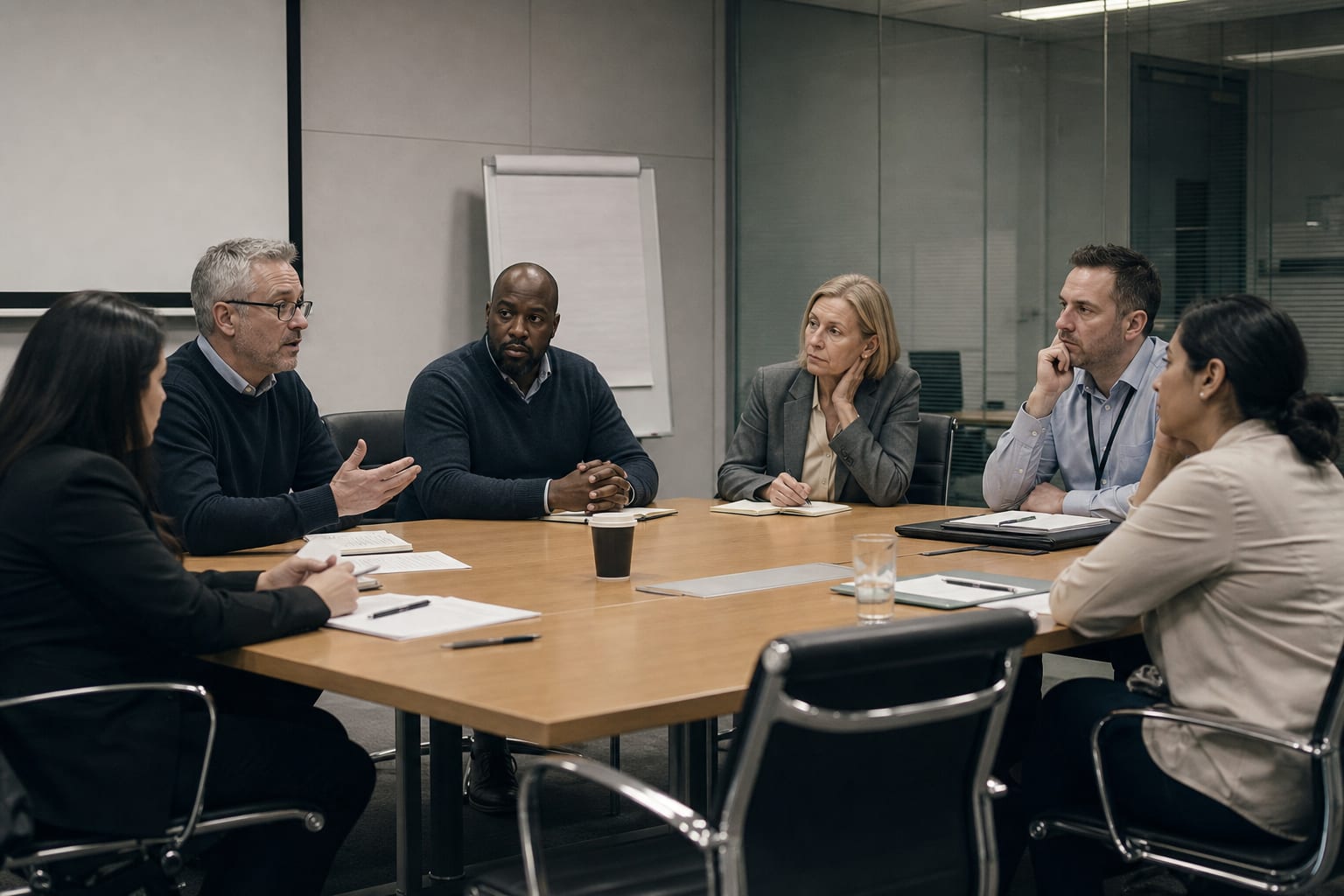
Leadership training scenarios you can run this week
Eight meetings, not eight models. Each one has a script. Where we have a live 1-1 for a similar conversation, I have linked it. Team rooms still need a room — a pair exercise will not fake a silent colleague plus a laughing director.
Why most leadership programmes do not change the meeting
A typical leadership course is good at language. People leave able to say “psychological safety” and “hold people accountable.” Then they walk into a room where someone is angry, someone is quiet, and someone senior is watching. The language falls out of working memory. That is not a content problem. It is a rehearsal problem.
Baldwin and Ford’s transfer-of-training work is old and still right: what people do after a course depends on how close the practice was to the real task, and whether the workplace actually requires the new behaviour. A pair exercise with a helpful colleague is not close. A live room with conflicting incentives is.
So the rest of this page is not a catalogue of “role play situations.” It is a set of leadership role play scenarios you can run until the first collapse, then run again.
1. The first team meeting after a restructure
The announcements have been made. Some chairs are empty. This is the first team meeting. People want certainty you do not have. Some want you to badmouth the decision. Some will not speak at all.
We built this as a team simulation — several people in the room at once, not a polite 1-1 — because that is how the hour actually feels.
Awkward
Manager: “I know this is hard. I don’t have all the answers. Let’s try to stay positive and focus on the work.”
Senior team member: “Positive? We just lost Dev. Are more cuts coming?”
Manager: “I really can’t say. I’m as much in the dark as you. Anyway, stand-up updates?”
The room hears: do not ask real questions.
Skilled
Manager: “Some of our people are not here. I am not going to open with the roadmap. I can tell you what I know, what I do not know, and what I will not pretend. I do not know if there is another round. I will not invent a guarantee. I will tell you the same day I know. What I will do in this hour is hear what you need in order to work this week — workload, clients, and what we stop. Who wants to go first?”
Operations: “So you want us to pick up Dev’s book with no extra people.”
Manager: “I want us to name what we will drop. If we leave here with the same list and fewer people, that is on me. Priya, you have been quiet. I am coming to you next. You do not have to be okay.”
The team version lives in our leadership programmes as a multi-person room. If you are building a programme, start from leadership development.
2. Delivering an unpopular decision you disagree with
The travel budget is cut. You argued against it. You still have to tell the team. If you side with them against “the business,” you are not leading. You are campaigning.
Awkward
Manager: “So… bad news, and for what it’s worth I think it’s a terrible decision. They want us to freeze conference travel. I did what I could.”
Team: “Can you go back again?”
Manager: “I mean, I can try, but you know what they’re like.”
Skilled
Manager: “Conference travel is frozen for this half. I argued against that in the room. I lost. I am not going to run a second campaign with you against the people I work for. I will tell you how we will still get development this half, and I will take one question on the decision. Then we will plan. If you want me to take a specific case — a talk that is already accepted — give me the artefact and I will ask once, cleanly.”
What to notice: you can name your disagreement once. Then you own the decision you are paid to implement.
3. Intervening when banter goes too far
Mid-meeting, a senior person makes a sexualised joke about a colleague who is not in the room. Two people laugh. One goes still. The agenda tries to move on. This is the moment most “respect” modules never reach.
In our library this is the active-bystander team scenario. It is also the conversation the Worker Protection Act will test — not whether you had a policy, but whether anyone can speak in the room.
Awkward
Senior director: “Come on, it was just banter. Don’t make this a thing.”
You: “Haha, yeah, anyway — slide six?”
(The junior analyst does not speak for the rest of the meeting.)
Skilled
You: “Stop for a second. That comment is not how we talk about colleagues, in the room or out of it. We are going to finish the agenda without it. I will pick this up with you after. If anyone wants to talk to me or to HR about what just happened, you can. We are not going to laugh it off and move on.”
Senior director: “It was a joke. You’re being very HR.”
You: “I am being the person running this meeting. The joke is done. Slide six.”
You do not need a perfect line. You need a line that exists. Practise it until you can say it while a senior person is looking at you.
Practise a related disclosure conversation
4. Visible conflict between two reports
Alex and Jordan talk across each other in the weekly. Everyone else watches you. If you take it offline every time, the room learns that conflict is unmanageable. If you referee the content, you become the third combatant.
Awkward
Alex: “Jordan keeps changing the scope.”
Jordan: “Alex doesn’t read the tickets.”
You: “Okay, okay, let’s be kind. Maybe take this offline? You’re both great.”
Skilled
You: “Stop. We are not doing character. Alex, name the last scope change in one sentence. Jordan, name the ticket Alex missed. Then I will decide what we do this week. The rest of you, stay. This is how we will disagree in this team — on artefacts, in the room, without a vibe trial.”
5. Saying no to your own boss
They want the extra analysis by morning. Your team is already on a committed release. A leadership course will tell you to “manage up.” The scenario is the sentence in which you refuse.
Awkward
You: “We’ll do our best. It might be tight, but leave it with me.”
That is not a no. That is a future miss with your name on it.
Skilled
You: “No. Not if you still want the release on Thursday. You can have the analysis on Wednesday, or you can have a thinner release and the analysis tomorrow. I will not take both and hope. Which one do you want me to tell the team?”
Practise holding a request under pressure
6. Holding a line with a senior stakeholder
A VP wants an unredacted export “for the board” and mentions the CEO. Your job is the data, not the friendship.
Awkward
You: “I mean, I probably shouldn’t, but if it’s for the board… can you just not forward it?”
Skilled
You: “I can get you an aggregated pack today. I cannot send an unredacted export on a Slack ask, including to you. If the CEO wants that, it goes through the access process and I will help you start it now. I am not going to be the person who skipped it.”
This is a compliance conversation dressed as leadership. Treat it that way. See how we talk about evidence if you need the audit version.
7. First team meeting as the new manager
You inherited the team. Someone in it applied for your job. Someone else has been “acting” for six months. The room is testing whether you will pretend none of that is true.
Awkward
You: “I’m not here to change anything. I just want to listen and learn. Think of me as a player-coach.”
They hear: there is no adult here yet.
Skilled
You: “I know at least one person in this room wanted this seat. I am not going to pretend that is not in the air. I will meet each of you this week. In this hour I will tell you what I will not change in the first month, and the one thing I will. I am not a player-coach. I am the manager. That includes the person who was acting — I will say thank you to them by name, and I will still be the one who decides.”
Practise a related career conversation
8. “One more thing before you go”
The meeting is over. Hands are on laptops. A senior person says, lightly, “One more thing before you go” — a new piece of work, a political ask, a name they want you to “keep an eye on.” The skill is not rudeness. It is not letting a corridor request become a commitment the room never heard.
This is one of the scenarios we built because it is how work actually moves, and almost no leadership agenda includes it.
Awkward
Stakeholder: “One more thing before you go — can you just get your team to look at the Dublin numbers tonight? Keep it quiet for now.”
You: “Yeah, of course. I’ll have a poke around.”
Skilled
Stakeholder: “One more thing before you go — Dublin numbers tonight? Keep it quiet.”
You: “If it is a real ask, it is not a doorway ask. I will not give you a quiet tonight. Tell me in one sentence what decision it is for, and I will tell you tomorrow morning whether we can do it without dropping Thursday. I will not ‘have a poke’ at something you want kept quiet.”
Practise holding an after-the-bell ask
How to run these in a workshop vs practise them in simulation
Workshop. Use one scenario, not eight. Brief the “other side” in writing: you are angry / you are silent / you are senior and mildly contemptuous. Three minutes. Stop at the first collapse. Replay only that minute. Do not let the group turn it into a debate about “what I would have said.”
Simulation. Put the same person in the same scenario twice in a week. The second time, change the mood. That is how you stop people memorising a script. Team scenarios — the redundancy meeting, the banter intervention — need more than one avatar in the room. That is why we built team mode, and why a pair exercise cannot fake a silent colleague plus a laughing director at the same time.
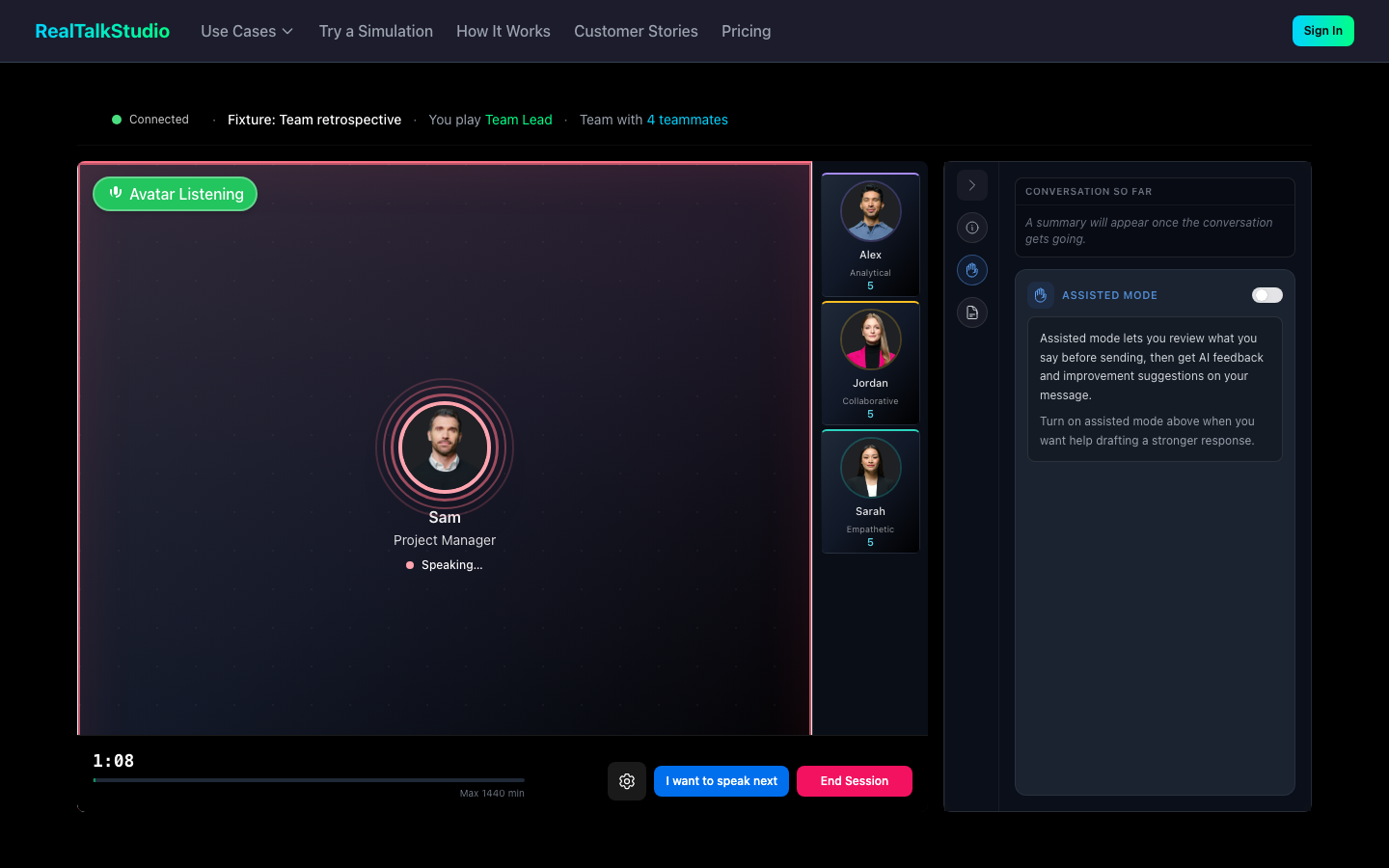
Team mode — the silent colleague and the person who talks over them are in the same room.
If you want the wider catalogue, use the workplace roleplay library. If the programme is really about 1-1s, use the coaching scenarios for managers. If it is about the words in the feedback itself, use the feedback role play scenarios.
Add team practice to a leadership programme
FAQ
Frequently asked questions
01What are leadership training scenarios?
They are practice meetings and conversations — restructures, unpopular decisions, conflict, saying no — designed so a leader rehearses the live moment, not the slide that describes it.
02How is a leadership role play scenario different from a case study?
A case study you discuss. A role play you have to speak in. If nobody’s heart rate changes, you ran a case study and called it practice.
03Can I run these as management training scenarios without AI?
Yes. Use short timed rounds and unhelpful briefs. The limit is dignity and availability: you cannot keep asking the same colleague to play the devastated report or the harassing director.
04Which leadership scenarios should I start with?
Start with the meeting your people actually have next month. For most UK programmes in 2026 that is either the post-restructure room or the banter intervention — not a generic “difficult conversation.”
05Do role play situations transfer to real meetings?
They transfer when the practice includes pushback and the workplace expects the behaviour. They do not transfer when the only practice is a friendly pair exercise at the end of a course.
Practise the live version on the Real Talk Studio platform— scored attempts against characters that push back, not a script on a slide.