Commercial
Synthesia Roleplay Sessions Review: HR & Manager Practice?

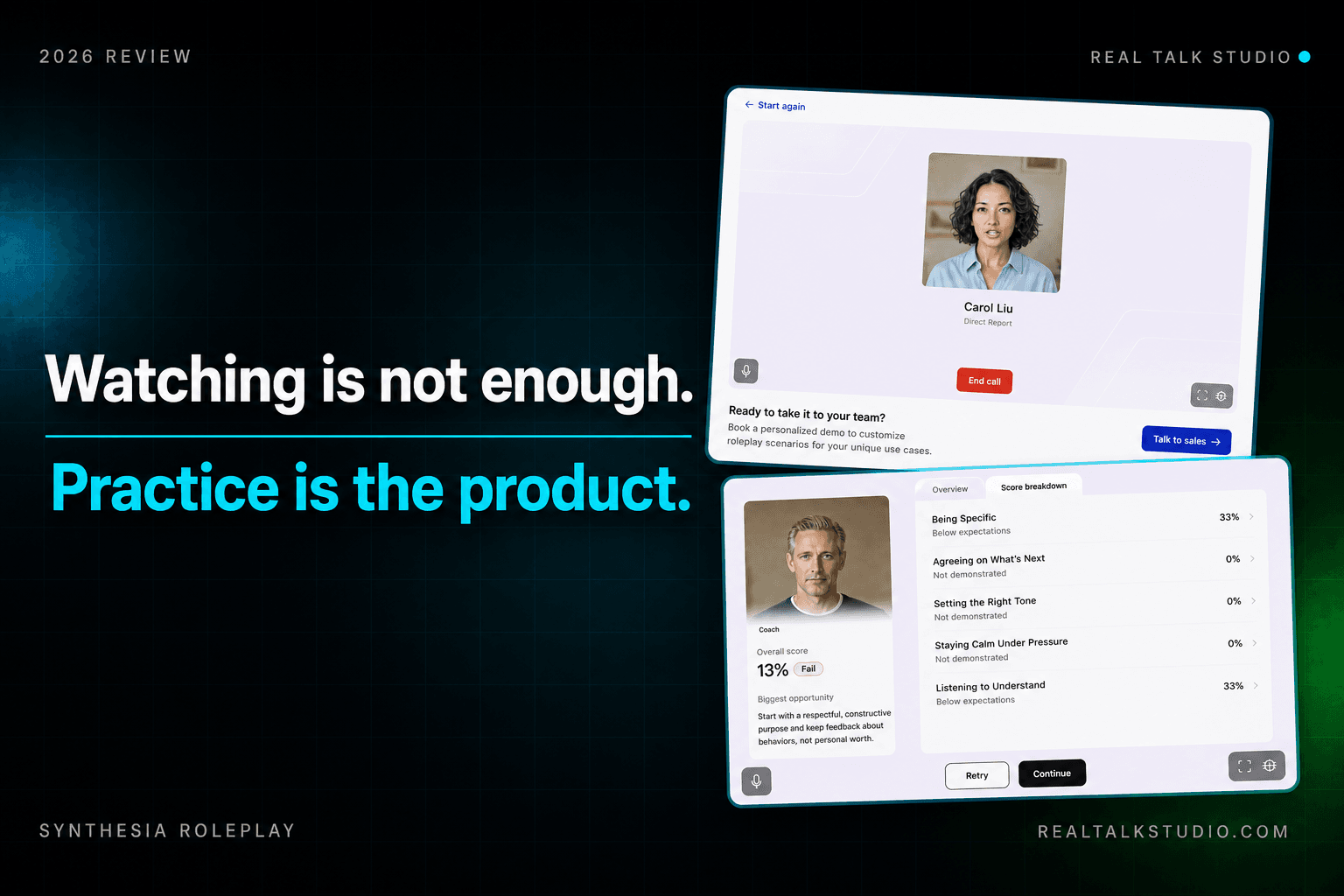
Synthesia Roleplay Sessions is a credible first version of live avatar practice, not a finished HR or manager-training platform. Stay if you already make video in Synthesia and want a 1-1 roleplay bolted onto the course. Compare specialists if the job is customer-support go-live, a hard manager 1-1, or a team room.
Real Talk Studio sits on the specialist side of that split: scored workplace conversations, including contact-centre and manager practice, not video production.
Updated September 2026.
I founded Real Talk Studio. We have been building AI conversation practice since 2024, so read this with that in mind. The product facts below come from Synthesia's own pages, the launch coverage, and time spent inside their public demo, deliberately trying to break it. It scored me 13 per cent and failed me, which was fair. What the character did while I earned that score is the most useful finding in this article.
What Roleplay Sessions is
Roleplay Sessions is a live practice conversation with one of Synthesia's Interactive Avatars. A learner opens an assigned scenario, talks to the avatar, gets pushed back on, and is then scored against a skills rubric. An AI coach walks through the attempt afterwards. Managers get analytics: pass rates, per-skill scores, improvement across attempts, exportable to the LMS via SCORM.
The launch templates are cold call, discovery call, field sales, customer conversation, and manager feedback. You can build custom scenarios inside Synthesia Studio, the same editor their video customers already use. It is the first product in a broader platform they are calling Sessions, with job interviews and candidate screening reported as next.
The strategic read, which TechCrunch made explicitly, is that Synthesia is moving from generating training content to proving that training worked. That is the right instinct. It is the same instinct our whole company is built on.
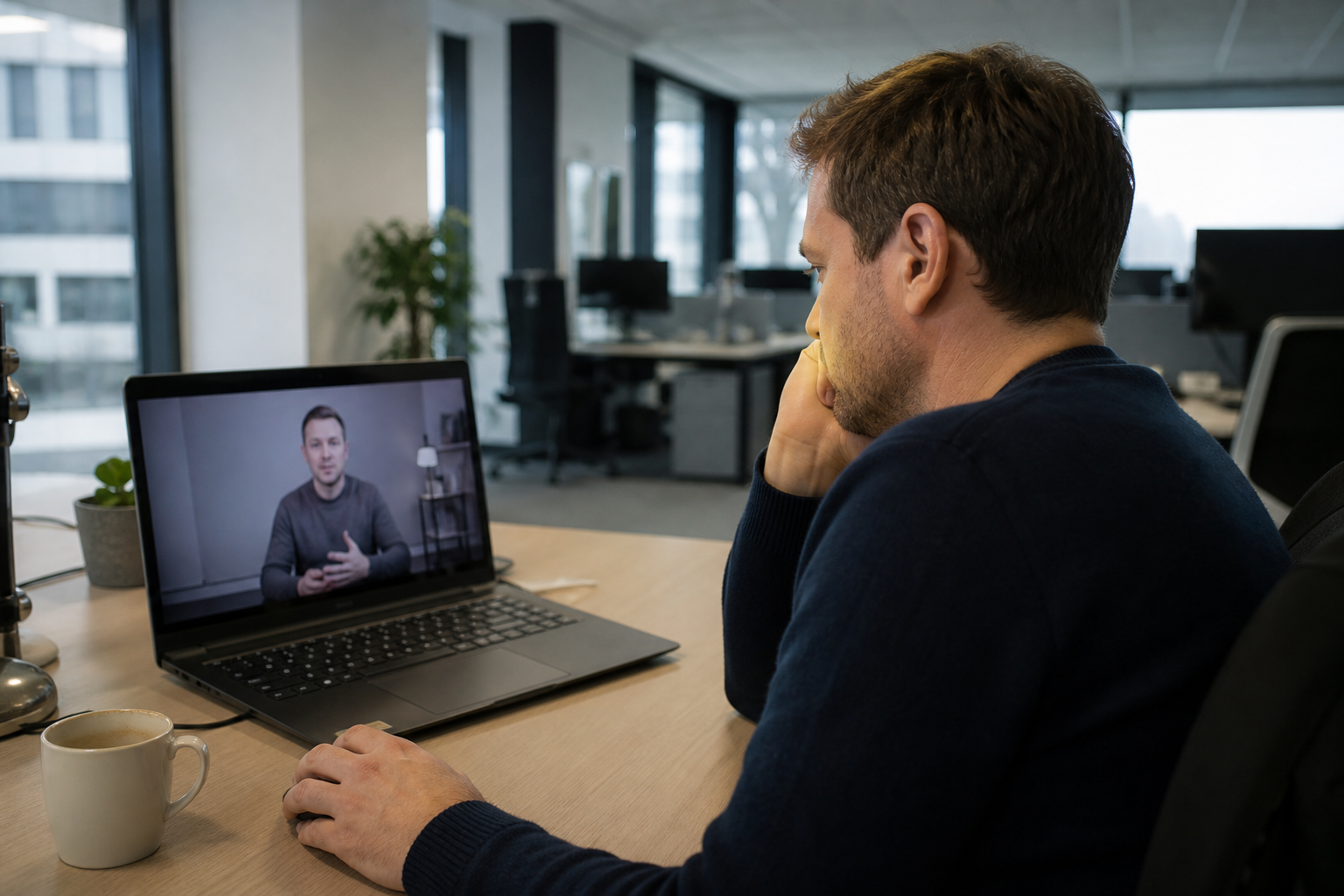
One learner, one face on a screen. That is the shape they launched.
What Synthesia is good at
Credit where it is due, because a lot of it is due.
Synthesia is the most successful AI video company in the world. Over 50,000 companies, a hundred million dollars in annual revenue, logos like SAP, Merck, and Heineken. Their avatars are proprietary and their production quality is the benchmark everyone else gets measured against. If your brief is "turn this policy document into a training video in 40 languages by Friday", nobody does that job better.
The enterprise wrapper on Roleplay Sessions is also real: SOC 2 Type II, ISO 27001, 27701 and 42001, GDPR with EU data residency, SSO and SCIM. Their security page will sail through your procurement team. ISO 42001, the AI management standard, is still held by a small number of companies worldwide. We are one of them, so consider this the rare compliment paid across a certification both sides had to earn.
And they have distribution most practice specialists would give an arm for. Rolling practice out to a workforce that already logs into Synthesia for video is a shorter conversation than introducing a new vendor.
I tried the demo. Here is what happened
Their feature page has a public demo, the Coaching Check-in: you play a manager giving feedback to a direct report called Carol Liu. I ran it the way I test every practice tool, including ours. I played the worst learner in your organisation. I wandered off topic, repeatedly. I got personal instead of specific. I did the things real people do when a conversation gets uncomfortable.
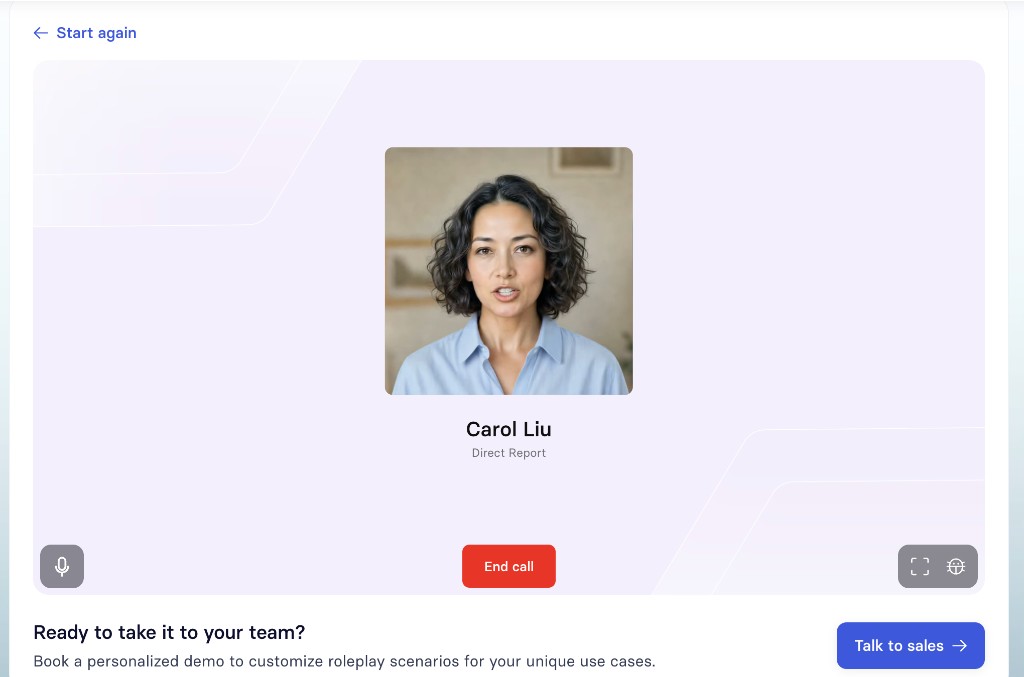
Carol Liu, Direct Report. The avatar looks excellent. The conversation did not.
What worked
The avatar looks excellent and the speech is natural, which is what you would expect from the best avatar company in the world. There is a Retry button sitting right next to Continue, which tells me the designers understand where the value lives. And when the conversation ends, a coach avatar debriefs you on your attempt before you see the score. Talking through your performance beats reading about it, and I can vouch for that design choice because we recently shipped the same thing.
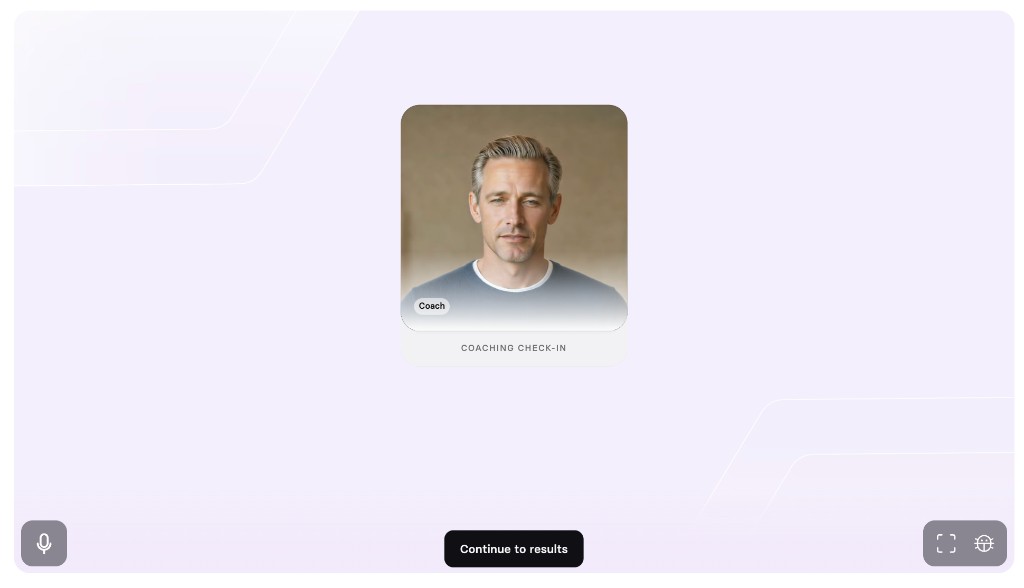
A coach walks you through the attempt before the score. That design choice is the right one.
What did not
Carol did not react to any of it. I went off topic again and again and she carried on, pleasant and composed, as if the conversation were going fine. She did not challenge me, did not push back on the drift, and did not end the call, which is what an actual direct report does, one way or another, when their manager makes it personal. The system scored me 13 per cent and stamped it Fail, which was the correct verdict. But the verdict arrived afterwards, as a report. Inside the conversation there were no consequences at all. The character and the scoring engine were watching two different meetings.
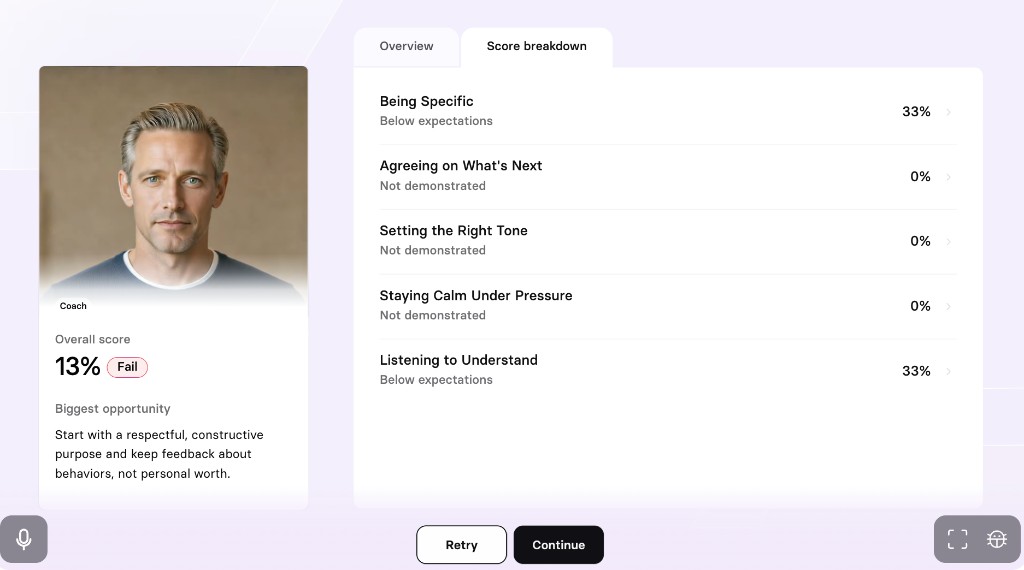
13 per cent, Fail. Correct verdict. It arrived after the conversation had already stayed polite.
The feedback itself was thinner than the polish suggests. The rubric criteria are well chosen: being specific, setting the right tone, staying calm under pressure, agreeing on what happens next. But the output was two bullets on what worked, two on what to try, and a set of percentages that mostly read as demonstrated or not. My conversation was a 13 per cent disaster with a lot to say about it. The coach said a paragraph.
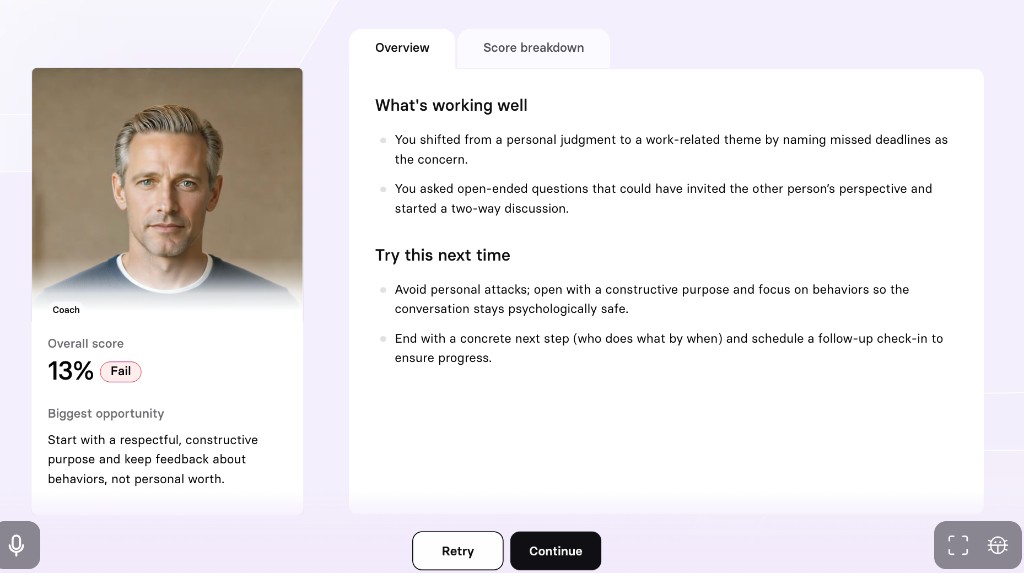
Two bullets each way. Retry sits next to Continue, which is the one thing I would keep.
And the conversation felt flat. The replies were generic, the exchange stunted, closer to a scripted branching exercise with a face than to the awkward, overlapping, half-finished way people talk when a conversation matters.
The whole category has a perfection problem, and Synthesia's avatars are the most perfect of all. Real difficult conversations are messy. People interrupt, trail off, contradict themselves, lose their thread when they get emotional. That mess is precisely what learners freeze on in the real meeting, so we engineer it in deliberately: characters that interrupt, clip their sentences, get confused, lose composure under pressure. A flawlessly composed avatar is rehearsal for a conversation that never happens.
One design note in fairness: the avatar renders quite small on screen, and my guess is that is a deliberate fidelity trade, since a smaller window invites less uncanny-valley scrutiny. Sensible. It also quietly concedes that even the best avatars in the business are not ready for a close-up, which supports a view I have held for a while: the avatar is the least important part of a practice tool. The behaviour is the product.
The caveat
This was one public demo scenario, stress-tested on purpose, and enterprise builds with custom scenarios may go deeper. But a public demo is a product's best foot forward, and this one showed me a beautiful face on a conversation engine that is not yet listening.
Where the product sits today
Roleplay Sessions in August 2026 looks like the conversation practice market looked roughly eighteen months ago. That is not an insult. It is what version one of a hard product looks like, and everyone in this category shipped a version like it. If you are evaluating, here is what the specialists have moved on to.
It is 1-1 only. One learner, one avatar. The practice market has moved to team scenarios: a manager running their first meeting after a redundancy announcement while four characters react differently, a witness in front of a four-politician select committee, a rep handling a buying committee. Most difficult conversations at work are not duets. We shipped team mode this year for exactly that reason, with characters that interrupt, challenge, and talk over each other, and we were not the only ones. You can watch one run rather than take my word for it.

A redundancy meeting, a buying committee, a select committee: the room is the point.
Practice runs in four languages. English, German, Spanish, and French. The videos around the practice support 160+ languages, which tells you the constraint is the live conversation engine, not the content. For a global rollout, check the languages your frontline speaks before the demo, not after.
The characters hold their shape. As the demo above showed, the avatars respond and push back politely, but nothing the learner does changes their state. No losing composure, no getting flustered, no ending the call because trust broke. Pressure is where practice earns its keep. A prospect who always stays professionally sceptical is a kinder prospect than the ones your team meets.
Feedback arrives at the end. Score, coach, debrief. Useful. The next step the market took is feedback in the moment, mid-conversation, while the learner can still change course. Think of the difference between a driving instructor who talks to you at the lights and one who posts you a report.
The free cap is not a pilot. Self-serve learner seats can be bought on a card, no sales call, no contract. The public demo still asks for a business email, and Enterprise Studio customers still talk to sales. What you cannot do is meaningfully trial on the free allowance: 10 plays a month on Basic/Starter/Creator, 25 for an entire Enterprise organisation. That is a taste, not a trial.
None of these are permanent. Synthesia ships fast and has $200 million of fresh Series E money to spend. But you buy the product that exists, not the roadmap, and the product that exists is a solid first release into a category where first releases happened in 2024.
The pricing question
They have now published a price. The short version: you are roughly a third of Synthesia's per-head cost, but they win on entry friction and on heavy users.
Synthesia's model, from their session caps and plan comparison:
- Free tier on every Studio plan: 10 plays a month on Basic, Starter, and Creator; 25 a month for an entire Enterprise organisation. No learner portal, analytics, or assignment on that free allowance.
- Learner seats at $29 a month, or $25 a month billed annually, with unlimited sessions per seated learner, plus a learner portal and analytics. Up to 100 seats self-serve, bought on a card with no contract.
- Custom (sales-led) above 100 seats, or for any Enterprise Studio customer: SSO/SAML, SCIM/HRIS sync, a CSM, and volume pricing.
- A separate product, the Interactive Avatar API, is billed at 10 credits a minute ($0.10/min) if you are building your own wrapper rather than using Roleplay Sessions.
Ours, on the pricing page: Starter is £1,200 per package (15 employees, about £40.20 each, about an hour of practice, 90 days). Enterprise starts at £20,000 a year, about £80.40 per employee assuming a two-hour average. Priced on practice hours, with no per-seat caps.
How it nets out, at about $1.30 to the pound, so a Synthesia annual seat is about £230 a year:
- 01
Break-even is about 5.5 hours a year
Below that per employee, we are cheaper. Above it, their flat seat is. A small group of very heavy users — a sales team drilling daily — is where their unlimited story beats us.
- 02
Their free cap is not a pilot
Twenty-five plays a month across a whole enterprise organisation, shared across every workspace, means an existing Synthesia customer cannot meaningfully trial roleplay without buying seats. Our Starter package is a real pilot. Their free tier is not.
- 03
They own the bottom of the market
One seat by credit card with no contract is a much lower bar than £1,200. For most of the buyers we work with that is the wrong customer. It is also where "why not just use Synthesia?" will come from in L&D teams that already have Studio licences.
Live roleplay and video have opposite economics, which is why the prices look like this. You render a video once and it plays ten thousand times for nearly nothing. Every minute of practice is a live avatar, live speech, and live reasoning. There is no rendering once. Synthesia's two answers: Roleplay Sessions sells a seat (unlimited plays, their compute problem once paid); the Interactive Avatar API sells minutes at $0.10. We sell pooled practice hours. You can disagree with the rate. You can at least find it.
Which tool for which job
Start here. The wide table underneath is the detail.
When Synthesia is the right buy
Stay with Synthesia
- Use it when
- You already make training video in Studio, the launch templates match the job, you want the same faces in the video and the roleplay, or you have a handful of heavy users and a credit card.
- It fails when
- Practice is the product, you need a team room, a fifth language, or a file a lawyer would recognise as evidence.
Compare a specialist
- Use it when
- The conversation is the thing you are buying: hard 1-1s, a room of people, repetition, and a record of what happened under pressure.
- It fails when
- You mostly needed video. We do not make videos. Buy Synthesia for that, not a conversation tool.
Those are real conditions and plenty of buyers meet them. This page exists for the ones who do not, and who searched "Synthesia roleplay" assuming the biggest name must be the furthest ahead.
What the analytics are for
One more difference worth naming, because it decides who each product is for.
Synthesia's analytics answer a performance question: who is ready to sell, who needs another attempt, where the skill gaps sit. Their CEO has talked about mapping the talent in a company. That is a sales enablement and L&D lens, and for those buyers it is the right one.
UK buyers increasingly need the analytics to answer a harder question: can we show a regulator, a tribunal, or a board that our people were competent before the conversation went wrong? The Worker Protection Act's "all reasonable steps" duty and the FCA's non-financial misconduct rules both land in autumn 2026, and a completion certificate answers neither. What answers it is a dated record of a person handling the situation under pressure, scored, exportable, and attributable to them.
That is the job we built for. When OVO Energy's Director of Customer Service described what she wanted from us, her phrase was evidence she could take to the board, not a completion certificate.
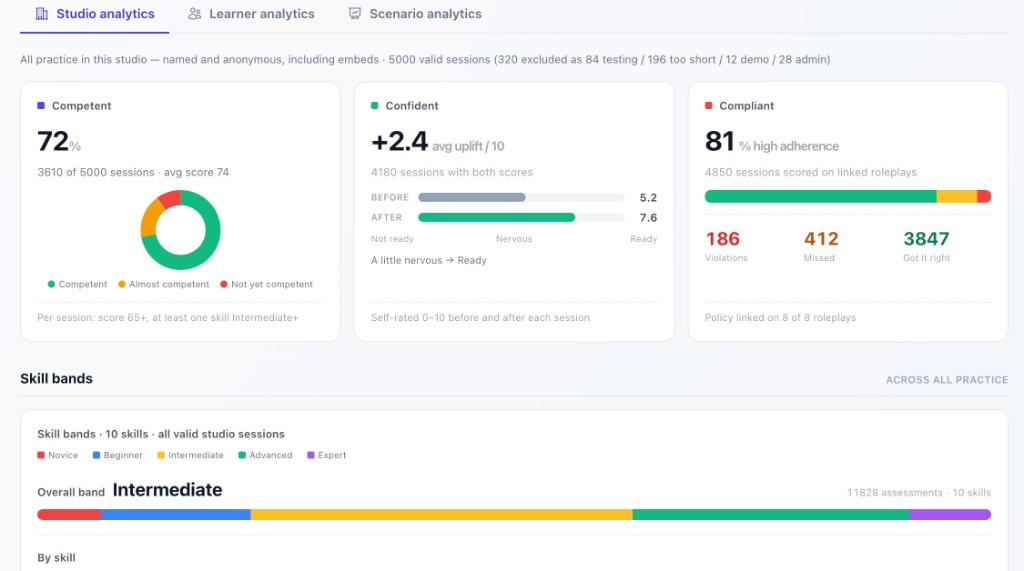
Competence, confidence, compliance — the board artefact, not a completion rate.
If your driver for buying practice is conduct risk rather than quota attainment, ask every vendor on this page, us included, to show you the artefact their analytics produce and whether your legal team would recognise it as evidence.
The mental model problem
Now the provocative part, and it is aimed at buyers, not at Synthesia.
Read the Roleplay Sessions page carefully and there is a quiet admission running through it. The "before" column describes training that people watch and forget. That "before" is a fair description of a lot of corporate video training — including, awkwardly, the product Synthesia built its first hundred million dollars on. When the category leader in passive content starts selling active practice, the argument about whether practice matters is over. The remaining argument is who does it best, and whether you will buy it as practice or as a fancier quiz.
Most organisations bought Synthesia to save money. That was the pitch and it was true: videos in minutes instead of weeks, no crews, no studios, no reshoots when the policy changes. Less time, less cost, same training. Efficiency was the product.
Roleplay is the opposite purchase. It costs more per learner, not less. It takes employee time instead of saving it. Nobody can run a roleplay at 1.5x speed while clearing their inbox. If you buy Roleplay Sessions with the video mental model still in your head, you will do the obvious thing: bolt one roleplay onto the end of the course, ask each learner to complete it once, and report the completion.
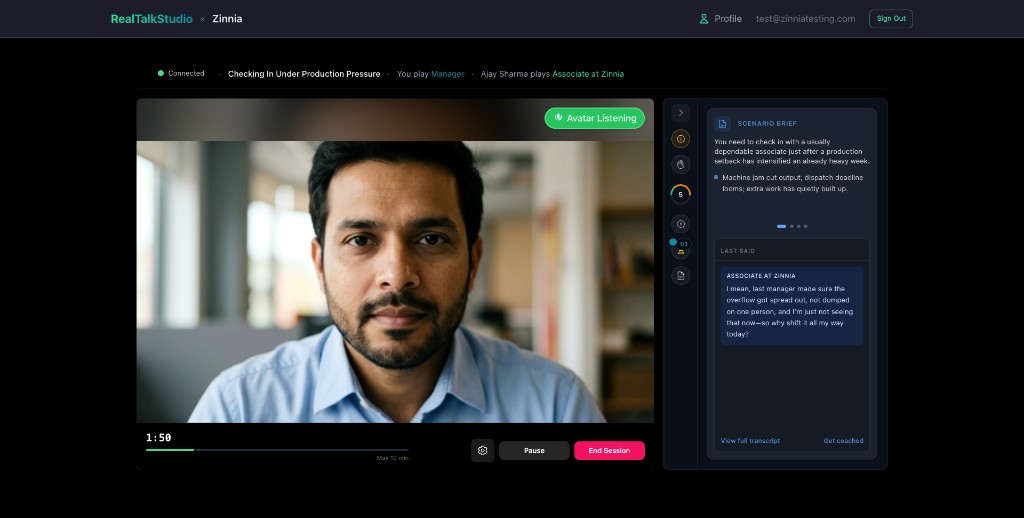
A live session, not a module. The next attempt is the point.
That version has no return on investment. It is a quiz with better production values. You have paid live-avatar prices for the same artefact the LMS already gave you, and one attempt under no pressure tells you very little about what the person will do on the real call. The uncomfortable truth underneath is one we have written about before: nobody practises, because most organisations have never set a bar of conversational performance high enough to require rehearsal. Adequacy does not need reps. Buying an avatar does not change the bar.
Practice pays back through repetition or not at all. Rep one is finding your feet. The skill shows up on reps two, three, and four, which is the number a classroom roleplay never reaches because the facilitator has to move on. It is why our platform puts no cap on practice volume, and why learners across our client base average around four hours of practice each, not four minutes.
The research name for this is deliberate practice: focused repetition with feedback, at the edge of your current ability, sustained over time. It is how surgeons, pilots, and athletes get good, and it is the design principle behind the tools in this category that work. Yoodli deserves credit here: their whole product is built for habitual use, low friction, come back tomorrow. Ours is built the same way, with pooled hours so the marginal rep costs a team nothing.
So the question to put to Synthesia is not "can learners retry?" Their copy says yes, as often as they want, with improvement tracked across attempts. For a seated learner that is now commercially true: extra reps do not cost extra, which is a genuine strength of the seat model for heavy users. The remaining pull toward one-and-done is the product design, not the invoice. The roleplay is built inside the training video the team already watches, which anchors it to the course. It is delivered through SCORM into the LMS, which is the natural habitat of the completion. On the free allowance the opposite is true: extra plays are blocked. Deliberate practice needs the next rep to feel free. A seat does that. A 25-play organisation cap does not.
Which surfaces the real question, and it is the one we would ask any L&D leader before they take the Synthesia sales call or ours: will you give your people the time? We have watched deployments stall for exactly one reason, and it was never the avatar. No practice time in the diary, no workflow to embed it in, usage dies by week six. A tool that needs repetition, bought by an organisation that will not fund repetition, fails at any price.
So the most interesting test of this launch sits with Synthesia's installed base: tens of thousands of companies that came for cost saving, now being asked to fund more time, more cost, and more reps. If they make that shift, the whole category wins, us included. If they treat roleplay as a fancier final quiz, the analytics will show a thousand single attempts, no uplift, and an invoice that is hard to defend at renewal.
How to evaluate without a twelve-week theatre
Same advice we gave in the Attensi comparison, because it holds:
- Give every vendor the same three job moments. One boring-operational, one hard conversation, one team room. Watch what happens to the vendors on the third one.
- Put a real learner in front of it without a host. If the demo needs a ceremony, adoption will die in week six.
- Ask what happens when the learner is rude, evasive, or upset. A character that stays serene is not practice, it is theatre.
- Price year two at real practice volume, per learner, fully loaded. If the vendor cannot put that number in writing, budget for the surprise.
- Before any of it, answer the question that sinks these deployments: how many reps per learner, and where in the working week does that time come from? If the answer is "one, after the course", save everyone's money, including yours.
- Ask for the artefact: a dated, exportable record of an attempt that a lawyer, an auditor, or a board would recognise as evidence.
FAQ
Frequently asked questions
01Can Synthesia run customer support roleplay to train agents before they go live?
A first customer-conversation template exists, so a support scene is possible. It is one learner and one avatar, in four languages, with no team room. If the job is training agents on angry, billing, vulnerable, or cancellation calls before they take live volume, a specialist with those queues — including Real Talk Studio — is the better comparison than a video platform's first roleplay product.
02What is Synthesia Roleplay Sessions?
A live 1-1 practice conversation with a Synthesia Interactive Avatar, scored against a skills rubric, with AI coaching and manager analytics. Launched July 2026 as the first product in Synthesia's Sessions platform.
03How much does Synthesia Roleplay Sessions cost?
Learner seats are $29 a month, or $25 a month billed annually, with unlimited plays per seated learner, up to 100 seats self-serve. Every Studio plan also includes a free cap: 10 plays a month on Basic, Starter, and Creator, or 25 a month for an entire Enterprise organisation. Above 100 seats, or on Enterprise Studio, pricing is sales-led. The Interactive Avatar API, a separate product, is $0.10 a minute.
04Does Synthesia Roleplay Sessions support team practice?
No. It is one learner and one avatar. If you need multi-character practice, a meeting, a panel, a buying committee, look at tools built for team scenarios.
05What languages does Synthesia roleplay work in?
Practice runs in English, German, Spanish, and French. The surrounding video content supports 160+ languages.
06What are the best Synthesia Roleplay Sessions alternatives?
For hard 1-1 and team conversations with transparent pricing, Real Talk Studio. For presentation and speech coaching, Yoodli. For enterprise sales roleplay, Second Nature or Hyperbound. For video creation itself, stay with Synthesia.
07Do Synthesia Roleplay Sessions give a return on investment?
Not if you use them the way most organisations use training video: one roleplay at the end of a course, completed once per learner. That is a more expensive quiz. The return comes from repetition, learners practising a scenario several times and improving across attempts, which means allotting real employee time. Budget for the time, not just the licence.
08Can Synthesia Roleplay Sessions provide compliance evidence?
It produces scores, transcripts, and analytics, exportable via SCORM. Whether that satisfies a Worker Protection Act "all reasonable steps" review or an FCA conduct file is a question for your legal team. If audit-ready behavioural evidence is the reason you are buying, make it the first question in the demo, not the last.
09Synthesia vs Real Talk Studio, which is which?
Synthesia is a video company that now also does practice. We are a practice company that does not do video. There is overlap in the middle. They are not built for the same job.
Practise the live version on the Real Talk Studio platform— scored attempts against characters that push back, not a script on a slide.