Manager
Coaching Scenario Examples for Managers (Scripts)

The collapse is the third turn.
Awkward vs skilled. Read them aloud.
Coaching scenario examples for managers only work if you can hear the words. Below are ten conversations we run in simulation — plus three new-manager scenarios — each with the setup, why it is hard, the awkward version, the skilled version, and what to notice. Read them aloud. If you wince, that is the point.
Updated September 2026.
Most lists of coaching scenario examples stop at a paragraph of context. That is why they fail in a workshop. The discomfort lives in the second and third line, when the other person does not play along.

Coaching scenarios for managers: ten scripts
Each block below is one conversation. Same shape each time: the setup, why it is hard, then the two scripts side by side so you can see the third turn change.
01. Underperformance that has been left too long
Why it is hard. You are not opening a fresh problem. You are admitting you watched it drift. Sam will hear the delay as well as the feedback.
Sam has been in the role for 18 months. Turnaround times have slipped for a quarter. Two colleagues are quietly covering the gaps. You have mentioned “keeping an eye on the queue” in passing. You have not named the pattern.
Awkward version
Manager: “So, just a quick one — I think we need to tighten things up a bit on the cases. The team’s been pretty stretched.”
Sam: “Yeah, it’s been mental. I’ve been helping Priya with the overflow as well.”
Manager: “Totally, and I really appreciate that. Maybe just try to keep on top of your own list where you can?”
Sam: “I’ll do my best.”
Nothing was named. “Tighten things up” is not a coaching point. Sam left believing the problem is the workload, not the work.
Skilled version
Manager: “I want to talk about your case turnaround over the last quarter. Three of the last six reviews were late, and two had to be rewritten. I’m not opening this to tell you off. I want us to find what is getting in the way, and agree what will be different by the 30th.”
Sam: “The queue has been worse than usual. I’ve also been covering Priya.”
Manager: “Covering Priya is real, and it does not explain the two rewrites. Walk me through last Thursday’s Johnson file. Where did it slip?”
Sam: “...I started it the morning it was due. I thought I could get it through.”
Manager: “That is useful. So the issue is starting late, not just volume. What would make you open the next Johnson-type file two days earlier — and how will I see that without chasing?”
02. Coaching a high performer who is coasting
Why it is hard. You are coaching someone who can point at the dashboard and win. If you only praise the numbers, you train coasting. If you sound ungrateful, you sound like you are inventing a problem.
Jordan hits every target and has done for two years. The work is fine. It is also the same work. They have stopped volunteering for the messy projects. In the last 1-1 they said, “I’m just in a groove.”
Awkward version
Manager: “You’re doing great, as always. I just wonder if you might want to stretch yourself a bit more?”
Jordan: “Stretch how? My numbers are green.”
Manager: “Yeah, no, they are. I just don’t want you to get bored.”
Jordan: “I’m not bored. I’m efficient.”
Skilled version
Manager: “Your numbers are green. That is not why I booked this. In the last two quarters you have not picked up a cross-team piece, and you declined the pricing review. I need a senior on this team who still takes the ugly work, not only the work they can finish by Thursday.”
Jordan: “So I’m being punished for being reliable?”
Manager: “No. I am naming a different standard. Reliability is the floor for this role. The next level is the work that has no playbook. I want you on the pricing review. Tell me what would make that a yes, or tell me if you do not want that standard — because that is a career conversation, not a vibe.”
03. Coaching someone older and more experienced than you
Why it is hard. You will be tempted to over-explain your right to speak. Pat will test whether you believe the standard or are just performing management.
You are 34. Pat is 56, has been in the industry for 30 years, and was doing this job when you were in school. Their stakeholder updates are late and lightly sourced. The room has started talking around them.
Awkward version
Manager: “I really value everything you’ve brought to this team. I know you’ve seen a lot. I just thought maybe we could look at how the updates are landing?”
Pat: “I’ve been writing those updates since before this template existed.”
Manager: “Of course, and they’re full of wisdom. Perhaps a bit more data for the new execs?”
Pat: “If they want a spreadsheet they can ask.”
Skilled version
Manager: “I am going to be direct, and I am not asking you to become a different person. The last two steering updates arrived after the pack deadline, and neither had the conversion numbers Finance asked for. That is now a problem for the team, not a style preference.”
Pat: “I’ve been doing this longer than most of the people in that room have been employed.”
Manager: “I know. That is why I am talking to you rather than rewriting it myself. Experience is not the issue. The pack is. What would it take for Friday’s update to be on time and include the two numbers — and do you want my help getting the extract, or do you want to own it?”
04. The defensive reaction
Why it is hard. Your nervous system wants to restore warmth. That is how the coaching point disappears.
You raise one missed client call. Mei’s face closes. Within a minute you are in a tour of last year’s crisis, the other team’s faults, and whether you “have her back.”
Awkward version
Manager: “I wanted to mention Tuesday’s client call — I think we missed it.”
Mei: “I was covering the outage. No one else was. This feels like you’re looking for something to criticise.”
Manager: “No, no, you’re brilliant, I didn’t mean it like that. Forget I said it. You’re doing a great job.”
Skilled version
Manager: “Tuesday’s client call was missed. I want to understand what happened, and I want a plan so it does not happen on Thursday’s call.”
Mei: “I was covering the outage. This feels like you’re looking for something.”
Manager: “The outage is relevant. It does not close the point. I am not attacking you. I am staying with one missed call. Walk me through how you decided the client could wait — then we will decide what you do differently when two things land at once.”
05. Coaching upward
Why it is hard. People hear “coaching your boss” as career suicide. The skill is not confrontation. It is making the impact visible without a verdict on her character.
Your director, Helen, keeps adding “quick” requests in the last ten minutes of meetings. Your team is missing its own deadlines. You are not her manager. You still have to coach the behaviour, because you are the one who can see the cost.
Awkward version
You: “Sorry, this is probably me, but I wondered if we could maybe be a bit more careful with last-minute asks? The team’s finding it quite tricky.”
Helen: “If it was important it would have been in the pack. This is just how the exec team works.”
You: “Yeah, of course. We’ll make it work.”
Skilled version
You: “I need two minutes on the last-minute asks. In the last month, three of them landed after 4pm and each one pulled a person off a committed delivery. I can keep absorbing that, or we can pick: either the Friday pack includes a ‘possible extras’ list, or I will say no in the room when it blows a committed date. Which do you want me to do?”
Helen: “I need flexibility.”
You: “You can have flexibility if we name it. What I cannot do is pretend a 4pm extra is free. If you want the extra, tell me which committed piece moves. I will do that live, so you are not surprised later.”
06. The person who agrees to everything and changes nothing
Why it is hard. Agreement feels like progress. It is often a way to end the meeting.
Every 1-1 with Alex ends in nods. “Yep. Makes sense. I’ll sort it.” A month later the same slip is back. They are not arguing with you. They are disappearing you.
Awkward version
Manager: “So you’ll get the documentation up to date this week?”
Alex: “Yep. All over it.”
Manager: “Brilliant. I knew we were aligned.”
You were aligned on a sentence. Not on a behaviour.
Skilled version
Manager: “You said the same thing on the 3rd and the 17th. The docs are still on the old template. I am not asking whether you agree. I am asking what you will finish by Friday at 3, and how I will see it without asking you.”
Alex: “I’ll sort it. I know what good looks like.”
Manager: “Good. Then say the artefact. Which three pages, in which folder, by 3pm. If something will stop that, say it now — not on Friday afternoon.”
07. Coaching after a public miss
Why it is hard. The coaching is not “don’t be wrong.” It is how they recover, and whether they will bring a miss to you before the room does.
In the weekly review, a number was wrong. You corrected it in the room. Now you have the private conversation.
Awkward version
Manager: “Look, I didn’t mean to show you up in there. I was just protecting the team.”
Chris: “It felt like you didn’t trust me.”
Manager: “I do trust you. Let’s just be more careful next time.”
Skilled version
Manager: “I corrected the number in the room because the room was about to take a decision on it. That was the right call for the decision. It was clumsy for you. I should have asked you to walk the number first. I want two things from here: you bring a shaky number to me before the review, and I will not ambush you if I can take it offline. Deal?”
Chris: “I didn’t want to slow the meeting.”
Manager: “Slowing the meeting is cheaper than a wrong decision. Next Tuesday, if you are not sure, you say ‘I need to confirm this’ — even if I look impatient. I will back that.”
08. “You’re not ready for promotion” as coaching, not a verdict
Why it is hard. They will ask what the last year was for. A vague “keep doing what you’re doing” is how people start job hunting.
Priya expected the next-level role. The decision is no, this cycle. If you only deliver the no, you have a disappointed person. If you coach, you have a path — or an honest conversation that the path is not here.
Awkward version
Manager: “You’re so valued. The timing just isn’t quite right. Keep being you.”
Priya: “So what was the point of everything I did this year?”
Manager: “It all counts. You’re on the radar.”
Skilled version
Manager: “You are not being put forward this cycle. I am going to say that first. The gap is not effort. It is that the next role has to hold a stakeholder conflict without escalating it to me, and in the March pricing row I still had to come in. I want to coach you on that — specifically, two live conflicts this quarter where you lead and I stay out unless you call me.”
Priya: “So what was the point of this year?”
Manager: “This year got you into the conversation. It did not close the gap I just named. If you want the role next cycle, that is the work. If you do not want that work, we should talk about what you do want, because I will not keep you on a promise I cannot keep.”
09. Opening a PIP without pretending it is a chat
Why it is hard. PIP sounds like firing with extra steps. Sometimes it is the last honest chance. You have to hold both without lying.
The informal coaching has happened. The measures have not moved. You are opening a performance improvement plan. If you call it “support” and hide the word, they will not hear the stakes — and you will have a worse conversation later.
Awkward version
Manager: “I thought we could put a bit of structure around your development. Nothing to worry about.”
Employee: “Is this a PIP? Because that means I’m getting fired.”
Manager: “God, no, it’s just a plan. Forget the label.”
Skilled version
Manager: “This is a performance improvement plan. I am saying the words because I will not dress it up. It is a real chance with measures and dates, not a decision already made. The gaps are the same two I named on the 4th and the 18th: complete case notes on time, and no client complaint caused by a missed callback. We will review weekly. If the measures are met, the plan closes. If they are not, we move to the next step in the process. I will not pretend this is informal coaching.”
Employee: “So you’ve already decided.”
Manager: “I have decided the informal route has not worked. I have not decided the outcome of this plan. Tell me what support you need to hit those two measures — and tell me if you believe they are the wrong measures. I will hear that today. I will not relitigate it every Friday.”
10. A sensitive personal issue that is now a work issue
Why it is hard. You want to protect dignity and still be specific. Euphemism (“freshness,” “presence”) is how people leave confused and humiliated.
Colleagues have complained about body odour. The person is good at the job. You have delayed this for weeks because it feels cruel. Delay made it crueler. They will ask who said it.
Awkward version
Manager: “This is super awkward. Some people have mentioned… you know… just being a bit more aware of personal presentation?”
Employee: “What are you talking about? Who said that?”
Manager: “I really don’t want to get into names. Maybe just have a think about it?”
Skilled version
Manager: “I am going to be plain, and I am doing this in private because I respect you. Colleagues have noticed body odour, and it is affecting how people work with you. I am not asking who you are as a person. I am asking that we find a practical fix this week — and I will not run a trial about who said it.”
Employee: “Who said that? This is humiliating.”
Manager: “It is uncomfortable. I will not give you names, because that turns a practical issue into a hunt. If something medical or personal is in the way, you do not owe me the story. You can speak to HR or your GP. What I need from you is that we agree a next step today, and that I will check in next week — not in the open office.”
New-manager coaching scenario examples
New managers fail these three before they fail a PIP. The standard is the same: name the thing, keep it in the room, leave with a date.
11. New manager: the first 1-1 you have ever run
Why it is hard. You will over-explain that you are new. They will fill the silence with status. You will leave with a chat, not a coaching point.
You were promoted last month. Sam is waiting to see whether you will actually manage or just be a nicer scheduler. The Friday pack has been late twice.
Awkward version
Manager: “So, I’m still finding my feet in this seat. How are you? Anything I can help with?”
Sam: “Yeah, all good. Queue’s been mental.”
Manager: “Totally, same. Let’s just keep chatting like this each week.”
Skilled version
Manager: “I want this 1-1 to be useful, not a status dump. The Friday pack has been late twice. I need it in by noon without me chasing. What got in the way last week?”
Sam: “You’re new — I didn’t want to dump it on you.”
Manager: “Dumping it is the job. We will look at next Friday together. If noon will slip, you tell me on Thursday, not in the exec review.”
12. New manager: you now manage a former peer
Why it is hard. You will try to stay ‘one of the team.’ They will test whether the old joke still works when the standard does not.
Jordan used to sit next to you. You got the seat. They are still late on the handoff, and they are still using the old nickname in the standup.
Awkward version
Manager: “Mate, I hate doing this, but people have noticed the handoff. Can we just… keep it friendly?”
Jordan: “You’re the boss now, I guess. Didn’t think you’d go like that.”
Manager: “I’m not. Forget I said anything.”
Skilled version
Manager: “I am your manager now, and I still like working with you. The tracking schema missed again, and it landed on my review. I need an earlier flag — Thursday, not Friday night.”
Jordan: “So the promotion made you corporate.”
Manager: “The role made the handoff my problem. The friendship is not a reason to miss it. Can we check in Thursday before I lock the pack?”
13. New manager: you still want to do the work yourself
Why it is hard. You will ‘just quickly’ take the file back. They will stop trying. You will be busy and still have no team.
Priya is slower than you were in the seat. The QBR is Thursday. You can finish the pack tonight. If you do, you will still be finishing it in six months.
Awkward version
Manager: “Don’t worry — I’ll just knock the QBR together tonight. Easier than explaining it.”
Priya: “Okay. Thanks.”
Manager: “We’ll find you something smaller next time.”
Skilled version
Manager: “The QBR is still yours. I will sit with you for thirty minutes on the three numbers that usually get challenged. I will not take the deck home.”
Priya: “It will be better if you do it. You know what they ask.”
Manager: “Then I will tell you what they ask, and you will answer it in the room. We will review the draft tomorrow at ten. If a slide is wrong, we fix the slide. We do not move the owner.”
How to actually practise these (not just read them)
Reading a script is useful the way reading a match report is useful. It is not training.
The pattern I hear when people practise out loud is not a bad opening. People can write a decent opening at a desk. The collapse is the third turn — when the other person gets sharp, goes quiet, or agrees too fast. That is the moment a workshop pair usually laughs and resets. That is also the moment that shows up at work.
If you are running these as coaching role play scenarios in a room:
- 01
Give the “employee” a hidden instruction
Defend, agree and stall, or make it personal. Do not let them play a helpful colleague.
- 02
Run three minutes, not fifteen
Stop at the first collapse. Replay only that minute.
- 03
Do not grade warmth
Grade whether the original point is still in the room at the end.
- 04
Do not use humans for the hardest versions
A PIP, a promotion no, a hygiene conversation — practise those in simulation. Dignity is the constraint.
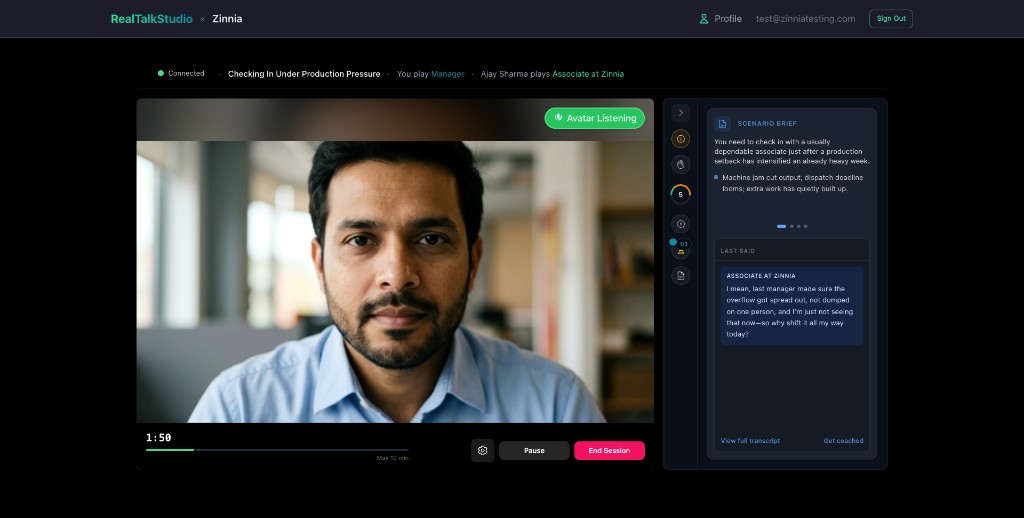
Real Talk Studio — a live coaching 1-1. The third turn is on the right, not in your head.
If you are practising alone, do not rehearse in your head on the drive in. Speak out loud against something that talks back. We built Real Talk Studio for that: a live character, a scored transcript, and another attempt while the wince is still useful.
Say What You Mean: Quick Feedback Chat
Most people soften the coaching point until the message disappears.
“Hi — you wanted a quick word?”
1-on-1 · ~5 min
The full workplace library sits behind these ten, plus the new-manager set.
Feedback role play scenarios
The drills inside a coaching conversation: praise, correction, and the ones that might become a grievance.
Leadership training scenarios
The meetings after a restructure, an unpopular decision, and conflict that the room can see.
50 workplace roleplay scenarios
The menu these ten sit inside. Pick three for the next four weeks, not all fifty.
How to start hard conversations
The opening line, before any of these scripts get a third turn.
FAQ
Frequently asked questions
01What are coaching scenarios for managers?
They are short, realistic conversations a manager can rehearse — underperformance, coasting, defensiveness, upward coaching — with enough dialogue that the discomfort is audible, not just described.
02How many coaching scenario examples do I need for a workshop?
Fewer than you think. Three well-run scenarios with a real pushback beat ten that people read off a card. Use this list to pick for your actual team, not to cover every theoretical case.
03Are coaching role play scenarios the same as feedback scenarios?
They overlap. Feedback is often one move inside a coaching conversation. Coaching adds the follow-through: the artefact, the date, and what you do when they agree and nothing changes. See the feedback role play scenarios if that is the skill you are teaching.
04How do I practise difficult coaching scenarios without embarrassing people?
Do not ask a colleague to play the devastated employee as entertainment. Use a simulation, or keep live roleplay short, specific, and stoppable. The dignity problem is real. That is why we do not use humans as crash-test dummies for the hardest versions.
05Can I use these scripts verbatim with my team?
Use them as a rehearsal, not as a play. The skilled versions are there so you can feel the difference. Your person will not say these lines. The point is that you can still hold the point when they do not.
Practise the live version on the Real Talk Studio platform— scored attempts against characters that push back, not a script on a slide.