Career
How to Roleplay with ChatGPT

Most people use ChatGPT like a smart assistant — a polite intern who never sleeps.
The real use is the opposite. Do not ask it to do the conversation for you. Ask it to be the other person while you practise being better at the conversation yourself.
Roleplay with ChatGPT is not playacting. It is rehearsal for a real room. It works when you give it a purpose, a constraint, and a debrief. It fails when you treat a helpful chatbot as a difficult human — and it fails harder when a whole organisation tries to run training on consumer ChatGPT.
Updated August 2026 for GPT-Live voice mode, with copy-ready prompts you can paste tonight.
How to roleplay with ChatGPT
Four moves. Do them in this order, every time.
- Name the skill, not the scene. “Sales call” is a setting. “Ask two open questions before I pitch” is a skill.
- Lock the other person. Role, history, what they want, what they will not give you for free.
- Add friction. Time pressure, distraction, a hidden objection, a mood. Polite ChatGPT is useless.
- Debrief on the skill. Step out of character and score the behaviour you named in step one.
That is the whole method: Purpose → Scene → Constraint → Debrief.
People do not improve by repeating conversations. They improve by getting a specific miss, then running the same scene again aimed at that miss. The science of rehearsal is not mysterious. The brain treats a vivid practice as close enough to the real event that the nervous system learns. Feedback is what turns the rehearsal into skill instead of theatre.
The copy-paste ChatGPT roleplay prompt
Paste this into a new chat. Fill the brackets. Then talk — do not type a script.
You are my roleplay partner, not my coach, until I say DEBRIEF.

PURPOSE
I am practising: [the skill — e.g. giving specific negative feedback without softening the message].
Success looks like: [one observable behaviour — e.g. I name the behaviour, the impact, and a dated next step].

SCENE
You are: [role, first name, one sentence of history].
I am: [my role].
The situation: [what just happened, what is at stake for you].

CONSTRAINTS
- Stay in character. Do not praise me. Do not give tips mid-scene.
- Be a real person: distracted, inconsistent, a bit self-protective.
- Do not collapse because I was polite. Make me earn the next beat.
- Push back on: [the specific resistance — e.g. you think the standard is unfair].
- Time pressure: [e.g. you have eight minutes / you are between meetings].
- If I go silent, wait. Do not rescue me with a question.

START
Open in character with one short line. Then wait for me.

When I type DEBRIEF, step out of character and score me only on the purpose above.
Three things this prompt does that “act as my customer” does not:
- It stops ChatGPT coaching you in the middle of the scene.
- It tells the other person how to be difficult, so they do not fold.
- It pre-commits the debrief to the skill you named, not to generic “that was great.”
If you only steal one thing from this page, steal that block.
Ready-made scenes (copy, then try the live version)
Use the master prompt, or start from one of these. After you have had a go in ChatGPT, run the same conversation with a face that talks back. That second attempt is usually the one that teaches you something.
Giving difficult feedback
You are Priya, a strong individual contributor. Two Thursday handovers have been late and the client noticed. You think the deadline was unrealistic and that I have been vague for weeks.

I am your manager. I am practising naming the specific behaviour, the impact, and a dated next step — without padding it with “you’re doing great overall.”

Stay in character. Be defensive, not theatrical. Do not agree just because I sound nice. If I stay vague, stay unconvinced. Open with: “Have you got two minutes? I saw the Slack.”
More setups: feedback role play scenarios and coaching scenarios for managers.
Asking for a pay rise
You are my manager. Budget is tight. You like my work and you are not allowed to invent money. I am practising asking for a specific number with evidence, then holding when you say the band is fixed.

Stay in character. Be warm and immovable. Ask what I would do if the answer is no. Do not volunteer a counter-offer unless I earn it. Open with: “I’ve got twelve minutes.”
Salary negotiation after an offer
You are the hiring manager. You have made a written offer. The band is “pretty much fixed.” I am practising naming a counter, citing market and value, and leaving with a written revision or a clear no.

Do not play the villain. Play someone who has a process. If I get fluffy, ask what number would make me walk. Stay in character until DEBRIEF.
Interview answers
You are a hiring manager who has heard a hundred polished answers. I am practising “tell me about yourself” in 90 seconds: present, past, future, one proof point, then a stop.

Interrupt if I ramble. Ask one sharp follow-up about what I did. Do not compliment my structure. Stay in character. Open with: “Whenever you’re ready — tell me about yourself.”
A conversation you should not practise on a colleague
You are an employee whose role is being removed. You are shocked and you will hear this as a verdict on you. I am practising leading with the business decision, separating you from the post, and not promising a job I do not have.

Be human. Ask the questions people actually ask. If I hide behind process language, push for what this means for you. Stay in character until DEBRIEF.
The full menu is on 50 workplace roleplay scenarios and the public practice library. ChatGPT is a good first draft of the scene. The live avatar is the attempt that feels like work.
ChatGPT voice mode in 2026 (GPT-Live)
Typing is tidy. Talking is true.
When you switch to voice, you stop scripting. Your pace, your hedges, the way you fill a silence — all of it shows up. That is the point. Text roleplay is a cognitive exercise. Voice roleplay is closer to the meeting.
In July 2026 OpenAI replaced the default Advanced Voice Mode with GPT-Live: a full-duplex voice system. It can listen while it speaks. It can backchannel (“mhmm”, “yeah”) while you are still talking. It can wait through a pause instead of treating every breath as the end of your turn. Paid plans get GPT-Live-1; free users get GPT-Live-1 mini. On paid, you can set intelligence to Instant, Medium, or High — Medium or High is the one to use for a hard conversation, because Instant will rush to be helpful.
Start it from the waveform icon on the right of the ChatGPT composer, on the web app or on iOS/Android. Advanced Voice Mode is still in settings if you need its older video and screen-sharing features. GPT-Live launched without those.
How to run a voice roleplay that does not collapse
Paste the master prompt in text first. Then switch to voice and say this:
We are roleplaying out loud. Until I say DEBRIEF:
- Stay in character. No coaching. No summaries.
- If I pause, wait. Do not fill the silence.
- If I interrupt you, yield.
- Be [busy / sceptical / upset]. Do not soften because I sound nervous.
Open with one line, then stop.
Then actually talk. Notice the things text hides: when your voice speeds up, when you sound defensive, when a silence is doing work.
What voice mode still cannot do
It is a better phone call. It is not a person in the room.
- There is still no face. No eye contact. No flicker of discomfort when you say the wrong thing.
- GPT-Live will still drift into coach mode unless you lock the role. Helpfulness is the default.
- The debrief is only as good as the prompt. Voice will not invent a rubric your organisation owns.
- A 30-minute voice chat is not a training record. There is no score your manager can see, no policy check, no second attempt waiting in a catalogue.
Use voice because it makes you honest. Do not confuse that feeling with a practice system.
The feedback loop (the bit everyone skips)
Most people play the scene and close the tab.
The gold is the debrief. After the roleplay, say DEBRIEF or paste this:
DEBRIEF. Step out of character.

Learning goal: [the skill I named at the start].

Do not say I did well unless a specific line earned it.

Give me:
1. The moment I earned trust or lost it — quote my words
2. How many open questions I asked versus statements I made
3. What you were thinking that I missed
4. One sentence I should say next time, worded as I should say it
5. A 1–10 on the learning goal, with the reason, not encouragement
Then run the same scene again. Change one behaviour. That is deliberate practice. Comparing this week to last week only works if the scene stays still:
Compare this attempt to the previous one in this chat. Was I more concise? Did I name the issue earlier? Quote the line that improved.
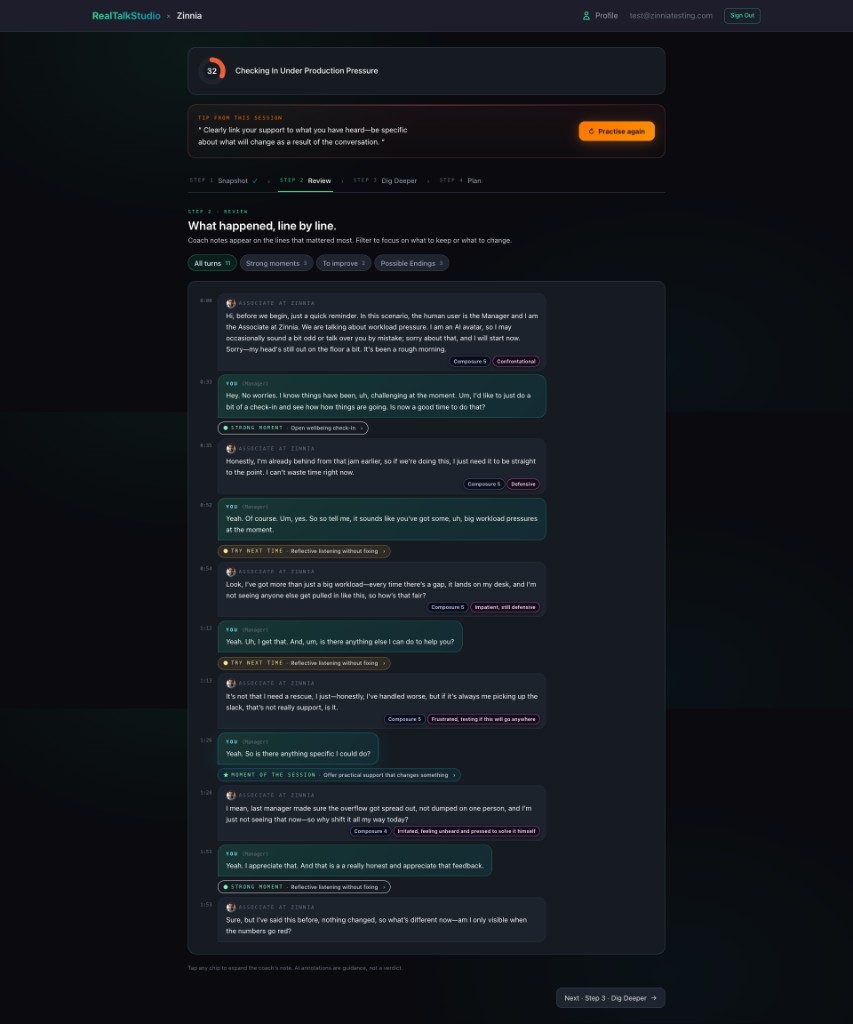
If you want the debrief written against a real transcript, with the exact turn marked, that is what a practice platform is for. ChatGPT can approximate it. It cannot produce the pack you would show a coach at 6pm.
Why ChatGPT roleplay fails at organisational scale
For one person, tonight, ChatGPT is an extraordinary rehearsal partner. For a team, a function, or an audit file, it is the wrong tool. Not because the model is “bad.” Because consumer ChatGPT is not a practice system.
This is the part L&D, HR, and enablement keep discovering the expensive way.
Everyone writes a different scene. Two hundred managers paste two hundred prompts. You do not have a standard. You have prompt drift. The person who needed the hardest conversation built the softest counterpart. There is no versioned scenario, no locked persona, no way to say “this is the conversation we expect.”
ChatGPT is too nice. It is trained to be helpful. In a roleplay that is a defect. Real counterparts do not collapse because you were polite. They stall, change the subject, agree and do nothing. Unless you fight the model with constraints, you are practising on a colleague who wants you to succeed. That is not the job.
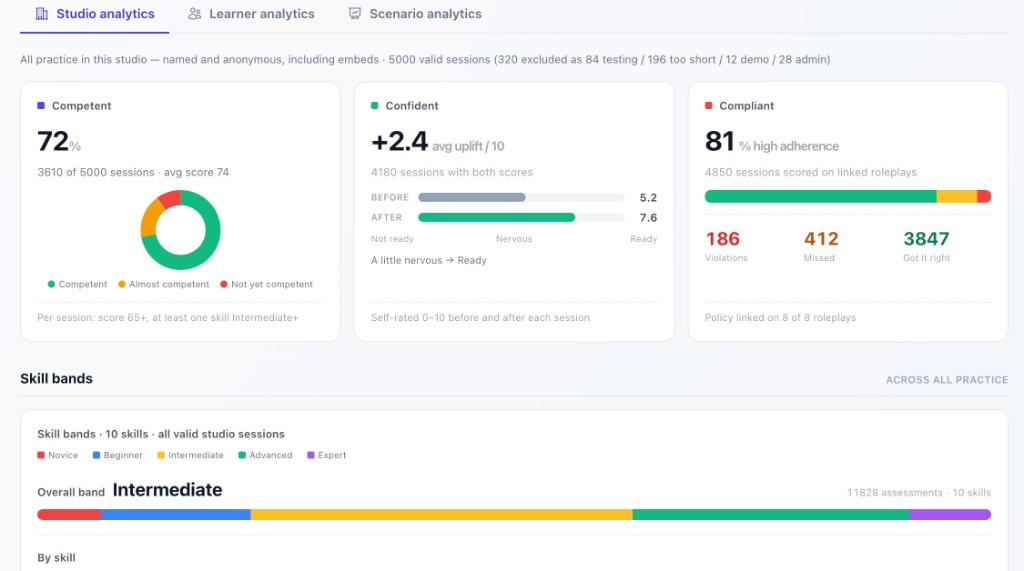
There is no evidence. A ChatGPT thread is not competence. There is no shared score, no skill band, no before-and-after, no record that the required line was said. Classroom training at least leaves attendance. Consumer ChatGPT leaves a chat history on someone’s phone. If you need competence, confidence, and compliance, you need a file.
People paste the real case. Performance notes, customer names, salary bands, a harassment disclosure. Into a consumer account, on a personal phone, under OpenAI’s consumer terms. Legal and security will not love the Slack message that starts “just use ChatGPT.” EU-hosted practice with a named processor is a different conversation. See security.
Nobody owns the second attempt. Skill needs another go while the miss is still warm, then another a week later. ChatGPT does not schedule that. It does not tell a manager who skipped it. It does not sit in the LMS. Nobody practises unless the system makes practice the default.
It will not survive a reasonable-steps question. If the conversation is a disclosure, a vulnerability, a dismissal, or a conduct intervention, “we told them to try ChatGPT” is not a training audit and it is not reasonable steps. You cannot show what was practised, by whom, against which policy, on which date.
Personal accounts are not a rollout. No SSO. No catalogue. No coach notes. No cohort view. No way to stop last quarter’s prompt being used after the policy changed.
ChatGPT is a brilliant individual gym. It is not a stadium, a referee, or a league table. Organisations that pretend otherwise get a burst of enthusiasm and nothing they can show a CFO — or a regulator.
When to leave ChatGPT
Text roleplay is a cognitive exercise. Voice adds heat. Neither gives you presence.
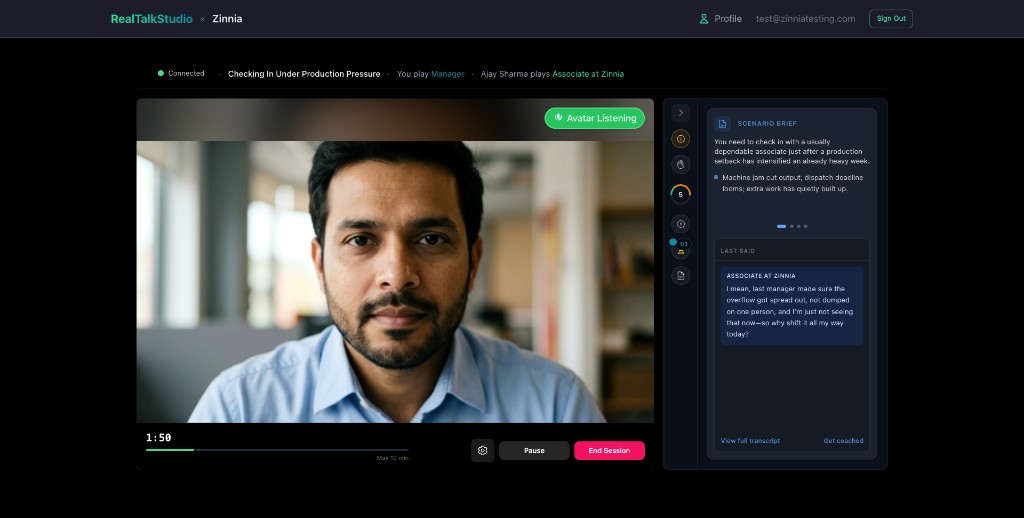
You are not watching a face. You are not managing the room. You are not seeing the moment the other person shuts down. Conversational avatars exist for that gap: a counterpart who listens, reacts, and will not fold because you were charming.
We built Real Talk Studio for the right-hand column. Public drills are free to try. Programmes are how Mews ran the same interview twice and moved confidence, and how UCFB taught negotiation as a spoken skill, not a slide.
If you design training for other people, the trainer’s guide to AI roleplay is the longer argument: practice first, knowledge second, the room as debrief not as the whole product.
Tips that actually change the next attempt
Be imperfect. A flawless first pass teaches nothing. Make the first one messy on purpose.
Add friction. “You’re busy and distracted.” “You have two minutes.” “You agree with everything and will change nothing.” Pressure is the lesson.
Ask for behaviour, not vibes. Not “was that good?” — “when did my tone make you trust me less?”
Keep the scene still. Improvement comes from iteration, not novelty. Same counterpart. Same stake. One changed line.
Make it tougher, not nicer. “Be harder this time. Do not help me.” If it still feels easy, the prompt is wrong.
Do not practise the worst content on a human. Harassment disclosure, a PIP that might become a grievance, a redundancy 1-1 — use a simulation. I have written about why in compliant and compassionate.
Know when you have outgrown the chat. If you are sending the prompt to a team, you already need a platform. The prompt was the prototype.
FAQ
Frequently asked questions
01How do I roleplay with ChatGPT?
Name the skill, lock the other person’s role and resistance, add a constraint, then talk. After the scene, type DEBRIEF and score only the skill you named. The master prompt on this page is the shortest version of that method.
02What is the best ChatGPT prompt for roleplay?
The one that stops ChatGPT being your coach mid-scene. Purpose, scene, constraints, and a deferred debrief. “Act as my customer” is not enough — the model will be polite and then congratulate you.
03Is ChatGPT voice mode good for roleplay?
Yes, for feel. GPT-Live (2026) is full-duplex: it can listen while it speaks, wait through a pause, and interrupt more like a person. Use it after you have pasted a role lock. It is still a voice in your headphones, not a counterpart in the room, and it still will not create a training record.
04Why is ChatGPT a bad roleplay tool for organisations?
Because every learner writes a different scene, the model is too agreeable, there is no shared score, people paste real cases into consumer accounts, and nothing schedules the second attempt. It is a personal gym, not a practice system you can show a CFO or a regulator.
05Can I use ChatGPT for workplace training?
For individual rehearsal, yes. For a programme — managers, service, conduct, interviews — you need locked scenarios, evidence, and a data boundary. “We told them to use ChatGPT” will not survive a training audit.
06What is better than ChatGPT for roleplay practice?
A live counterpart with a brief, a face, a score, and a retry: that is the job Real Talk Studio is built for. Use ChatGPT to draft the scene. Use a practice platform when the conversation has to transfer on Monday, and someone has to prove it did.
Practising with ChatGPT is not pretending. It is preparing.
Preparation only becomes skill when it is anchored in feedback, then repeated. Let ChatGPT show you the line you missed. Then, when you want the same conversation with presence — and a record you can keep — step into a live practice.
Because confidence does not come from being told what to do. It comes from hearing yourself do it, and knowing this time you did it better.
Practise the live version on the Real Talk Studio platform— scored attempts against characters that push back, not a script on a slide.