Thought leadership
The Trainer's Guide to AI Roleplay

For thirty years, corporate learning has run the same play.
Explain the model. Walk through the slides. Check understanding. If there is time left — and there is almost never time left — put two volunteers in front of the room and call it practice.
Then we wonder why nobody does it differently on Monday.
AI roleplay is the first tool that makes the opposite possible: practice as the default, knowledge as the support act. It is a paradigm shift. Most trainers are using it as a gimmick at the end of the old paradigm. That is why so many first deployments feel expensive, awkward, and easy to drop.
This guide is for the people who actually design the learning: L&D trainers, independent consultants, and training organisations. Not a buying checklist — that lives in the 2026 buyer’s guide. This is the design argument. How you use the tool matters more than which logo is on it.
Theory won. Practice lost.
Classroom training got very good at knowledge. E-learning got very good at distributing that knowledge cheaply. Neither got good at the thing work actually requires: doing the conversation while another human pushes back.
That is not a small gap. It is the gap.
A manager can recite the feedback model and still freeze when a report goes quiet. An agent can pass the vulnerability quiz and still process a disclosure as a transaction. A new hire can watch the onboarding video and still walk into their first objection with nothing but hope.
We have written about this as nobody practises. The industry confused content with rehearsal. Watching the match is not training for the match. A completion certificate is not readiness. The performance bar in most organisations is so low that practice looks like overkill — until the conversation that matters goes badly, and everyone pretends surprise.
AI roleplay is the first time practice can run at the scale of content. Not two volunteers. Not a booked actor. Not a peer who lets you off the hook because they have to work with you tomorrow. A live counterpart, on demand, who will not fold because you were polite.
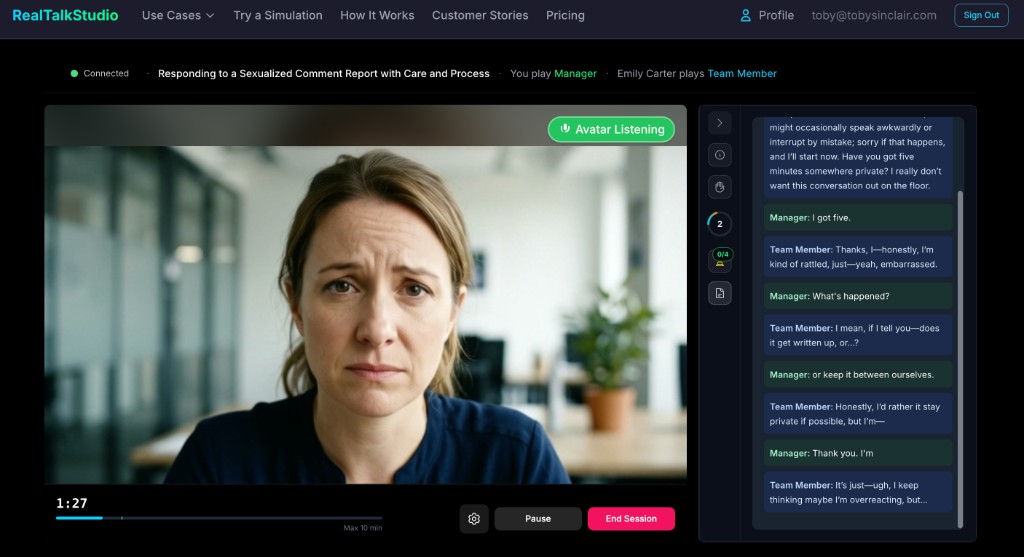
This is the unit of learning now. Not a slide. A conversation that talks back.
That is the opportunity. It is also the trap. Because the instinct of a well-trained trainer is to do what they have always done — and slot the new thing into the last ten minutes.
The anti-pattern: a new tool in the old paradigm
Here is how most first AI roleplay programmes get designed.
Two hours of theory. A framework. A few films. A discussion. Then, if the tech works and nobody has gone over time, each person gets one practice session. Sometimes they watch one person do it. Then they fill in a smile sheet and go back to work.
That is knowledge-first design with a novelty at the end. It is the old course wearing a headset.
It fails for three boring reasons.
Volume. Skill is not installed in a single attempt. One conversation at the end of a workshop is a demo, not training. Deliberate practice needs repetition, feedback, and another go while the miss is still warm. Ericsson’s work on expert performance is blunt about this: the mechanism is structured, repeated, coached rehearsal — not exposure.
Cost. AI roleplay is not a cheap party trick. The value is in the reps, the feedback, and the data those reps produce. If you pay for a practice engine and use it once per person per year, you have bought a sports car to sit in a car park. The licence looks expensive because you are using it like a projector.
Transfer. People do not walk out of a knowledge session and spontaneously become fluent. They walk out with a model they cannot yet run under pressure. The one practice they did — if they did it — is usually their worst attempt, because it is their first. Then the course ends, and that first attempt is the only one the organisation ever sees.
If all you can offer is a single practice bolted onto a classroom, keep the classroom. Do not spend the money. You will get a story about innovation and almost no change in behaviour.
The trainers who get this right do something that feels uncomfortable at first. They flip the sequence.
Why AI roleplay works
Not because the avatar is impressive. Because the conditions for skill finally exist.
It is safe. Nobody is watching from the back row. Nobody has to play the angry customer in front of their peers. The first attempt can be bad. The second can be less bad. That is how people actually learn a hard conversation — privately, then with more heat, then in the real room. Sticky Change put 30 leaders into upward-feedback practice for exactly this reason: the conversation is too risky to rehearse on a colleague who is also your political landscape.
It enables repetition. The partner does not get tired. The diary does not have to match. Six times more practice than a classroom, in the studies we cited in why AI roleplay actually works, is not a slogan. It is what happens when practice stops being an event.
It can be personalised. Not a generic “difficult conversation.” This associate, after this production setback, with this history of being dumped on. The scenario can match the job, the policy, the product, the culture. Mews did not train “interview skills.” They trained their interview, then ran it again two weeks later. Confidence between the first and second attempt rose 70%.
It produces evidence. Every session leaves a transcript, a score, a skill band, a confidence delta, and — if you attach policy — a record of whether the conversation was run the way it has to be run. Classroom training leaves attendance. That difference is the rest of this guide.
None of that works if you treat the roleplay as a treat at the end of the slides.
Practice first, knowledge second
The sequence that works is the one most course designs cannot tolerate.
Start with the conversation. Let people fail it. Show them the line that landed and the line that did not. Then teach the model — because now they have a reason to want it. Then send them back in. Then again next week. Then again when the real conversation is on the calendar.
This is not a preference. It is how skill is built.
Spaced practice beats massed practice. The attempt you do two weeks later is not a recap. It is the session that tells you whether anything stuck. Deliberate practice is not “have a go.” It is a specific behaviour, a specific miss, another attempt aimed at that miss. Knowledge is what you reach for when the attempt shows you the hole.
That sequence fundamentally challenges the classroom.
A classroom is timed, cohorted, and front-loaded with explanation because that is what a room full of people can do together. It is a poor engine for reps. You cannot get thirty people to a third attempt in a 90-minute workshop without the workshop becoming the practice, and the slides becoming optional.
So the honest design question is not “how do we add AI roleplay to our course?” It is “what is the course for, if practice can live outside the room?”
Some trainers will hate that. Their product is the room. Their day rate is the room. Their confidence is the room. AI roleplay does not kill the room. It stops the room pretending it was ever enough.
From classroom event to digital product
This is the part that elevates a trainer’s offering — and the part most training businesses are still pricing as a workshop.
If practice is always on, you are no longer selling a day. You are selling a capability that sits in the flow of work.
New-hire onboarding. Not a two-day induction and a hope. The five conversations this role will actually have in month one, practised before the first live one, scored, repeated until the bar is met.
Manager daily work. The feedback chat, the workload push-back, the wellbeing check-in, the “you are not getting promoted” conversation. Available on a Tuesday afternoon when the meeting is Thursday. Not next quarter’s leadership programme.
Compliance that is not a PDF. The disclosure, the bribe, the vulnerable customer, the harassment report. Dated proof someone can run the conversation — the argument we made in competence, confidence, compliance and in the training audit.
That is a digital product. It has a catalogue. It has usage. It has a before-and-after. It can be in the LMS, in Slack, in the onboarding path, in the manager’s weekly rhythm. The trainer who builds it stops being the person who flies in, delivers, and leaves a workbook. They become the person who installed the practice system the organisation keeps using.
Independent consultants and training organisations should sit with that. Your competitor is not the other facilitator. It is the client’s growing suspicion that a brilliant day with no reps is entertainment.
The trainer’s playbook
You do not have to throw the classroom away on day one. You do have to stop using AI roleplay as garnish. These are the patterns that work — in the room, around the room, and instead of the room.
1. Benchmark before you teach
Run the roleplay before the input.
You will see who can already do it, who is confident and wrong, and which part of the conversation the cohort actually fails. That data sets the agenda. You stop teaching the framework everyone can already recite and start teaching the behaviour the scores say is missing.
This is the opposite of the diagnostic quiz at the start of an e-learning module. The quiz measures recall. The roleplay measures performance under a person who is not cooperating.
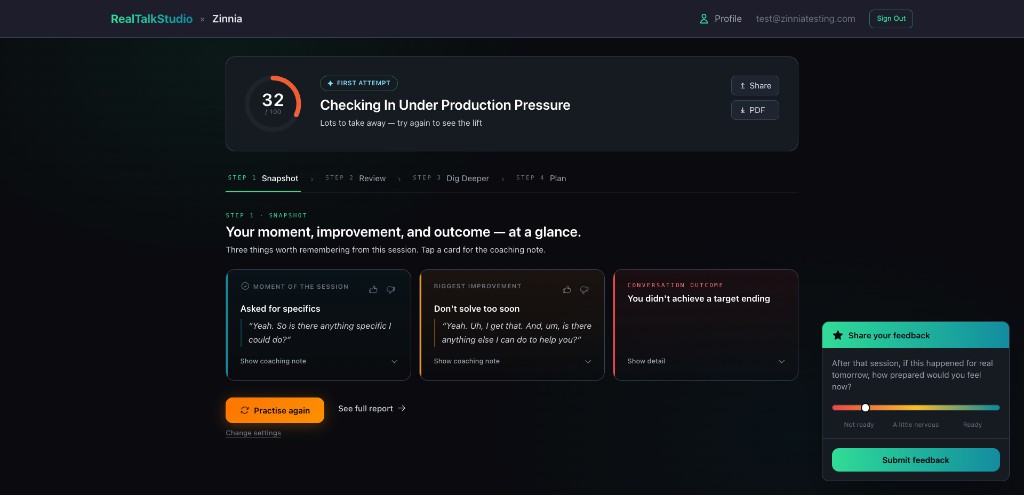
A first attempt is a diagnosis, not a verdict. The score tells you what the day is actually for.
2. Role-model the conversation in front of the class
Put the avatar on the main screen. Run the conversation live. Let the room watch how you open, how you recover, how you do not rescue yourself with a speech.
This is better than a scripted demo film, because the partner will not stay on your slides. The room sees an expert work, not an expert present. Then you pause. You show the line. You ask what they would have done at the moment the associate went defensive.
Sticky Change did a version of this in a 90-minute masterclass: a live demonstration, then practice. The demonstration is not the learning. It is the standard.
3. Show a pre-recorded expert run
Not every trainer wants to roleplay live in front of a sceptical cohort. Record an expert — you, a senior manager, a top performer — running the same scenario. Play it. Annotate it. Then send the room to try.
The point is not a perfect model answer. The point is a concrete picture of what “good” sounds like in this conversation, so people are not practising against an abstraction.
4. Breakouts: everyone practises, not two volunteers
This is the use most facilitators reach for first, and it is a good one — if it is not the only one.
Small groups. Each person runs the same scenario. The others watch one attempt, or they run their own in parallel. You come back and debrief the misses the scores have in common.
The rule: everyone speaks. If only the confident people practise, you have reproduced the classroom’s worst habit.
5. Practice independently, then debrief with a coach
The pattern that scales.
People run the conversation on their own time. They get the snapshot, the transcript, the exact line. Then they talk it through — with you, with an internal coach, or with an AI coach attached to the roleplay.
The debrief is where the attempt becomes learning. Without it, people remember the feeling and forget the behaviour. With it, they leave with one thing to try next time.
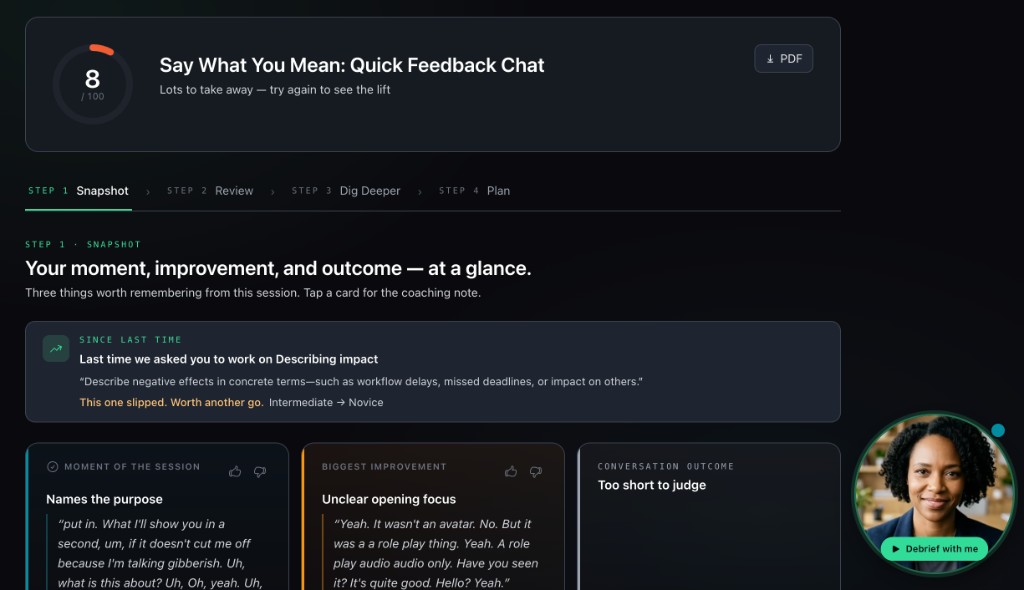
The report is the evidence. The coach is how they use it — while the attempt is still warm.
On Real Talk Studio the coach sits on the results. They have the transcript. They have the moment that mattered. This is not a generic “how did that feel?” chatbot. It is a conversation about this attempt. You can attach a coach in your image and your method, so the debrief sounds like you when you cannot be in the room.
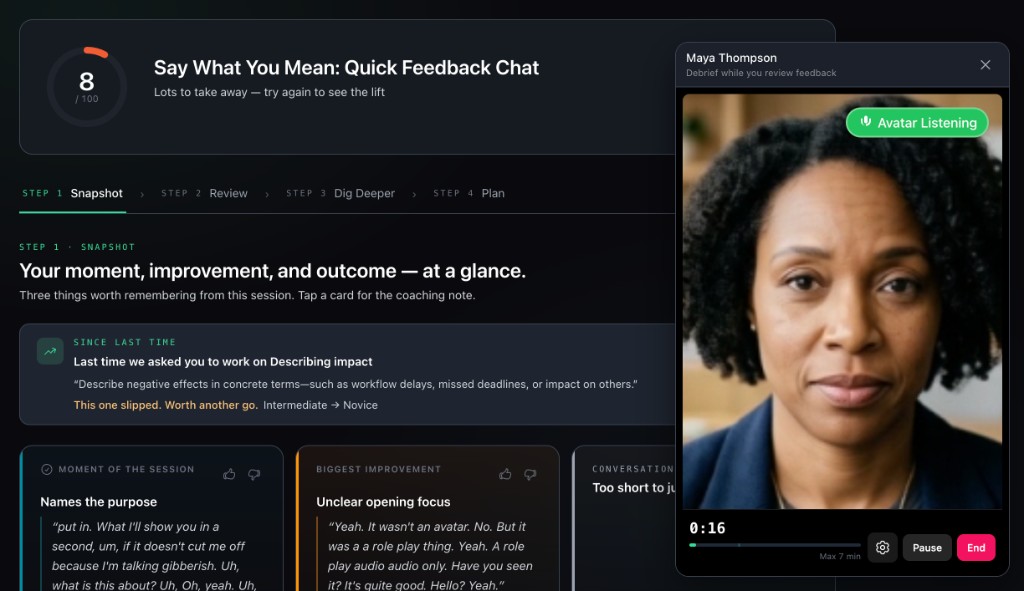
Practice, then talk. The missing half of every workshop that ran out of time.
6. Spaced practice after the classroom — then a two-week debrief
Do the input. Send people away with the roleplay. Require a second attempt after two weeks. Then meet — live or async — on what changed.
This is the Mews pattern: first attempt, feedback, second attempt, measured lift. It is also the only honest test of a classroom. If the second attempt looks like the first, the day did not work. You want to know that. So does the sponsor.
Two weeks is not magic. It is long enough to forget the script and short enough that the real conversation may have happened in between. Ask what they tried for real. The roleplay is rehearsal. The debrief is whether rehearsal transferred.
7. Create the roleplay in the flow of work
The scenario should not only come from a design sprint six months ago.
A manager has a conversation on Thursday that went badly. A trainer hears the same miss in three coaching sessions. A policy changes on Friday. The useful move is to spin the next practice from that moment — not to wait for the next curriculum review.
That is what MCP is for on Real Talk Studio. Connect Claude (or another assistant) and you can create a roleplay from the conversation you are already having: “Build a practice for this workload push-back, this hiring interview, this disclosure.” The simulation lands in the catalogue. People can run it the same day.
Practice that has to be commissioned like a film will always lose to the calendar. Practice that can be created where the work already happens can keep up.
8. Leave it on
The end state is not a better workshop. It is a studio people keep using.
A catalogue of the conversations this organisation actually has. Assigned in onboarding. Revisited when someone is promoted. Re-run when the policy changes. Available the night before the meeting. That is embedded learning. That is how behaviours move: not because the day was memorable, but because the reps kept happening after the day was forgotten.
The data classroom training never gave you
Smile sheets tell you the sandwiches were fine. Completion certificates tell you people were in the room. Neither tells you whether a single person can hold the conversation.
AI roleplay does, because the learning event is the measurement event.
A session on Real Talk Studio leaves more than a score. It leaves the transcript, the skill bands, whether the objective was met, whether policy was followed, and how ready the person felt before and after. First attempt versus best attempt. The same person, over time. The same scenario, across a cohort.
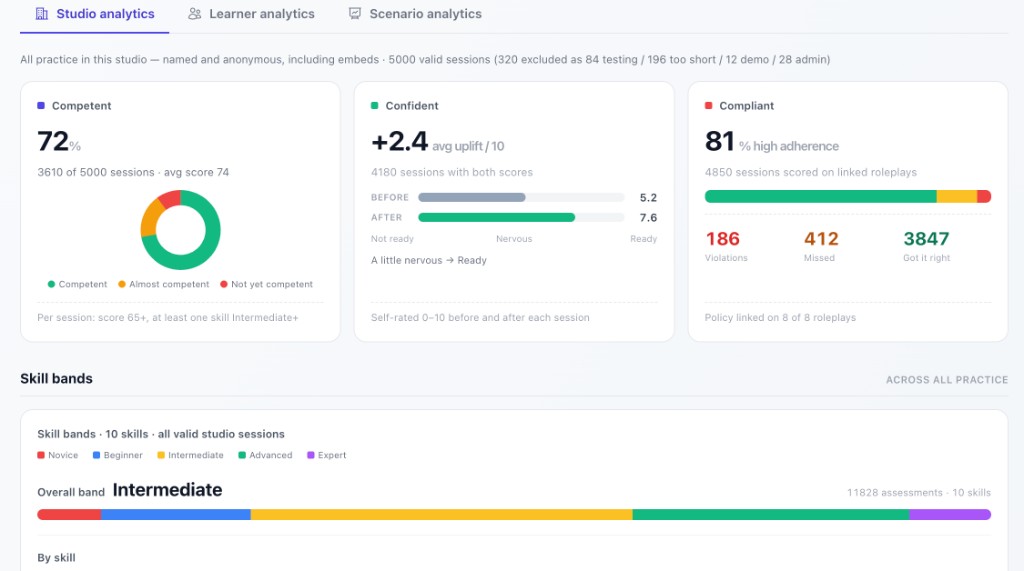
This is what “the training worked” looks like when you can see it. Not a 4.6 out of 5 on the feedback form.
That is gold dust for a trainer.
You can walk into a sponsor meeting with competence, confidence, and compliance — the three measures we unpack in the longer evidence piece — instead of a stack of happy sheets. You can show the median sessions to the bar. You can show who is confident and not yet capable. You can show ROI in weeks, not in a hope that “people will use the model.”
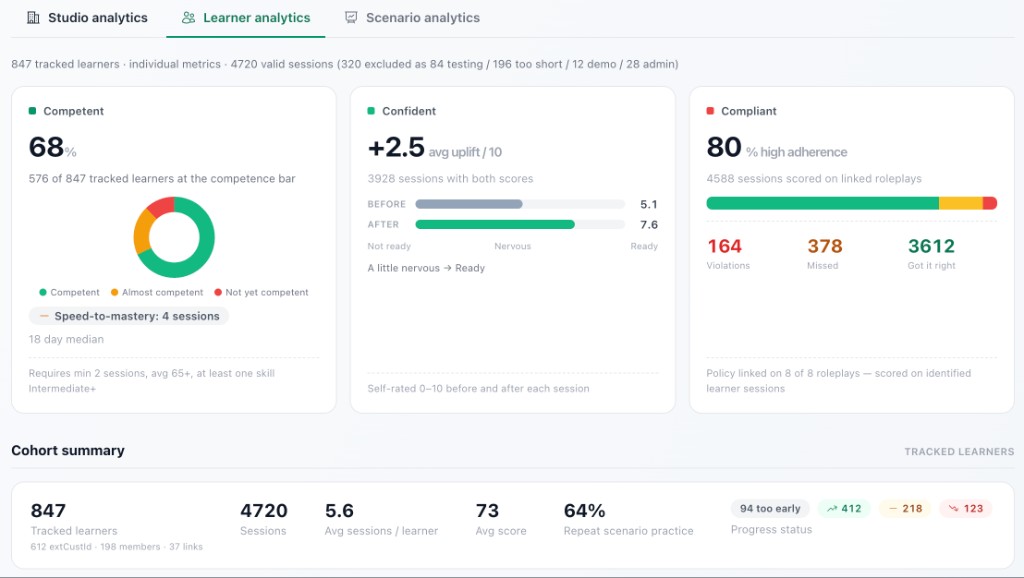
847 learners. 4,720 sessions. That is not a workshop. That is a practice system — and the numbers survive a CFO.
Line-by-line review is what makes the number believable. A score without the words is a grade. A score with the words is coaching.
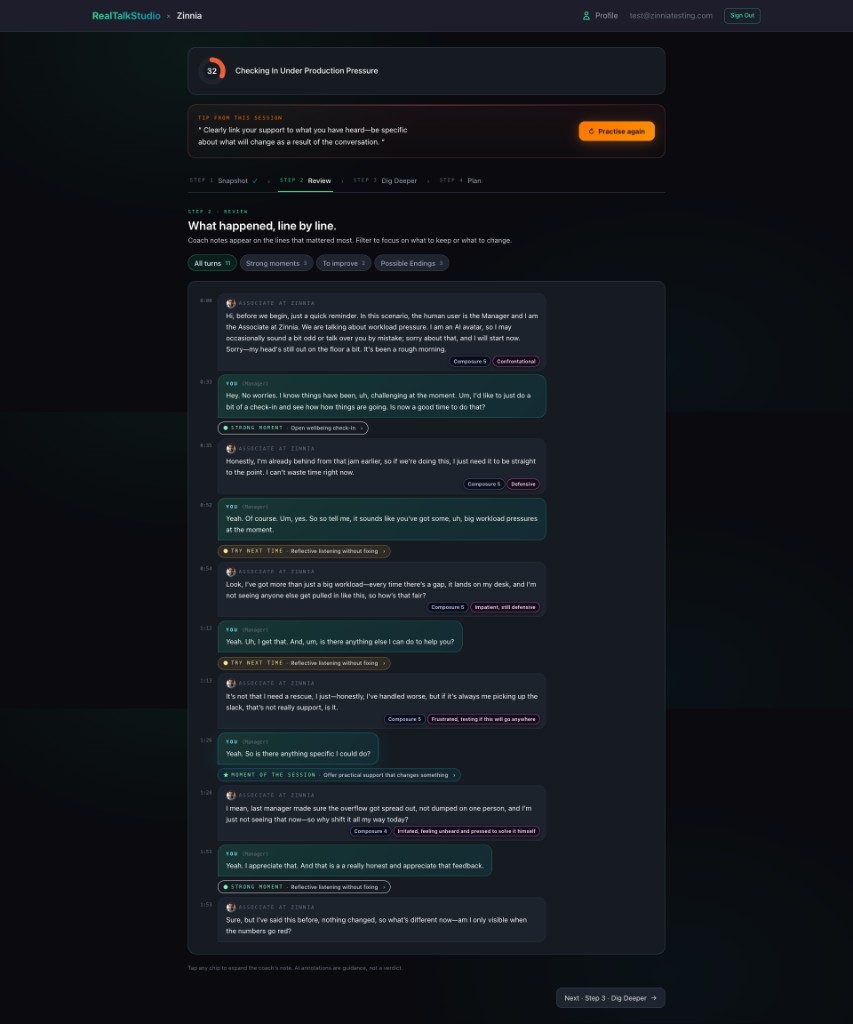
This is the debrief pack you never had time to write at 6pm. It is already there.
If you are still reporting training success as attendance, you are leaving the only commercially interesting part of this category on the table.
What this means if you sell training
If you are an independent consultant or a training organisation, the threat is obvious. A client can now see — in data — that a brilliant day produced one weak attempt and no second one. The opportunity is larger than the threat.
You can sell the system around the day.
Design the conversations. Build the catalogue. Run the live room as the ignition: benchmark, role-model, first attempt, shared debrief. Then own the next eight weeks. Second attempts. Coach debriefs. A report that shows the lift. A studio the client keeps, with your scenarios and your coaching style still in it.
That is a different commercial offer. Retainer, not day rate. Product, not performance. Evidence, not testimonials.
It is also a more honest one. You already knew the day was not enough. You now have a way to stop pretending it was.
Try a practice conversation and you will see the loop in a few minutes: the live partner, the snapshot, the coach waiting on the results. If you are choosing a platform rather than designing the programme, take the buyer’s guide into the next demo. If you want the measurement story, start with competence, confidence, compliance.
The old style of learning asked people to know. The new one asks them to do it, again, until they can.
That is the whole job. It always was. We finally have a tool that does not let us avoid it.
FAQ
Frequently asked questions
01Why doesn't one AI roleplay at the end of a course work?
Because one attempt is a demo. Skill comes from repeated, spaced, deliberate practice with feedback — not from watching a model and trying it once while the taxi is booked. AI roleplay is too costly to use as a garnish. If the design is still knowledge-first, keep the classroom and save the licence.
02What does practice-first training look like?
People try the conversation before the input. The misses set the teaching agenda. They try again in the room or after it. They come back days or weeks later for another attempt, then debrief what transferred. Knowledge is the support act. The reps are the programme.
03How should independent trainers and training organisations use AI roleplay?
Stop selling only the day. Use the room to benchmark, demonstrate, and debrief. Put the reps in a studio that stays on — onboarding, manager work, compliance — and sell the weeks after the workshop as part of the offer. Your scenarios and your coach can remain when you are not in the building.
04What data do AI roleplays give you that classroom training cannot?
A scored transcript of what was actually said, skill bands, whether the objective was met, confidence before and after, and — where policy is attached — whether the conversation was run the required way. That is competence, confidence, and compliance. Attendance and smile sheets cannot produce it.
05How do you create roleplays in the flow of work?
On Real Talk Studio, MCP lets you create a simulation from Claude or another assistant — from a conversation that just went badly, a policy change, or a coaching theme — and put it in the catalogue the same day. Practice that has to wait for a design sprint will lose to the calendar.
06Why do AI roleplays work when classroom roleplay often doesn't?
They are safe enough for a bad first attempt, available enough for a second and a fifth, and specific enough to match the real conversation. Peers let you off the hook. Diaries do not match. Actors do not scale. An always-on counterpart with feedback and a coach debrief removes those three excuses.
Practise the live version on the Real Talk Studio platform— scored attempts against characters that push back, not a script on a slide.