Company
Introducing AI Coaches

Practice was only half the job.
You could rehearse the hard conversation. You could get the score, the snapshot, the exact line that landed — and the one that didn't. Then you were on your own. The insight sat on the page. Nobody sat with you in it.
And nobody sat with you before it, either. You walked into the scene cold, with a vague intention and no one to sharpen it.
That changes today.
AI coaches are live on Real Talk Studio — and they now facilitate the practice itself. A coach greets you. They find out what you want from the session. You practise. Then the same coach comes back to debrief what happened.
One coach. Before, during the hand-off, and after. That is what makes learning stick.
Coach-facilitated practice
Roleplay on its own gives you a rep. It does not guarantee you learn anything from it.
Learning sticks when you go in with a clear intention, get honest evidence, and then reflect on it with someone who was there for the whole thing. So we built the session around a coach who does exactly that.
1. The coach opens: greeting and focus
You start a practice session and the coach is the first face you see. They greet you by name, tell you the setup — who you are about to speak to, and what the situation is — and explore what you want from the attempt. What are you nervous about? What are you trying to get right? What do you want to leave with?
This is not a form and it is not a wall of instructions. It is a short conversation that turns "I should probably practise this" into a specific goal for the next few minutes.
Then the coach hands over. The practice partner joins the same session, and it is over to you. If you already know what you are doing, you can skip the intro and go straight in.
2. You practise
The roleplay is the roleplay. A counterpart with a job, a mood and a reason to push back. Pressure, evidence and a scored attempt. Nothing about the rehearsal gets softer because a coach opened the door.
3. The same coach comes back to debrief
Finish the roleplay. Get your feedback. Then tap Debrief with me.
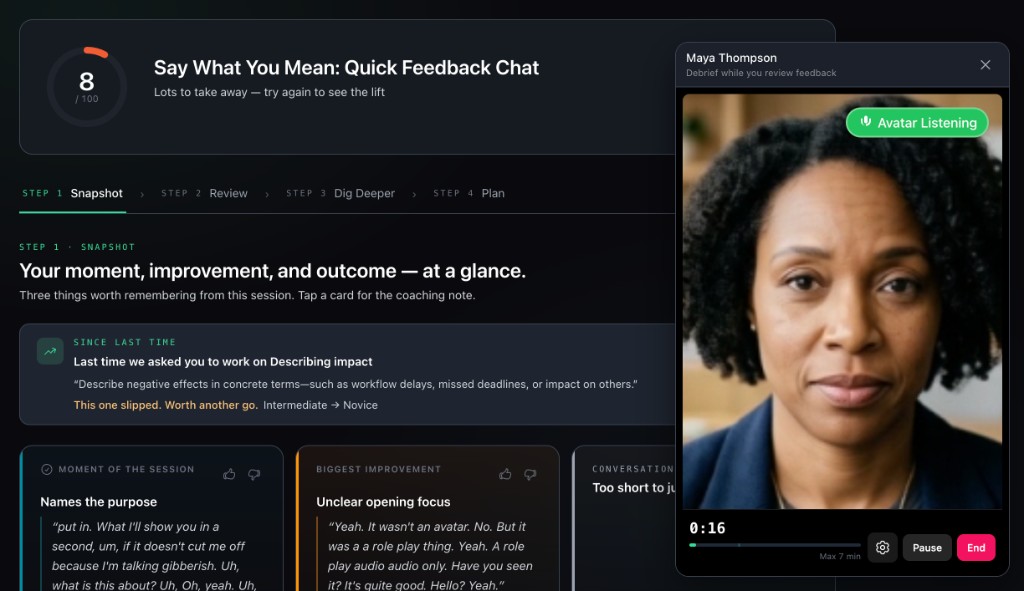
It is the same coach who set you up. They know what you said you wanted from the session. Now they are sitting on the snapshot with you, looking at the same attempt — the transcript, the moment that mattered, the improvement you keep missing. This is not a generic "how did that feel?" chatbot. It is a live conversation about this attempt, measured against your goal: the turn that shifted, the phrasing you used, the choice you avoided.
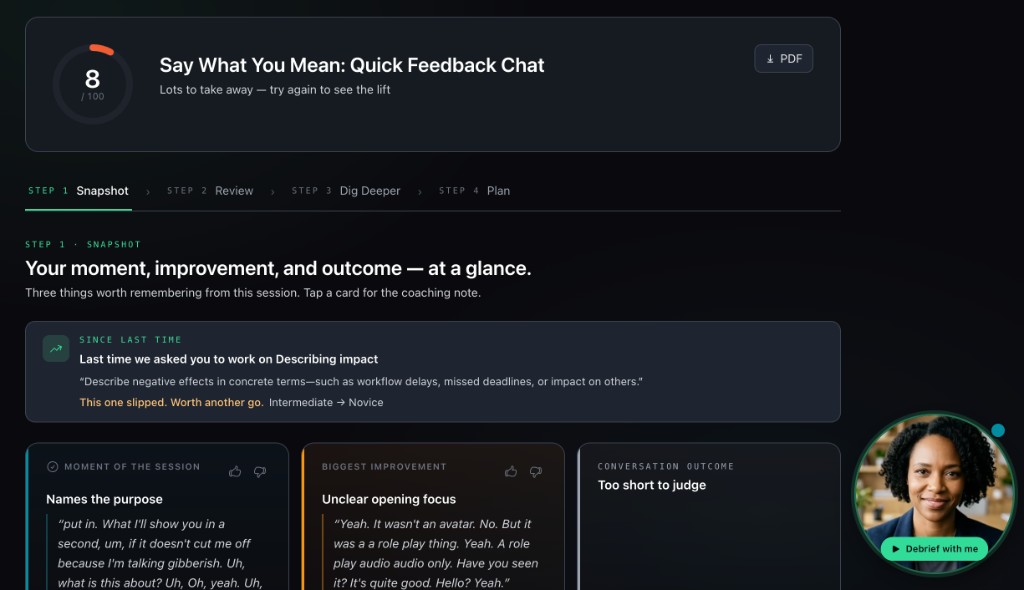
The debrief runs alongside the report. You stay on the results. The coach sits with you while you review them. You can slow down at the exact line. You can argue with the note. You can leave with one behaviour to try next time — not a pile of advice you will forget by Thursday.
Why a coach on both sides makes it stick
Most practice tools give you one half: the rep, or the report. Coach-facilitated practice closes the loop.
- Before: the coach helps you decide what good looks like for you, today. You start with intent, not just a scenario.
- During: the practice partner does the hard part — pushes back, tests you, makes it feel real.
- After: the coach connects what happened to what you wanted, and turns it into one thing to do differently.
Set a goal. Try it under pressure. Reflect with someone who knows what you were aiming for. Commit to the next move. That is the learning cycle, in one continuous session, with one coach who holds the thread.
The roleplay gives you evidence. The coach makes you use it.
I have already linked a coach to the existing roleplays. Give one a go — the coach greets you at the start and is waiting for you at the end.
Or use a coach on their own
Not every conversation needs a counterpart to practise against. Sometimes you just need a coach.
Talk through a leadership challenge. Strategise an upcoming conversation. Work a problem before you walk into the room. Book six minutes with a coach who already knows how you work — or start from a blank page and tell them what you want to focus on today.
This is a standalone coaching session, not a roleplay. There is no persona on the other side pretending to be your report, your customer, or your board. There is a coach. They ask. They reflect. They challenge. They help you think.
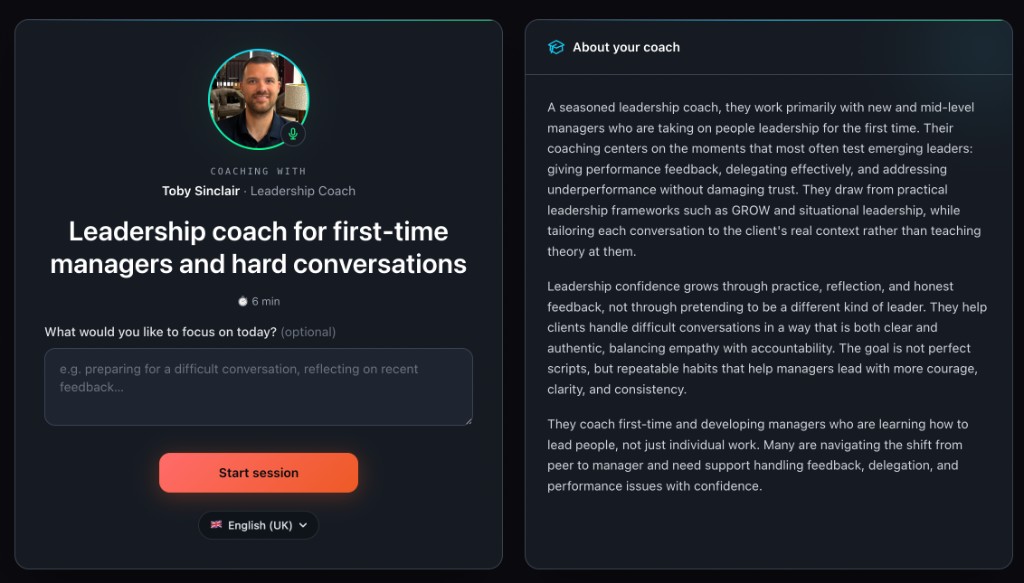
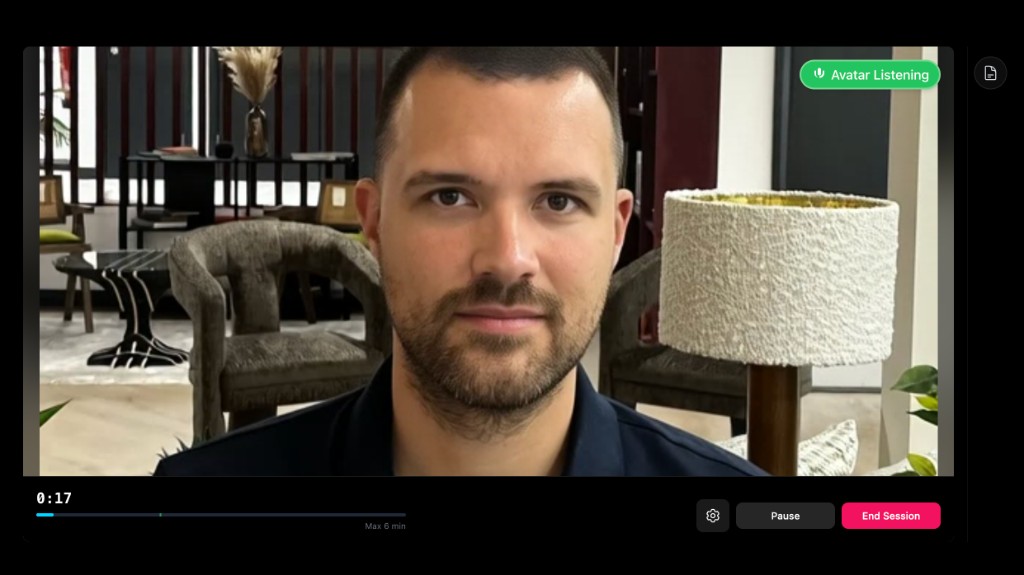
Start a coaching conversation with me — Toby Sinclair, leadership coach — and see what a standalone session feels like.
A coach is not a roleplay partner
The two do different jobs, and the best sessions use both.
Roleplays are for rehearsal. You step into a scene. Someone on the other side has a job, a mood, a reason to resist you. You practise the conversation you will have for real.
Coaches are for the work around that conversation: advice, mentoring, reflection, strategy. They help you prepare, make sense of what just happened, and decide what you will do differently.
You needed both. You only had one. Now they come together: the coach opens the session, the partner tests you, and the coach comes back to close the loop.
Build a coach in your image
Every coach is fully customisable. Not a name and a stock photo. The whole approach.
Style, tone, and method. Write the coaching style in plain language. Curious and slow, or sharp and commercial. Questions only, or advice when asked. Open conversation, or a strict sequence. You set the psychological approach — not a vendor's default personality.
Philosophy, credibility, audience, and boundaries. Define what they believe. What they have done. Who they are for. Where they stop — and when they should refer out. A coach that will not give HR, legal, or clinical advice is a coach you can put in front of a team.
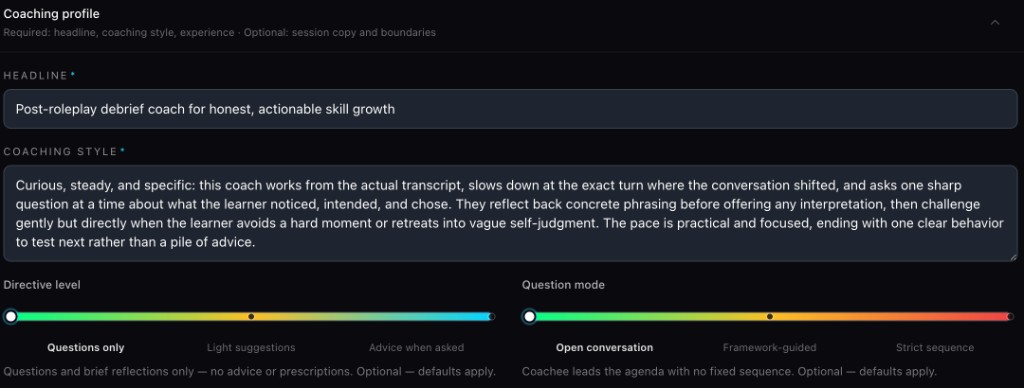
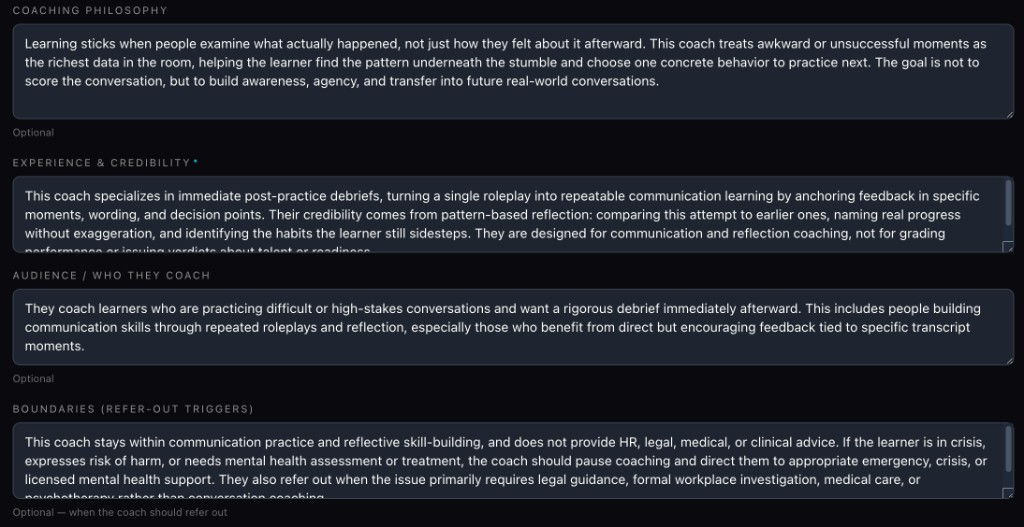
Your face. Upload your own image and create a coach of yourself. Your learners are welcomed by you before they practise and debrief with you afterwards — at scale, at 11pm, after the attempt they would never have booked a real session for.
Your knowledge. Train the coach on how you coach. Your frameworks. Your language. Your standards. The stories you always come back to. The result is not a generic leadership bot. It is a coach that coaches like you.
Your team's default coach. Set one coach for your organisation and they front every practice session — the same welcome, the same debrief, the same standard of coaching for every learner. Switch it on or off per roleplay, so it is there when it helps.
The coaches you can create
Start from a specialism, or invent your own.
- Real Talk Coach — frame the session and debrief the attempt while it is still warm
- Leadership Coach — people, influence, and the conversations managers avoid
- Executive Coach — senior leaders under pressure, making the call only they can make
- Startup Coach — founders on focus, funding, and the one conversation that unlocks progress
- Career Coach — direction, promotion, interviews, the next move
- Life Coach — purpose, balance, and the goals that keep slipping
- Relationship Coach — communication and conflict with the people who matter
- Sales Coach — pipeline, objections, deal reviews, the call that stalled
- Performance Coach — habits, consistency, mindset
- Wellbeing Coach — stress, energy, burnout before it becomes a crisis
- Communication Coach — presence, storytelling, speaking when the room is watching
- Your own — any approach, any style, any niche. If you can describe how you coach, you can build it
Attach any of them to a roleplay and coach-facilitated practice is part of the product — the welcome at the start, the debrief at the end — not an optional extra you hope people book later.
Try it now
Two doors. Both open.
Try a coach-led practice session. No login. A few minutes. The coach greets you, the partner tests you, and at the end the coach is waiting.
Or skip the roleplay and talk to a coach. A standalone session with me — leadership challenges, upcoming conversations, the problem you have been carrying.
Practice got you into the room. The coach is how you walk in ready — and how you leave it better.
Practise the live version on the Real Talk Studio platform— scored attempts against characters that push back, not a script on a slide.