Compliance
Would you put your CEO on a PIP?

Would you put your CEO on a performance improvement plan?
Most boards would laugh. PIPs are for the agent who keeps missing call targets, not the chief executive who keeps missing the quarter. Senior people get managed out a different way: a quiet word from the chair, then a settlement agreement with a number on it.
That worked because the number had a ceiling. An unfair dismissal claim could only cost so much, so a senior exit was a negotiation over price rather than a legal risk.
From 1 January 2027, the ceiling goes. Employment lawyers advising private equity sponsors are now telling clients that a genuine PIP should be a serious consideration even at the most senior level.
So yes, you might have to put your CEO on a PIP. And someone will have to sit across the table and say the words.
Performance improvement plan
Form- Name
- Contact Centre Agent
- Role
- Customer operations
- Measures
- Support
- Review date
Performance improvement plan
Same form- Name
- Chief Executive Officer
- Role
- Chief executive
- Measures
- Support
- Review date
What changes on 1 January 2027
Two changes in the Employment Rights Act 2025 land on the same day, and together they move the risk of a badly handled exit onto every manager's desk. Commencement regulations confirm both apply where the effective date of termination is on or after 1 January 2027.
Until 31 December 2026
- Service needed to claim
- Two years
- Compensatory award
- Capped
- Lower of 52 weeks’ gross pay or £123,543
From 1 January 2027
- Service needed to claim
- Six months
- Compensatory award
- No cap
- Salary, bonus, pension and equity can all be in play
The shorter qualifying period is not limited to new hires. Anyone with six months' service on 1 January 2027 is protected from that day, which means everyone who started on or before 1 July 2026.
The cap removal was a late surprise. It arrived as the government dropped day-one unfair dismissal rights, and it was not in the original Bill at all. Most claims never came near the old cap. The people it held back were senior and well paid.
Illustrative loss
£400,000
One senior exit. The old cap covers the first £123,543.
- Covered by the old cap
- £123,543
- Above the old line
- £276,457
- Salary for the loss period
- Bonus
- Pension contributions
- Forfeited equity
In this example the old cap covered £123,543 of a £400,000 loss. The £123,543 figure is the compensatory award cap from April 2026. The £400,000 total is an illustration, not a valuation. From January, a tribunal can look at all of it.
Why your senior team now has to be performance managed
Until now, most senior people did not bother with unfair dismissal claims. The maximum award fell well short of what they lost, so the usual exit skipped the process and went straight to the settlement.
White & Case describe the classic version: find a fair reason, terminate on notice, then buy out the capped award with a settlement agreement. From January, the same exit handled the same way carries uncapped exposure. That can reach salary for the loss period, bonuses, pension contributions and forfeited equity.
The detail that matters most for anyone in L&D or HR is why these claims succeed. At senior level they usually win on process, not substance. The employer had good reasons and no record of having said them.
White & Case list three reasons performance management gets avoided at the top. None of them is a policy problem. Every one is a conversation someone has been putting off.
It's awkward at this level.
You can't measure strategy.
We don't really do feedback up here.
The chair who has never told the CEO the numbers are not good enough. The managing director who rates every direct report "strong" because the alternative is a hard Tuesday afternoon. From 1 January 2027, each of those silences has a price, and there is no longer a ceiling on it.
Probation becomes the real decision point
For most roles, the six-month mark is now the line. After it, a dismissal needs a fair reason and a fair process, and the award has no ceiling.
Probation does not move that line. From 1 January 2027, an employee gains protection at six months' service whether or not they are still on probation. Extending someone's probation at month five buys you more time to decide. It does not buy you more time without risk.
The line also arrives earlier than the calendar suggests. Statutory notice is added to the date of dismissal when counting service, so a decision taken in the last week can tip someone over six months. In practice, the honest conversation has to happen around month five, and the warning signs need to have been named well before that.
Day 1
Start
Probation begins. Protection has not.
Month 3
First honest review
Name the doubts while there is still time to be fair.
Month 5
Decision and conversation
The conversation happens here, not at the wall.
Notice
Statutory notice
Added to the dismissal date when service is counted.
Month 6
The wall
Unfair dismissal protection. No cap.
This is where most organisations are weakest. Probation reviews tend to be a form filled in after a friendly chat, and a lot of people pass by default because nobody booked the meeting. That was a minor problem when the protection started at two years. It is a serious one when the manager who said "you're doing fine" at month three is the same manager explaining a dismissal at month five.
Where these conversations go wrong
A fair process is mostly a sequence of conversations: the first concern, the probation review, the PIP meeting, the review points, the final hearing. The policy says what each one should achieve. It says nothing about what happens when the other person pushes back.
These are the moments managers lose control of the conversation, and what each one costs once the cap has gone.
01. The concern that never gets named
What it sounds likeNothing to worry about, just wanted a quick catch-up on how things are going.
The manager softens the opening so much that the person leaves without knowing they are at risk. Months later, a tribunal asks a simple question: was this person told clearly what was wrong and what would happen if it did not improve? A friendly chat with no named concern is not evidence of either.
02. The month-three you're doing great
What it sounds likeHonestly, you're settling in really well. Let's keep going as we are.
The manager has doubts but wants the relationship to stay warm. Two months later they want to end the probation. The only written record of the person's performance now says the opposite, and the manager wrote it.
03. The target nobody can measure
What it sounds likeThe board needs you to be more strategic and show more leadership presence.
This is the senior-level version of a vague concern. A PIP built on targets like these cannot be failed fairly, because nobody can say what passing looks like. It is the exact problem lawyers flag when they say senior objectives feel too hard to measure. The fix is a harder conversation up front: which number, by when, judged by whom.
04. The PIP that sounds like a verdict
What it sounds likeI'll be straight with you, this is mostly a formality. I think we both know where it's heading.
The manager is trying to be honest. What the employee hears, and what a tribunal will read, is that the decision was made before the process started. A PIP that was never meant to be passed is a liability, not a protection.
05. The apology that undermines the process
What it sounds likeI hate doing this. HR are making me put it in writing.
Managers say this to protect the relationship. It tells the person the concerns are not the manager's own, and that the process belongs to someone else. Senior people will remember that line and repeat it.
06. The pushback that changes the claim
What it sounds likeIs this because I raised the issue about the audit? Or about my time off last month?
Senior people push back harder and know where the pressure points are. If the manager gets defensive, dismissive or goes quiet, a performance case can start to look like a whistleblowing or discrimination case. The manager needs to acknowledge the point, record it, route it properly, and keep the performance conversation on its own evidence.
07. The off-the-record chat that ends up on the record
What it sounds likeOff the record, I think you should start looking. We can make it worth your while.
White & Case suggest pairing a senior PIP with an early off-the-record discussion about a negotiated exit. Pre-termination talks can be protected from being used in an ordinary unfair dismissal claim. That protection can fall away if the conversation includes improper pressure, and a nervous manager improvising the words is how pressure creeps in.
None of these are knowledge gaps. Every manager who makes these mistakes has read the capability policy. They make them because they have never had to hold the line with a real person looking back at them.
Practise it before it's real
Reading about a hard conversation is the theory test. Practising it is the driving test. Here is one built for exactly this moment.
You are the chair of a private-equity-backed technology company. Your CEO, Nadia, joined 14 months ago on a strong track record. Revenue has missed plan by around 18% for three quarters in a row, two senior hires have gone, and the board has lost confidence in the turnaround. Until now she has only had soft signals. Today you tell her, in plain words, that the board is putting her on a formal performance improvement plan.
Nadia is sharp and used to winning the room, and she has just read a bad trading update. She argues the targets were never realistic and that the board signed off the plan. She asks whether you speak for the whole board, and whether this is a formality. Then she asks if it is really about her clash with an investor director over acquisition strategy last month, mentions her equity and her lawyer, and tries to take it off the record.
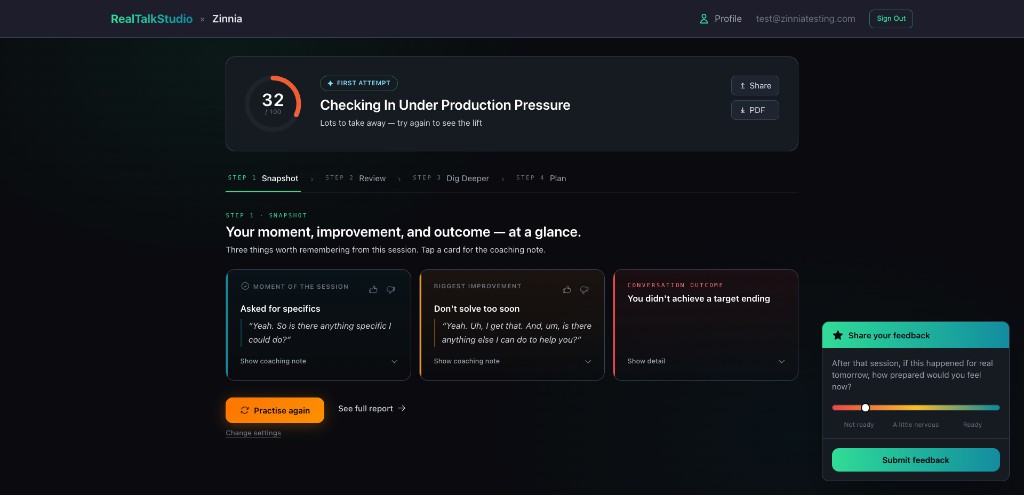
The feedback shows the moments you softened, the lines that would read badly in a written record, and what to try on the next attempt. The room looks like this: the person in front of you, the brief beside them, then a snapshot of what you actually did.

Check your probation and performance policy first
Before you train anyone, find out where your own process leaves managers guessing.
Most capability and probation policies were written when a slip in process had a known, capped cost. They are full of words that read fine in a document and fall apart in the room.
Managers should hold an informal discussion
Should, or must? And what counts as one?
A reasonable period to improve
Four weeks? Twelve? Who decides?
Probation may be extended
By whom, how many times, and what does the manager say?
Senior appointments may follow a different process
Which one? Who runs it?
Each of those gaps is a moment where a manager hesitates mid-conversation, improvises, and creates a record you would rather not have.
The free policy check reads a policy the way a manager would in the moment. Paste a section or upload the PDF of a probation or performance management process. You get a clarity grade and a list of confusion moments, each one linked to a practice scenario that tests it. It takes about a minute, needs no login, and the policy text is not stored or used to train AI models.
Before January
The law firms are right that process now matters more than ever. A process is only as good as the conversations inside it, and those are held by managers and chairs who have mostly never practised them.
Take a narrower question into the next leadership meeting. If the CEO needed a PIP tomorrow, has the person who would deliver it ever said those words out loud?
If the answer is no, there is until 1 January to change that.
Sources
- Browne Jacobson: Further details on the changes to unfair dismissal protections
- White & Case: Unfair dismissal reform, considerations for sponsors
- TLT: Senior exits in a post-cap world
- Brodies: Employment Rights Bill passed with removal of cap
- Brightmine: Unfair dismissal compensation cap is removed
- NatWest Mentor: The six-month qualifying period explained
- BDBF: A guide to the Employment Rights Act 2025
Practise the live version on the Real Talk Studio platform— scored attempts against characters that push back, not a script on a slide.