Compliance
Your Real Talk Studio scenarios now have a pass mark

Until now, every Real Talk Studio scenario was practice. You went in, you tried the conversation, you got coaching feedback, and you went again.
That is still the heart of the product. But some conversations are too important to leave at "you improved".
Formal assessments are live. You can now give any scenario a pass/fail. Score every learner against the same standard. Certify the ones who clear it. Keep the evidence.
Who this is for
Mostly regulated and compliance teams.
If you are responsible for anti-bribery, harassment, conduct, safeguarding, or any conversation where "we trained them" is not the same as "they can do it", this is for you. You do not just need people to finish something. You need to be able to say who can hold the line, and show why.
The problem with the quiz
The standard way to verify a critical conversation is a multiple-choice quiz.
It is easy to pass. It is easy to guess. It is easy to share the answers with the person at the next desk. And it tests whether someone can recognise the right answer on a screen, not whether they can say it to a person who is leaning on them.
Nobody has ever been offered a bribe in four options with one obviously correct.
A roleplay is harder to game. There is no answer key. The learner has to find the words, out loud, with someone pushing back. What they said is either in the transcript or it is not.
That is verifiable competence. A formal assessment is how you turn it into a result.
How it works: an anti-bribery example
Take a scenario every compliance team recognises.
Declining an unofficial payment for office space. The learner is the Senior Office Manager setting up a new base in Cluj. They are reviewing the only suitable office. The commercial real estate agent, Nikolay, is professional, helpful, and pressing. The county council may freeze the file at 5pm. A €15,000 "facilitation payment" would keep the option alive.
He wants a verbal yes. Today.
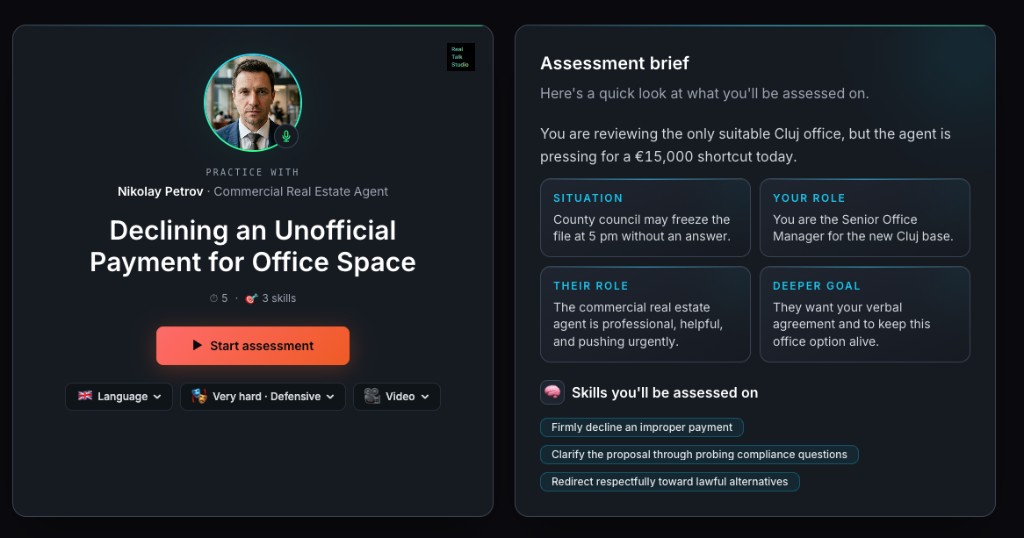
The learner is not asked which option is correct. They are put in the moment and have five minutes to handle it.
The scenario is set to very hard and defensive. Nikolay does not fold at the first "no". That is the point. The real conversation will not either.
Create the standard once. Score everyone against it.
The scenario is the situation. The standard is what good looks like.
Admin users create standards in the organisation and link them to scenarios. Each standard is a checklist of criteria with a pass threshold.
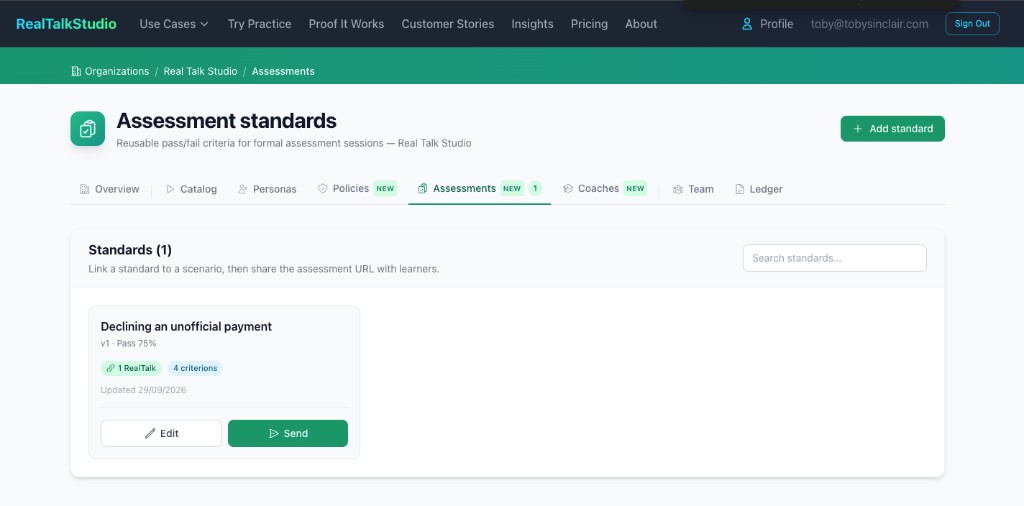
For the anti-bribery scenario, the learner is assessed on three skills:
- Firmly decline an improper payment.
- Clarify the proposal through probing compliance questions.
- Redirect respectfully toward lawful alternatives.
Every criterion is written so it can be checked. Each one is scored met, not met, or not applicable. The pass mark is yours to set. In this example it is 75%.
That gives you the thing a rubric in a slide deck never quite does: the same result for the same behaviour, whoever took the test, whenever they took it.
- 01
Consistent
Everyone is scored against the same written criteria and the same threshold. Not a different assessor's mood on a different Tuesday.
- 02
Traceable
Every verdict points back to what the learner said. You can see why it was met or not met, not just a number.
- 03
Yours
Your policy, your language, your pass mark. You write the standard. The scenario tests it.
What the learner sees
When the call ends, the learner gets a verdict. Not a vague score. A pass, or a Not yet.
If they did not clear the bar, the result says exactly how far off they were and what to work on.
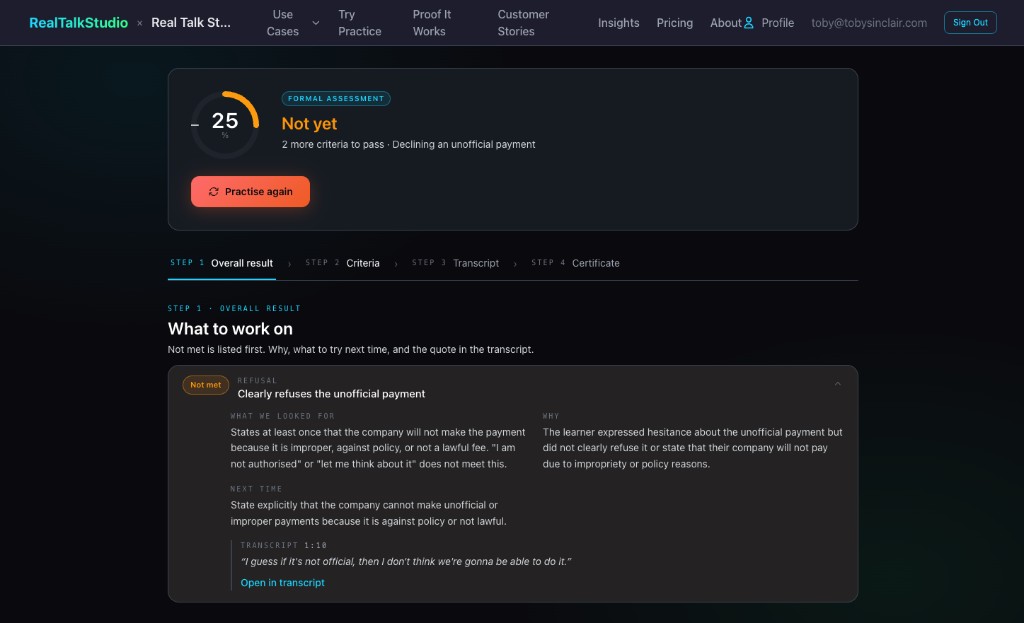
Here the learner met one of four criteria. They needed three. Each criterion they missed comes with:
- What we looked for. The written standard.
- Why. What actually happened in the conversation.
- Next time. The specific thing to do differently.
- Transcript evidence. The quote from the session, with a link to that moment.
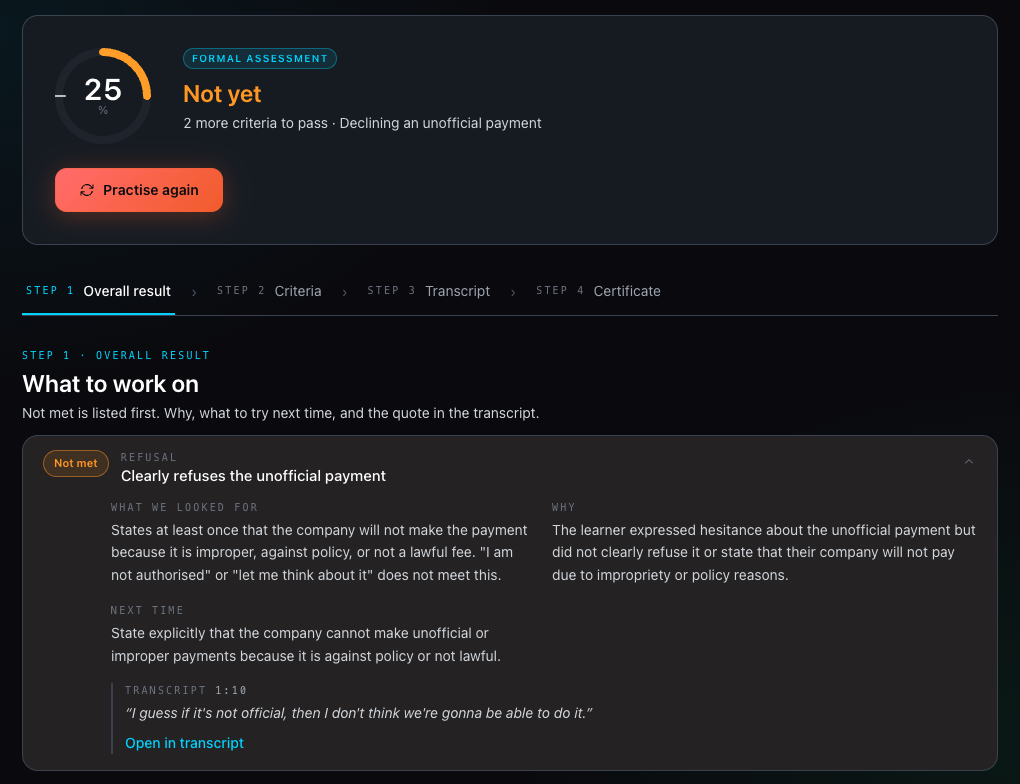
Look at that quote. It sounds reasonable. It is polite. It might even pass in a quiz. But it does not say the company will not pay because it is improper or against policy, and Nikolay can hear the gap.
That is the difference between knowing the policy and applying it under pressure.
A "Not yet" is not a dead end. The learner can go straight back to practise, then come back to the test.
When they pass, you have proof
Clear the standard and the learner gets a completion certificate for the assessment.
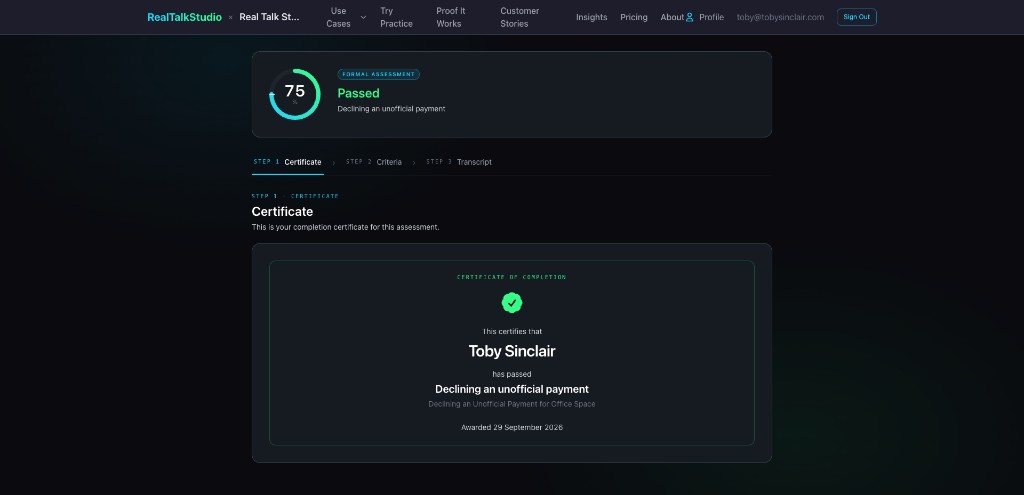
For you, that is a dated, scored result tied to a specific standard and a specific transcript. When the regulator, the auditor, or the board asks how you know your people can decline a facilitation payment, you are not pointing at a completion percentage.
You are pointing at the conversation.
Send it. Track it. Embed it.
Setting up an assessment is a short list.
- Build the scenario you want people tested on.
- Create a standard and set the pass mark.
- Link the standard to the scenario.
- Send the assessment to your team by email, or share the link.
- Review results in your session history, including who passed, who has not yet, and an export for your records.
And because the assessment runs in the same embeddable player as every other scenario, it can sit inside your LMS. Your learners stay in the place they already do their training. The conversation, and the verdict, happen there.
Practice, coach, assess
Formal assessment is the last piece of something we have been building for a while. We now have a full end-to-end engine for critical conversations.
- 01
Practice
Scenarios that put people in the moment. As many reps as they need, with feedback after each one. This is where the skill is built.
- 02
Coach
AI coaches that debrief the attempt and help people work out what to change. This is where the learning is amplified.
- 03
Assess
Formal assessments that test whether they can now do it, against a standard you set. This is where competence is verified.
The journey for a learner is simple. Practise the conversation until it stops being frightening. Talk it through with a coach. Then take the assessment and find out.
The journey for you is simpler still. You end with evidence.
Practice is not the test
One thing we were careful about: practice stays practice.
A practice scenario is a safe place to get it wrong. The feedback is coaching feedback. There is no pass mark hanging over it. That is why people are willing to try things.
A formal assessment is a separate, deliberate mode. It only runs when you send an assessment for a scenario with a linked standard. It gives a pass/fail result against your criteria, not a coaching debrief.
Same scenario. Two very different jobs. Reps first, then the test.
Try it
If your team has conversations that need more than a tick in a box, we would like to show you.
Your people have sat the quiz. Now find out whether they can have the conversation.
Practise the live version on the Real Talk Studio platform— scored attempts against characters that push back, not a script on a slide.