October 2026
How to evidence all reasonable steps
This is practical commentary for people, HR, and compliance leaders — not legal advice. Confirm commencement dates, wording, and what the 2027 regulations require with qualified UK employment counsel before you rely on any of it in a policy or a board paper.

A reasonable steps checklist exists for one conversation: a board, a general counsel, or a people director asking what have we done? How to prevent sexual harassment in the workplace is not a poster. It is a file. Every item below maps to a form of evidence you can open.
The one most organisations cannot currently produce is behavioural. Policies prove intent. Completions prove distribution. Practised conversations prove that someone could do the thing the duty is aimed at. That is the gap all reasonable steps opens on 30 October 2026.
Print it. Tick in ink. The empty rows are the programme.
How to use this checklist
This is not a statutory form and it is not legal advice. It follows the EHRC eight steps plus the evidence question a tribunal already knows how to ask. Use it as a board pack appendix, not as a substitute for counsel.
- Tick Have only if you can open the artefact this week.
- Tick Dated only if the date would survive Gehlen (not a module from three years ago with no refresh).
- Tick Evaluated only if someone looked at whether it worked and changed something when it did not.
- The conversation rows are not optional extras. They are how you show training for employers was aimed at the live moment.
The rest of the file: risk assessment template, manager training, third-party harassment, handling a complaint.
Reasonable steps to prevent sexual harassment — evidence checklist
1. Policy
2. Engage staff
3. Risk assessment
4. Reporting
5. Training — knowledge
6. Training — behaviour (the row most files lack)
7. Third parties
8. Complaints and after
9. Monitor and evaluate
Board one-liner: We can show policy, routes, a local assessment, knowledge training, and dated proof that the people who have to speak can speak. If you cannot say the last clause, you are not finished.
Why behavioural evidence is the missing row
How to prevent sexual harassment in the workplace, in every strategy deck, still collapses to “we trained them.” Reasonable steps to prevent sexual harassment, in a tribunal, is a different sentence: what did this person do when it was live, and what did you do to make that possible?
Knowing the definition is easy to buy. Doing it under pressure used to be expensive — a human with a clipboard, or a cringe roleplay in a classroom. That is why the folder is all certificates.
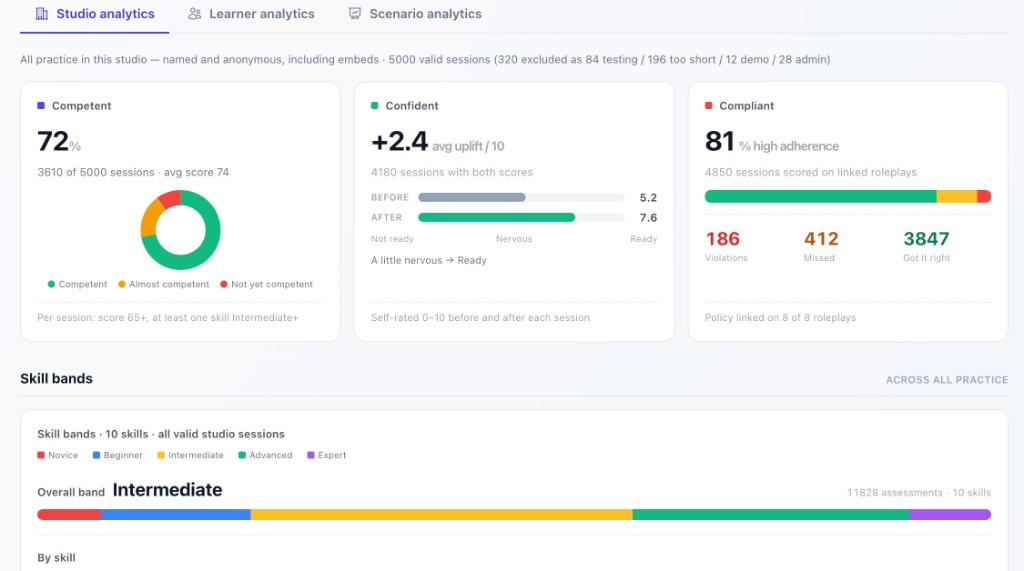
Real Talk Studio is built for that row. People rehearse the conversation. You keep the date, the score, the transcript, the miss. That is what evidence and analytics are for. It does not replace items 1–4. It stops item 5 from being a lie.
What “good enough for the file” looks like
You do not need every employee in a simulation tomorrow. You need the roles the assessment marked as high — the people whose mouths the duty runs through — on a cycle that would not embarrass you in Gehlen. New managers before they hold 1-1s. New agents before they hold the late queue. Investigators before they own a case. Refresh when the person or the risk changes.
If the board asks what you have done, do not lead with the LMS percentage. Lead with the assessment, the routes, and three dated conversations. Then the percentage, if you must.
FAQ
Frequently asked questions
01What is a reasonable steps checklist?
A practical list of preventative actions mapped to artefacts you can show — policy, assessment, reporting, training, third-party response, complaint handling, and evaluation. It is not a statutory safe harbour.
02What are reasonable steps to prevent sexual harassment?
The EHRC eight steps are the starting list: policy, engagement, risk assessment, reporting, training, complaint handling, third parties, and evaluation. From 30 October 2026 the legal test is all reasonable steps. Completions alone are a weak story.
03How do we prevent sexual harassment in the workplace in a way we can prove?
Assess the real risks, train for the live conversations, give people routes that work, and evaluate whether behaviour changed. Proof is dated competence, not a poster.
04What evidence do boards actually need?
Something counsel can open: versions, dates, audiences, exceptions, and Level 3 evidence for the high-risk conversations. See also training audit.
05Can simulation records count as evidence?
They are a form of behavioural evidence — who practised what, when, against which standard. Whether they satisfy a particular claim is for your legal team. They are the artefact most files currently lack.