October 2026
Sexual harassment training for managers
This is practical commentary for people, HR, and compliance leaders — not legal advice. Confirm commencement dates, wording, and what the 2027 regulations require with qualified UK employment counsel before you rely on any of it in a policy or a board paper.
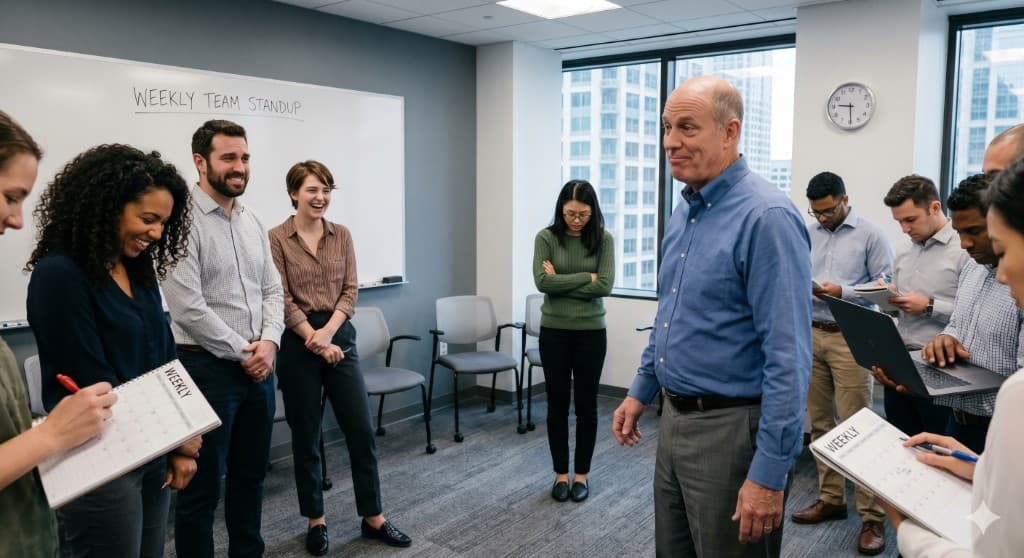
Sexual harassment training for managers that counts as a reasonable step is not the annual e-learn. Every tribunal has already seen that artefact a hundred times. The harder step — the one the preventative duty is actually aimed at — is proving your managers can have the conversation.
Most harassment never reaches a formal complaint. It is a comment in a meeting, a joke about someone’s body, a private message, a “don’t make this a thing.” The person who has to act is a line manager who completed a module in January and is sitting across from a colleague in June. If they freeze, minimise, or turn it into a process speech, the organisation has already failed the human test. From 30 October 2026, all reasonable steps makes that failure much harder to explain.
You do not need another definition of harassment. You need managers who can do the private follow-up after inappropriate banter — before anyone has filled in a form.
Why annual e-learning is the minimum every tribunal has seen
E-learning is not useless. It can teach the definition, the reporting route, and the fact that “banter” is not a defence. Call that knowledge training. It is a step. It is not the step.
Three reasons it fails as the manager programme:
It is not aimed at their job. All-staff modules are written for everyone, which means they are written for no one who has to intervene. The EHRC treats manager training as its own problem. A people manager needs the 1-1, the bystander moment in a meeting, and the client dinner — not the same cartoon as the intern.
It decays. Allay (UK) Ltd v Gehlen [2021] EAT treated brief or stale training as insufficient for a reasonable steps defence. Unused knowledge decays. A January click is not a September skill. Anti-harassment training is still bought on a 12-month licence because procurement likes anniversaries. Harassment does not run on the licence date.
It is not evaluated. Completions prove distribution. They do not prove that anyone can sit with a colleague after a sexualised comment and not make it worse. How to evidence all reasonable steps is the board version of that sentence.
If your current “training for employers” pack is a policy acknowledgement plus a 20-minute module plus a quiz, you have the file every respondent will put in. Under all reasonable steps, that is not a differentiator. It is the baseline the other side will already have.
What the EHRC actually asks of managers
The 8-step guide expects training that follows the risk assessment, is relevant, and is evaluated. Managers and seniors need more than the all-staff version because they are the reporting route, the culture cue, and often the first person who hears it.
That is not a request for a longer video. It is a request for skill.
The live moments:
- Someone tells them, privately, that a comment landed as sexual harassment.
- They hear the comment themselves, in a room with a more senior person, and the agenda tries to move on.
- They have to tell a high performer that the “joke” is now a conduct issue.
- They have to follow up with someone who asked them not to make it official.
None of those are multiple-choice. All of them happen before a case file exists. Handling a complaint is the investigator’s job. Your managers still have to get the first hour right. Most of the duty is discharged before anyone owns a formal investigation.
The private follow-up after banter
The status quo assumes the risk is the formal grievance. Design the process for that, train for that, measure time-to-close for that. Meanwhile the actual pattern is quieter.
A senior person makes a sexualised joke about a colleague who is not in the room. Two people laugh. One goes still. The meeting moves on. Afterward, someone asks their manager for “a quick word.” They do not want a case. They want it to stop. They are already calculating what happens to their next project if they are labelled difficult.
This is the conversation anti-harassment programmes almost never write, because it cannot be filmed as a neat “report it to HR” ending. The manager has to name what happened without inflating it into a courtroom, refuse to collude with “it was just banter,” explain the route without forcing the person through a door they are not ready for, and not promise secrecy they cannot keep.
Get it wrong and you have taught the team that the values statement is wall copy. You have also created a disclosure that will look, later, like the organisation had a chance and declined it. That is the conversation that happens on a Tuesday. It is the one your programme almost certainly does not currently evidence.
The colleague is not performing a textbook complaint. They are testing whether the manager is safe. In the live practice, an AI partner plays that colleague. They will hedge, minimise their own experience, ask not to make it a thing, and notice immediately if the manager reaches for policy before they have heard them.
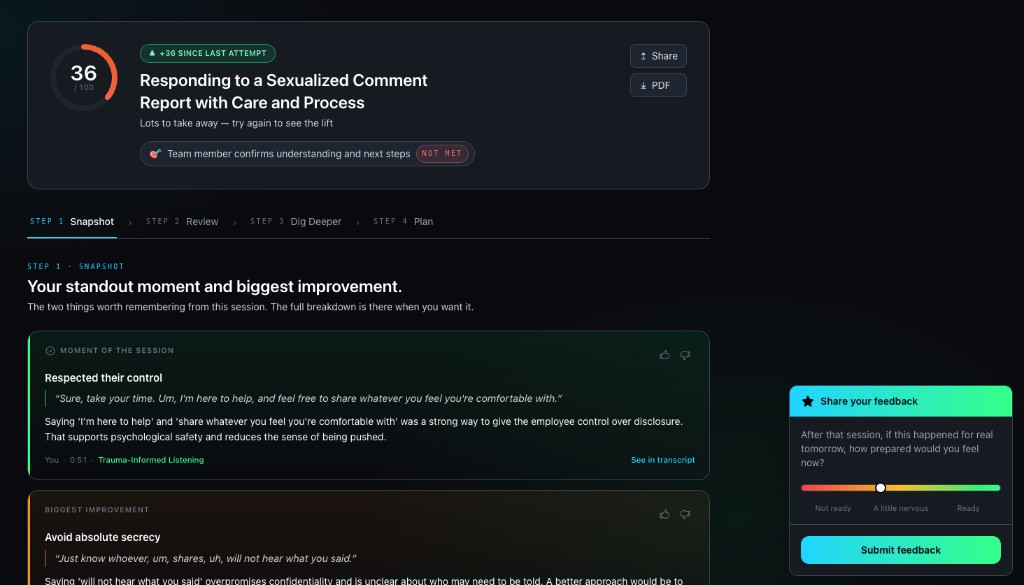
The cousin conversation, when the person is more frightened and asks the manager to keep it quiet, is Please don’t tell anyone. Use both. Real disclosures do not arrive in one mood.
Classroom roleplay of sexual harassment, with colleagues watching, is why most programmes stopped rehearsing it. The vulnerability was too high and the cringe was real. Simulation is how managers get the reps without using a colleague as a crash-test dummy.
What good looks like in that 1-1
A manager cannot script the whole conversation. You can name the moves that usually decide it — and require them as the standard.
Listen first. Advice in the first minute lands as dismissal. Reflect what the colleague said, in their words, not the organisation’s.
Name it without theatre. “What you described is sexual harassment. Thank you for telling me.” Not “I’m sure they didn’t mean it.” Not “that’s just their humour.”
Do not become the investigator in the corridor. They are not taking a statement for a hearing. They are making it safe enough that the real route can be used.
Do not promise secrecy they cannot keep. Since 6 April 2026, a sexual harassment disclosure can be a qualifying whistleblowing disclosure. Getting the first conversation wrong now carries detriment risk as well as the original harm. The practised sentence is: I will not gossip; I also cannot keep this as a secret between us if the organisation has a duty to act. Detail on handling a complaint.
Make the next hour specific. A named person, a time, an offer to go with them. “You should tell someone” is not a plan.
Managers who have never said those sentences out loud will improvise. Improvisation is how disclosures die.
Training for employers that you can evidence
A programme that would survive a reasonable-steps question looks like this:
- Risk assessment first — including which managers will actually receive these conversations.
- All-staff e-learning for definitions and reporting. Keep it. Stop pretending it is the manager curriculum.
- Spoken practice of the live moments, with pushback, scored against your policy — the follow-up after banter, the bystander meeting, the high-performer conduct conversation.
- A dated record per person. Who has passed. Who has not. What you did about their team in the meantime.
- Refresh when the role changes, after an incident, and when the assessment changes — not only when the LMS invoice does.
That is preventing sexual harassment training as a system, not as a content purchase. Real Talk Studio holds the practice and the dates. It cannot be the only step — policy, reporting, and complaint-handling still have to exist — but it is the step almost nobody else can currently show.
The artefact is on evidence and analytics. The rest of the programme is conduct-risk practice.
FAQ
Frequently asked questions
01What sexual harassment training do managers need?
More than the all-staff e-learn. They need practised skill in the 1-1 after a comment, the bystander moment, and the follow-up that does not promise secrecy they cannot keep. The EHRC treats manager training as its own step.
02Does annual e-learning count as a reasonable step?
It can count as a knowledge step. It is unlikely to be enough, on its own, under all reasonable steps — especially if it is generic, stale, or never evaluated. Tribunals have already seen the certificate.
03What is anti-harassment training in the UK actually for?
Preventing harassment, not documenting that you mentioned it. The preventative duty is anticipatory. Training should follow your risk assessment and be checked for effectiveness, not only completion.
04Why practise the conversation if we have a reporting hotline?
Because most people tell a human they already know, not a hotline. The manager is the hotline. If that conversation fails, the formal route often never opens.
05How do we evidence that manager training worked?
Dated attempts at the live conversations, who was in scope, who has not yet passed, and what you changed when people failed. See the evidence checklist.